Americas Market Update 13 Mar
Fuel prices have mostly moved upward, and a gale watch due to expected high wind gusts tomorrow could impact deliveries in New York.
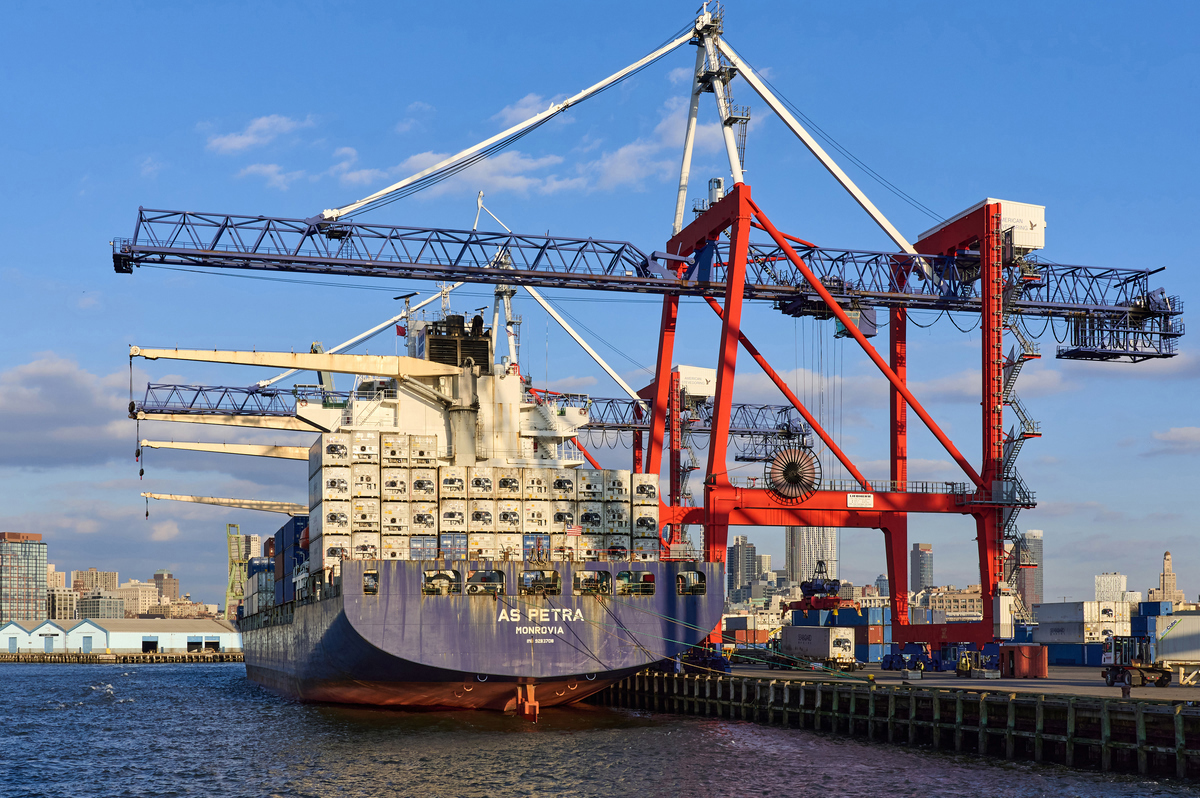
 IMAGE: Cranes loading a container ship at a terminal in New York. Getty Images
Changes on the day to 08.00 CDT (13.00 GMT) today:
- VLSFO prices up in Zona Comun ($8/mt), New York ($6/mt) and Houston ($4/mt), and down in Balboa ($14/mt)
- LSMGO prices up in Balboa ($28/mt), New York, Zona Comun ($10/mt) and Houston ($8/mt)
- HSFO prices up in Houston ($7/mt) and New York ($5/mt)
Bunker prices have mostly moved up with Brent, except for Balboa’s VLSFO price, which has dipped in the past day.
A 150–500 mt VLSFO stem has been booked in Balboa in the past day at $908/mt, putting downward pressure on its benchmark.
In Panama, bunker demand has increased over the past few weeks. Prompt supply is currently tight across all three conventional fuel grades in Balboa and Cristobal, with lead times of at least 5–6 days advised.
In New York, prices across all three conventional fuel grades have moved up, with LSMGO taking the lead with an increase of $10/mt in the past day. The port’s Hi5 spread remains slim at $19/mt today.
Prompt availability for all fuel grades has been tight in New York this week. Suppliers are recommending lead times of 7–8 days for HSFO and VLSFO, while LSMGO requires 4–6 days.
A gale warning will come into effect in New York from Saturday morning through to the afternoon. This may further delay a few bunker deliveries, a source said.
Brent
The front-month ICE Brent contract has gained by $0.46/bbl on the day, to trade at $98.82/bbl at 07.00 CST (13.00 GMT) today.
Upward pressure:
Brent crude’s price has moved above $100/bbl this week amid persisting tensions across the Persian Gulf.
Iran will continue blocking the Strait of Hormuz – which handles 20-25% of global seaborne oil trade daily – the BBC reported, referring to a statement by Iran’s newly appointed Supreme Leader Mojtaba Khamenei.
“Iran launched a new offensive, targeting ships and ports in the Persian Gulf, underscoring the widening threat to energy supply,” ANZ Bank’s senior commodity strategist Daniel Hynes said.
The US forces have struck more than 60 Iranian vessels since the beginning of the conflict on 28 February, the US Central Command (CENTCOM) official Brad Cooper said.
“The clock is ticking for the oil markets, with developments in the Persian Gulf choking off as much as 20 million barrels a day of oil supply,” ING Bank’s head of commodities strategy Warren Patterson said.
Downward pressure:
The International Energy Agency (IEA) has agreed to release 400 million bbls of crude oil from strategic reserves as the US-Israeli conflict with Iran continues to disrupt oil flows through the Persian Gulf.
This is the sixth time a coordinated emergency stock release is occurring in the IEA’s history, the agency said, adding that all 32 member countries have backed the move.
Individual allocations from member countries have yet to be detailed. The US, however, will contribute 172 million bbls from its Strategic Petroleum Reserve (SPR) as part of the IEA-led effort, the US Department of Energy (DoE) said in a statement.
“It’s a record amount, eclipsing the 182m barrel [182 million bbls] emergency release from 2022. We're still waiting for the IEA to provide full details of the release,” ING Bank’s analysts said.
By Gautamee Hazarika and Aparupa Mazumder
Please get in touch with comments or additional info to news@engine.online