East of Suez Fuel Availability Outlook 16 June
Availability tight in several Japanese ports
Bunker demand rises in South Korean ports
Bunker supply remains tight in Fujairah and Khor Fakkan
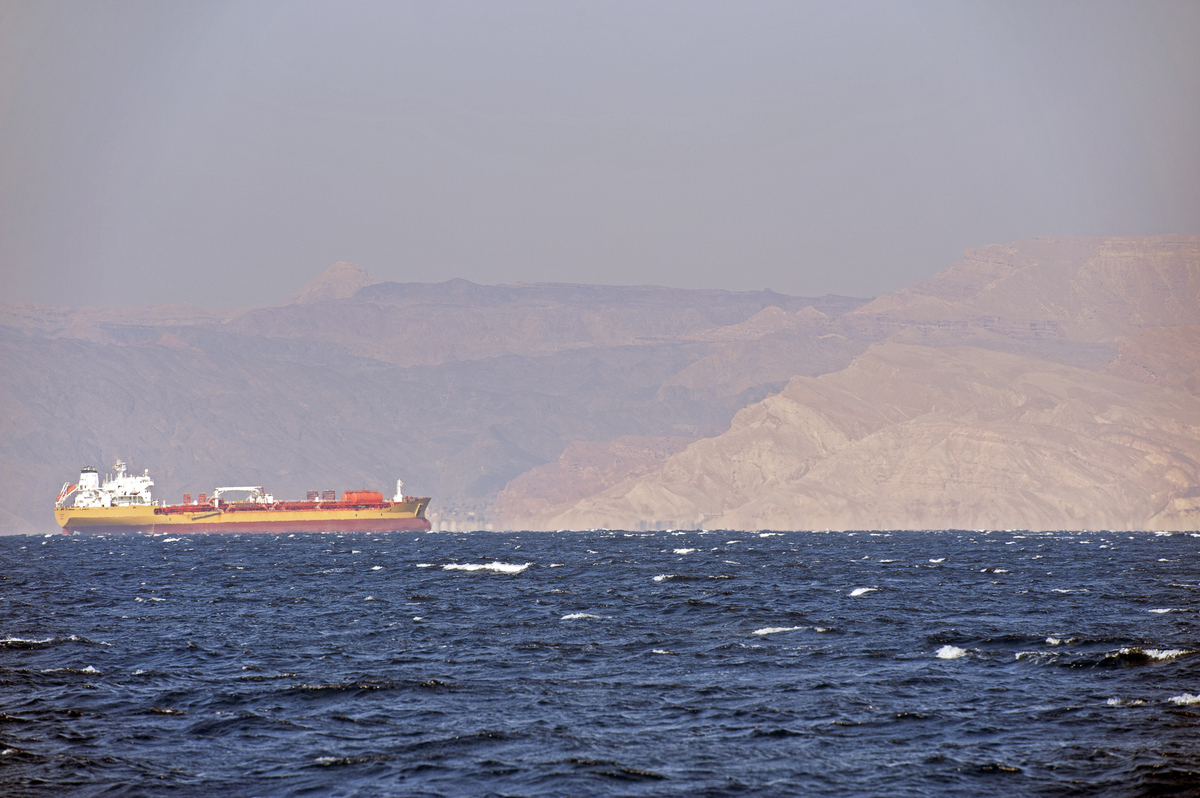 IMAGE: Freighter makes headway towards the Red Sea port of Aqaba, Jordan with Sinai Desert behind. Getty Images
Singapore and Malaysia
VLSFO availability in Singapore continues to face constraints, with suppliers recommending lead times of 10–14 days for VLSFO deliveries, largely unchanged from the previous week.
Lead times for HSFO have tightened slightly, now standing at 7–10 days, compared with 5–12 days last week. LSMGO availability has also become more stretched, requiring 7–10 days of advance planning versus roughly seven days previously.
The port’s residual fuel oil inventories have averaged 25% lower so far in June compared with May. Stock levels have fallen below 15 million bbls, amid a sharp decline of 34% in net fuel oil imports, according to the latest data from Enterprise Singapore.
Imports fell by 1.34 million bbls, while exports decreased by a more modest 454,000 bbls.
Singapore’s middle distillate inventories have also weakened considerably, averaging 6.90 million bbls so far in June. This marks a 25% decline from earlier levels and has pushed stocks down to multi-year lows.
Elsewhere in the region, bunker supply conditions in Malaysia's Port Klang remain mixed. VLSFO availability is generally steady, particularly for smaller prompt orders. However, LSMGO remains difficult to obtain due to limited supply, while HSFO availability continues to be restricted, keeping both fuel grades under pressure.
East Asia
Bunker fuel availability in Zhoushan continues to be constrained, with suppliers maintaining recommended lead times of 7–10 days for VLSFO, unchanged from the previous week. In contrast, LSMGO and HSFO remain more readily available, with lead times holding steady at 3–5 days.
Across northern China, bunker supply conditions differ from port to port. Suppliers in Dalian and Qingdao report sufficient stocks of both VLSFO and LSMGO, although HSFO availability remains limited in Qingdao. All major bunker grades are under pressure in Tianjin, while Shanghai is experiencing tight supply of VLSFO and HSFO. LSMGO availability in Shanghai, however, remains relatively stable.
In southern China, supply constraints persist. Both VLSFO and LSMGO remain tight in Fuzhou, while Xiamen has adequate VLSFO availability but faces tighter LSMGO supplies. Similar challenges are evident in Yangpu and Guangzhou, where availability of both fuel grades remains restricted.
Hong Kong’s bunker market continues to show stable conditions, with lead times for all major grades remaining at around seven days, broadly unchanged in recent weeks.
Meanwhile, repair work at an oil terminal in Tolo Harbour is underway and is expected to continue for approximately eight months from June 2026. The works are being carried out daily between 0900 and 1700 hours, excluding Sundays and Public Holidays.
Vessels transiting the area are advised to navigate with caution, maintain slow speeds, and keep clear of the work zone, particularly as diving operations are also being conducted nearby, according to GAC Hot Port News.
At Taiwan’s key ports of Hualien, Keelung, Taichung, and Kaohsiung, bunker fuel availability remains stable. Recommended lead times for both VLSFO and LSMGO are approximately two days, largely unchanged from the previous week.
Taiwan will observe the Dragon Boat Festival public holiday on 19 June, during which bunker fuel orders cannot be placed or delivered, according to state-owned supplier CPC Corporation.
South Korea’s bunker market has seen a pickup in demand following a decline in Brent crude futures, which has contributed to downward pressure on bunker fuel prices, according to a local trader. In Busan, VLSFO prices have dropped by more than $100/mt over the past week, falling to around $695/mt.
Across the country’s southern ports - including Busan, Ulsan, Masan, Onsan, Yeosu, and Kwangyang - lead times for VLSFO and LSMGO have lengthened slightly to 2–12 days, compared with approximately 3–10 days previously. By contrast, HSFO availability has improved significantly, with lead times shortening from 9–11 days last week to around five days currently.
Supply conditions have also improved at western ports such as Incheon, Daesan, Dangjin, Pyeongtaek, and Taean. Lead times for both VLSFO and LSMGO have eased to 2–5 days, down from 3–9 days a week earlier. HSFO availability in these ports remains subject to enquiry.
Weather-related disruptions continue to pose operational risks, with delays forecast at Busan, Ulsan, and Daesan between 20–21 June.
In Japan, despite reports that the Strait of Hormuz has reopened, market participants expect it will take 2–3 months for supply chains and regional refinery operations to fully normalise. Monthly bunker supply volumes remain heavily constrained by refinery output, and most local suppliers have already sold out their allocated June stems, limiting prompt availability. However, small parcels of around 200–300 mt may still be obtainable, according to a Japan-based trader.
At major Japanese ports including Tokyo, Chiba, Kawasaki, Osaka, Kobe, Mizushima, and Oita Yokkaichi, availability of both VLSFO and LSMGO remains tight, with only a limited number of suppliers able to offer these grades. HSFO is comparatively more accessible, with lead times of approximately 5–7 days.
In Kashima, VLSFO and LSMGO supplies remain restricted and are available only via berth deliveries, although access to some berths is currently prohibited.
Meanwhile, supply of VLSFO, LSMGO, and HSFO is extremely tight in Nagoya and Yokkaichi due to periodic maintenance at the Idemitsu refinery. Similar constraints continue to affect all three bunker grades in Tokuyama.
Oceania
In Western Australia, VLSFO supply remains available at Kwinana and Fremantle, where suppliers are generally advising lead times of around seven days. Bunker deliveries at both ports are currently handled by barge and supported by a single supplier.
Along Australia’s east coast, supply conditions differ by location. In New South Wales, Port Kembla can receive VLSFO via truck or pipeline, while Sydney continues to maintain adequate inventories of both VLSFO and LSMGO. HSFO availability in Sydney remains constrained, with suppliers typically requesting approximately seven days’ notice.
In Queensland, both VLSFO and LSMGO are available in Brisbane and Gladstone, with recommended lead times also standing at around seven days.
Further south, Melbourne and Geelong continue to report healthy VLSFO stock levels. However, bunker operations at both ports depend on a single barge, resulting in lead times of roughly one week.
HSFO inventories are becoming critically tight in both Melbourne and Brisbane, adding pressure to supply of the grade.
One supplier is currently recommending lead times of approximately five days for all bunker grades across Brisbane, Sydney, and Melbourne. In Dampier, bunker deliveries continue to rely on truck-assisted pipeline operations, making advance scheduling and berth confirmation particularly important, according to a market source.
Across the Tasman Sea, New Zealand’s bunker market remains broadly stable. VLSFO is readily available in Tauranga and Auckland, where suppliers are advising lead times of about four days. At Marsden Point, both VLSFO and LSMGO can be supplied directly to vessels through pipeline connections.
Weather continues to be a key operational challenge across New Zealand. Bunker deliveries remain especially vulnerable to disruptions in Wellington and at ports throughout the South Island, where adverse conditions can affect supply operations.
South Asia
Bunker fuel availability across all major grades is currently described as “super tight” at India’s ports of Mumbai and Kandla, according to a market source.
Weather conditions are also expected to pose operational challenges at several Indian ports in the coming days, with the potential to disrupt bunker delivery schedules. Delays are forecast at Kandla and Sikka between 16–20 June, while elevated wave conditions are expected to affect operations at Cochin and Visakhapatnam over the same period.
In Sri Lanka, bunker market conditions remain comparatively stable. Both Colombo and Hambantota continue to hold sufficient inventories across all bunker fuel grades, and at least one supplier is currently able to offer prompt stems, an improvement from the approximately five-day lead times reported last week.
Nevertheless, weather remains a potential source of disruption. Bunker operations in Colombo and Trincomalee are expected to face intermittent weather-related impacts between 16–20 June, which could affect delivery schedules.
Middle East
Bunker fuel availability has tightened considerably at the UAE ports of Fujairah and Khor Fakkan, where only a limited number of suppliers are currently able to provide fuel. Many suppliers are responding selectively to enquiries and issuing quotations only against firm requests, according to a Middle East-based trader.
The supply squeeze is particularly acute for VLSFO and LSMGO in Fujairah, where only a handful of suppliers still have available stocks. HSFO availability is somewhat less restricted, although only two suppliers are currently offering the grade.
In Khor Fakkan, supply conditions are similarly constrained across all bunker grades, with suppliers evaluating enquiries individually before deciding whether to submit offers.
The shortage is primarily linked to a lack of incoming cargoes, leaving bunker barges without sufficient product to replenish inventories. While replacement cargoes had been expected to arrive over the past two weeks, there is still no confirmed timeline for their arrival, the trader said.
Barges, that had previously loaded fuel, continue to serve the market until their stocks are exhausted, but a substantial portion of these volumes have already been sold. Suppliers have warned that Fujairah and Khor Fakkan could effectively run out of bunker fuel within days if the anticipated cargoes do not arrive and the remaining barge inventories become fully committed.
Bunker prices are likely to remain elevated even if fresh cargoes reach the ports, the trader also noted.
Meanwhile, bunker supply in Dubai is also coming under increasing pressure, with suppliers largely limiting quotations to firm enquiries rather than issuing open market offers.
Elsewhere in the UAE, port operations at Jebel Ali, Hamriyah, and Sharjah continue without disruption, according to Inchcape Shipping. Ports in Ras Al Khaimah are also operating normally, although the RAK Ports Authority has maintained a marine risk surcharge on vessels calling at its ports, harbours, and anchorages since March.
In Kuwait, operations at Shuaiba and Shuwaikh remain unaffected despite ongoing geopolitical tensions across the region.
No formal operational advisories have been issued by Saudi Arabian ports. In Jeddah, VLSFO and LSMGO supply remains relatively stable. However, adverse weather conditions could disrupt bunker operations in Jeddah and Yanbu between 16–20 June.
In Qatar, round-the-clock maritime navigation for all vessel types was reinstated at the beginning of May, according to Inchcape Shipping. However, availability of both VLSFO and LSMGO remains tight at Ras Laffan.
“Following the recent easing of tensions, vessel movements have started to normalize and shipping lines are currently re-organizing their schedules across the region. Market sentiment has improved and LSMGO prices have softened compared to previous weeks. Lead times remain manageable, although we recommend early planning while the market continues to stabilize,” an Oman-based trader said.
Oman continues to provide strong prompt availability of LSMGO. One supplier is currently advising lead times of just 1–2 days at major ports including Duqm, Muscat, Sohar, and Salalah.
In Egypt, port operations remain normal. At Port Suez, HSFO stocks are tight, while VLSFO inventories are approaching depletion.
Further south, availability of both VLSFO and LSMGO remains constrained in Djibouti. Meanwhile, port and bunker operations across Jordan, Iraq, Cyprus, Pakistan, and Lebanon continue to function normally, according to Inchcape Shipping.
By Tuhin Roy
Please get in touch with comments or additional info to news@engine.online