East of Suez Fuel Availability Outlook 21 Apr
Bunker availability good in Zhoushan
VLSFO and LSMGO availability good across several Taiwanese ports
Bunker demand picking up across South Korean ports
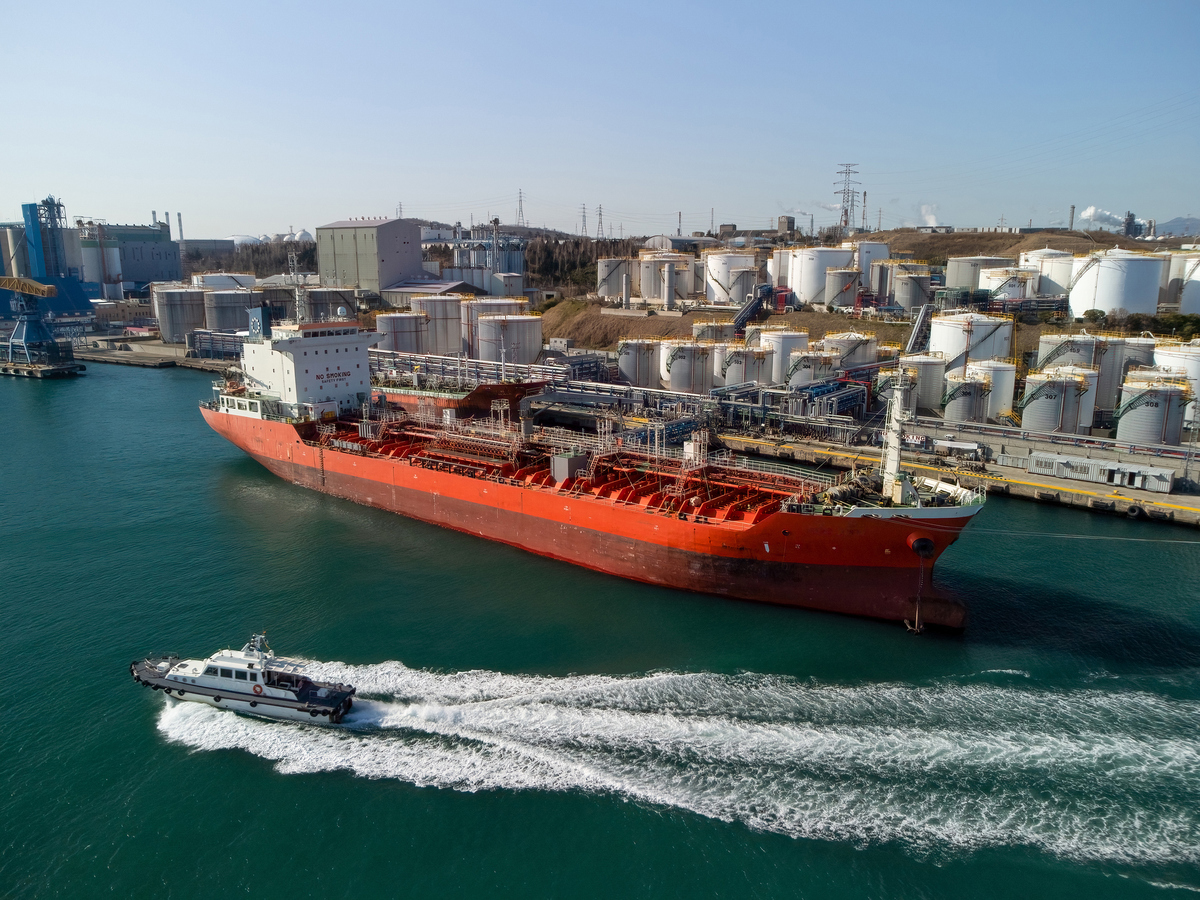 IMAGE: Tanker at Ulsan harbor in South Korea. Getty Images
Singapore and Malaysia
Prices in Singapore have edged lower, supported by expectations that upcoming US-Iran peace talks could ease regional tensions and potentially increase supply from the Middle East, a source said.
Soft demand is adding to the pressure. “Demand for VLSFO is slow,” a Singapore-based trader said, contributing further to the decline in the benchmark.
In terms of availability, VLSFO lead times in Singapore remain broadly stable at 5-12 days. HSFO lead times are now assessed at 5-10 days, compared with a wider 3-12-day range last week.
LSMGO lead times continue to hold steady at 2-7 days, largely unchanged week on week.
On the supply side, Singapore’s residual fuel oil inventories have averaged 5% lower so far in April compared to March, according to Enterprise Singapore. Total fuel oil stocks have dropped below 23 million bbls, driven by a sharp 54% decline in net imports this month. Imports have fallen by 2.39 million bbls, while exports have risen slightly by 151,000 bbls.
In contrast, middle distillate inventories have increased, averaging 15% so far this month and reaching their highest levels since September.
At Malaysia’s Port Klang, VLSFO availability remains relatively steady, particularly for smaller prompt stems. However, tighter LSMGO supply and continued constraints in HSFO availability are making both grades harder to secure.
East Asia
Availability in Zhoushan remains strong across all grades, with recommended lead times steady at 3-7 days, largely unchanged from last week. However, adverse weather later this week could disrupt bunkering operations, a source noted.
Across northern China, supply conditions are uneven. Dalian and Qingdao have sufficient VLSFO and LSMGO stocks, although HSFO remains limited in Qingdao. Tianjin is facing tight availability across all grades, while Shanghai is seeing constrained VLSFO and HSFO supply, with LSMGO relatively stable.
Further south, supply remains tighter. Fuzhou is experiencing limited availability of both VLSFO and LSMGO. Xiamen has adequate VLSFO supply but restricted LSMGO volumes. In Yangpu and Guangzhou, both grades continue to face supply pressure.
In Hong Kong, bunker availability is largely stable, with lead times for all grades holding at around seven days in recent weeks.
Meanwhile, CPC Corporation has lifted restrictions on bunker delivery order extensions and cancellation charges at Taiwanese ports with immediate effect.
“There is no such problem [shortage of cargo] happening till now, therefore CPC thinks it is unnecessary to keep this rule in place,” a trader said.
The company added that it will resume accepting requests to extend delivery order validity, and that cancellation charges introduced on 10 March will no longer apply.
In Taiwan, supply conditions remain stable, according to a local trader. Lead times are around two days for both VLSFO and LSMGO across Keelung, Taichung, Kaohsiung and Hualien.
In South Korea’s southern ports - including Busan, Ulsan, Masan, Onsan, Yeosu and Kwangyang - recommended lead times for all fuel grades remain steady at around 2-3 days, broadly unchanged from approximately three days last week.
At western ports such as Incheon, Daesan, Dangjin, Pyeongtaek and Taean, lead times are also at 2-3 days, easing from a wider 4-6-day range in the previous week.
Bunker demand in the country has shown some improvement, supported by a decline in Brent futures amid expectations of easing tensions in the Middle East, a South Korea-based trader said.
Weather disruptions persist, with potential delays expected in Busan and Ulsan between 23-24 April, in Yeosu on 23 April, and in Daesan between 26-27 April.
In Japan, a 7.5-magnitude earthquake struck off the Sanriku coast in Iwate Prefecture on Monday, prompting the Japan Meteorological Agency to issue tsunami warnings for Iwate and parts of Hokkaido and Aomori. Waves of up to 3 metres were anticipated, though the warnings—and subsequent advisories covering parts of Hokkaido, Aomori, Iwate, Miyagi and Fukushima—were later lifted.
Port operations were unaffected, with a source confirming there was “no impact.” However, the Japan Meteorological Agency has since warned of a potential mega quake, advising residents across seven prefectures to remain alert and follow updates.
Bunker supply in Japan remains tight overall, driven by crude procurement constraints and ongoing Middle East tensions. Osaka is described as severely tight, while Tokyo Bay (Chiba, Kawasaki and Yokohama) offers limited, selectively available supply depending on demand. Suppliers are prioritising discreet, case-by-case negotiations, avoiding open market inquiries, the source added.
As a result, availability across all fuel grades in major Japanese ports - including Tokyo, Chiba, Yokohama, Kawasaki, Nagoya, Yokkaichi, Mizushima, Kashima, Tokuyama and Oita - is now assessed individually rather than through standard market availability.
Oceania
Availability across Australian ports has improved, although prices remain elevated and smaller operators continue to face volume constraints, an Australia-based trader said.
Last week, a fire broke out at the Viva Energy Refinery Geelong. Emergency services responded and brought the situation under control. Geelong Port has since confirmed that the refinery pier has resumed normal operations, with all berths now operational, according to Inchcape Shipping. The trader added that the incident had “no impact” on LSMGO and VLSFO supply.
In Western Australia, VLSFO supply at Kwinana and Fremantle typically requires about one week’s notice, with deliveries carried out by barge through a single supplier.
In New South Wales, VLSFO deliveries at Port Kembla can be arranged via truck or pipeline. Suppliers in Sydney maintain ample VLSFO and LSMGO stocks, while HSFO remains tight, with lead times of around seven days.
In Queensland, ports including Brisbane and Gladstone are offering VLSFO and LSMGO with lead times of roughly seven days. HSFO in Brisbane is available on request. Deliveries of VLSFO and LSMGO are handled by two barges operated by separate suppliers, while HSFO availability depends on enquiry.
In Victoria, VLSFO inventories remain strong in both Melbourne and Geelong, although HSFO availability is limited for prompt supply. Bunkering operations in these ports rely on a single barge, with recommended lead times close to seven days.
Australia’s cyclone season, which typically runs from November to April, is also coming to an end, the source said.
In New Zealand, bunker supply conditions remain stable. VLSFO is readily available in Tauranga and Auckland, with some Tauranga berths connected by pipeline. At Marsden Point, both VLSFO and LSMGO can be supplied via pipeline to vessels.
South Asia
In India, VLSFO availability remains good in Cochin, while lead times of around 3-4 days are reported in Kandla, a source said.
Adverse weather is expected to affect operations at several Indian ports, including Kandla between 22-24 April, Sikka on 23 April, Visakhapatnam between 22-25 April, and Mumbai on 25 April, which could disrupt bunkering activities.
Middle East
“The bunkering situation in the Middle East is more stable now, but still not fully consistent,” a regional source said.
At Fujairah, bunkering continues without disruption, with terminals and anchorages operating normally. “Avails [are] ok as of now, all offers are subject to firm inquiry,” another trader said.
While operations are ongoing, some suppliers are loading barges based on actual demand rather than at full capacity, reflecting subdued demand in the port.
Elsewhere in the UAE, operations at Jebel Ali, Hamriyah and Sharjah are running as usual. Petroleum terminals in Abu Dhabi, including Ruwais, are also functioning normally. Ship-to-ship (STS) operations at Dubai anchorage have resumed with tug support, with each case evaluated individually, according to Inchcape Shipping.
“Prices have improved slightly, but they can still change quickly. Vessel operations are better than before, with smoother port entry and departure, though some delays can still happen. It is still recommended to book in advance to avoid any issues,” a trader noted.
Ports in Ras Al Khaimah remain fully operational. However, RAK Ports introduced a marine risk surcharge in March for vessels calling at its ports, harbours and anchorages.
In Kuwait, Shuaiba and Shuwaikh are operating normally. Saudi Arabia has not issued formal alerts, although bunker availability in Jeddah remains tight, particularly for VLSFO and LSMGO.
In Qatar, port activity remains steady at Hamad, Doha and Al Ruwais, with operations also ongoing at Mesaieed and Ras Laffan. However, VLSFO and LSMGO supply is tight in Ras Laffan, while in Al Ruwais availability is limited to smaller vessels such as dhows and barges.
In Oman, all ports are fully operational, with good LSMGO availability and prompt lead times in Muscat, Duqm and Sohar, the source said.
In Bahrain, vessel movements are gradually resuming, though operations remain limited. Egyptian ports are functioning normally, but VLSFO is nearly depleted at Port Suez, while LSMGO supply remains sufficient.
Both VLSFO and LSMGO availability are tight at Djibouti’s port of Djibouti.
Port conditions remain stable in Jordan, while ports in Iraq, Cyprus, Pakistan and Lebanon continue normal operations.
Israeli ports—including Eilat, Ashkelon, Ashdod, Hadera and Haifa—are operating at full capacity, according to Inchcape Shipping.
By Tuhin Roy
Please get in touch with comments or additional info to news@engine.online