East of Suez Market Update 10 Apr
Prices in East of Suez ports have moved in mixed directions, and availability is good in Sri Lanka’s Colombo.
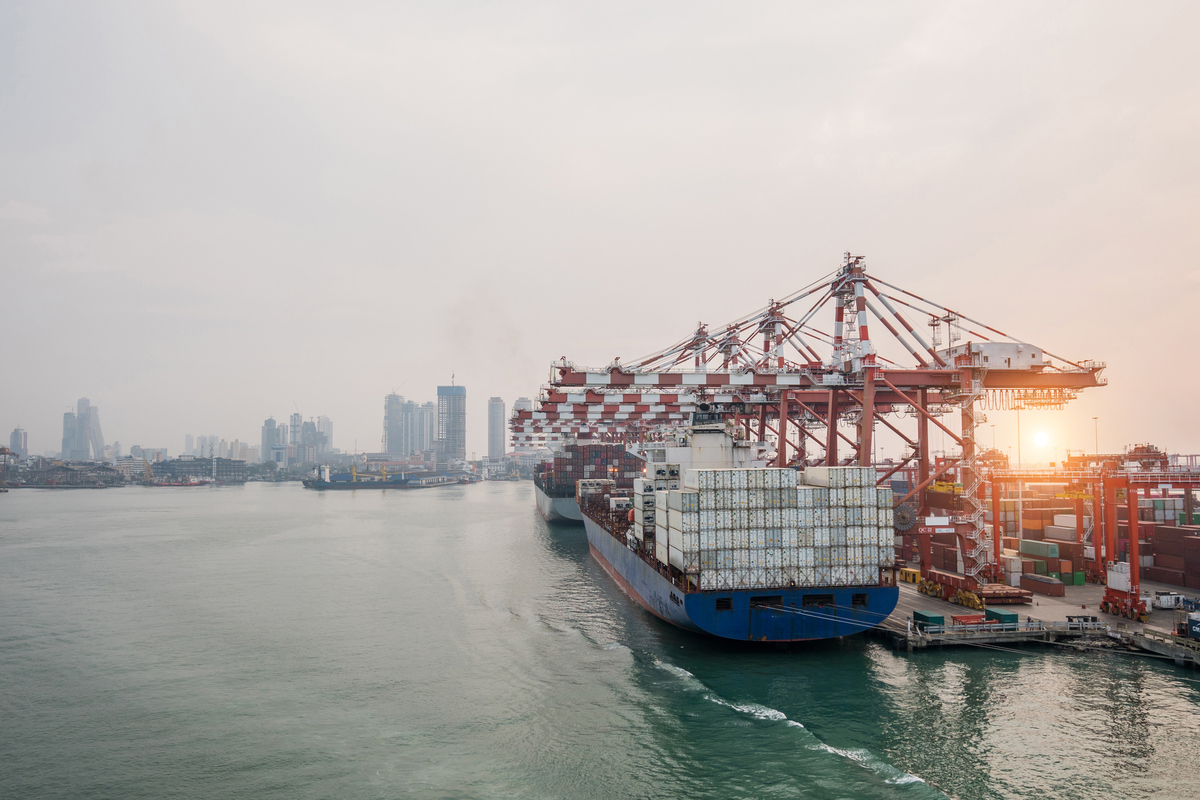 IMAGE: Container ship at Colombo port, Sri Lanka. Getty Images
Changes on the day to 17.00 SGT (09.00 GMT) today:
- VLSFO prices up in Fujairah ($4/mt), and down in Zhoushan ($62/mt) and Singapore ($10/mt)
- LSMGO prices down in Zhoushan ($148/mt), Fujairah and Singapore ($24/mt)
- HSFO prices up in Singapore ($13/mt), and down in Zhoushan ($46/mt) and Fujairah ($26/mt)
- B30-VLSFO prices down in Singapore ($2/mt)
Zhoushan’s LSMGO price has dropped sharply by $148/mt over the past day - the steepest decline among the three major Asian bunker ports. Despite this fall, it still carries significant premiums of $248/mt over Singapore and $222/mt over Fujairah.
Prompt fuel availability in Zhoushan has tightened across all grades, with most suppliers now advising lead times of around 5–10 days for LSMGO, up from 3–5 days last week.
In India, supply of both VLSFO and LSMGO remains constrained at several ports. At Kandla, prompt availability is tight, with lead times of 7–8 days, while HSFO stocks in Mumbai are nearly depleted. At Tuticorin and Mormugao, availability is also limited, with all fuel grades nearing exhaustion, according to a source.
Meanwhile, supply conditions at Colombo remain stable across all grades, with one supplier indicating lead times of about three days.
Bunker demand at the port initially increased amid the Middle East crisis, as disruptions and uncertainty at key hubs such as Fujairah diverted enquiries to alternative locations. However, demand has since stabilised, a Sri Lanka-based source said.
Brent
The front-month ICE Brent contract has dipped by $0.23/bbl on the day, to trade at $97.92/bbl at 17.00 SGT (09.00 GMT) today.
Upward pressure:
Brent crude prices have remained broadly steady, supported by concerns over Saudi supply disruptions and as tanker traffic through the critical Strait of Hormuz continued to be largely stalled.
Attacks on Saudi Arabia’s energy infrastructure - including oil and gas production, transportation, refining, petrochemical facilities, and parts of the electricity sector across Riyadh, the Eastern Province, and Yanbu Industrial City - have reduced the kingdom’s oil production capacity by around 600,000 b/d. Throughput along the East-West Pipeline has also declined by approximately 700,000 b/d, according to the state-run Saudi Press Agency, citing an official from the Ministry of Energy.
Oil has received some support “amid fresh Middle East supply concerns,” two analysts from ING Bank said.
“Concerns of further oil supply disruptions were heightened after Saudi Arabia’s press agency said the nation’s oil production capacity has been cut by around 600kb/d due to attacks on energy infrastructure,” added Daniel Hynes, senior commodity strategist at ANZ Bank.
At the same time, a fragile two-week ceasefire between the US and Iran began to show signs of strain within a day. Washington accused Tehran of breaching commitments related to the Strait of Hormuz, while Israel launched strikes on Lebanon that Iran claims violate the truce.
The upward pressure also came “as the US-Iran ceasefire failed to allay fears of further supply disruptions,” said Daniel Hynes, senior commodity strategist at ANZ Bank.
“Even if transit through the Strait of Hormuz resumes, the return of energy supplies is unlikely to be immediate. Output has already been reduced at oil and gas fields, while refinery operations have been curtailed or temporarily shut, suggesting that some supply disruptions may take weeks, or longer, to fully reverse,” ING Bank analysts warned.
Downward pressure:
Brent crude prices faced mild downward pressure after the latest weekly inventory data from the US Energy Information Administration (EIA).
US commercial crude inventories increased by 3.1 million bbls to 464.7 million bbls in the week ending 3 April, according to the EIA.
By Tuhin Roy
Please get in touch with comments or additional info to news@engine.online