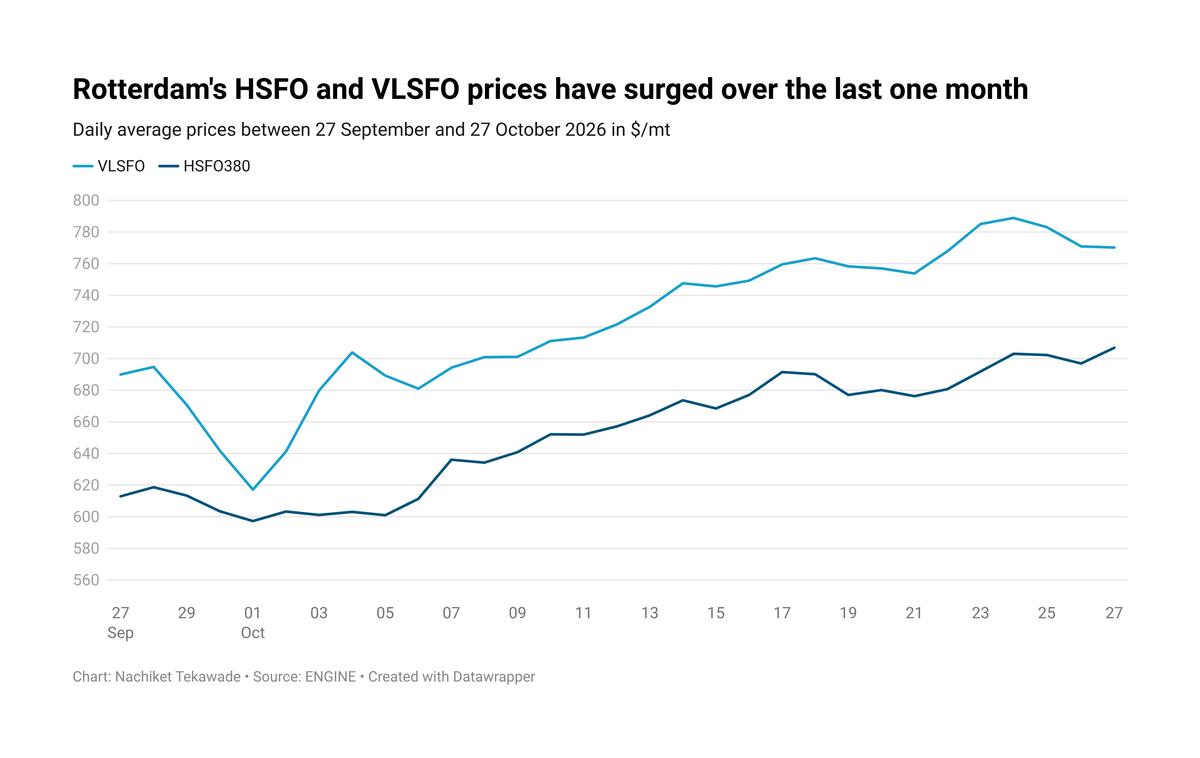
East of Suez Market Update 28 Oct
Most prices in East of Suez ports have fallen, and availability of LSMGO and HSFO remains limited in Fujairah.
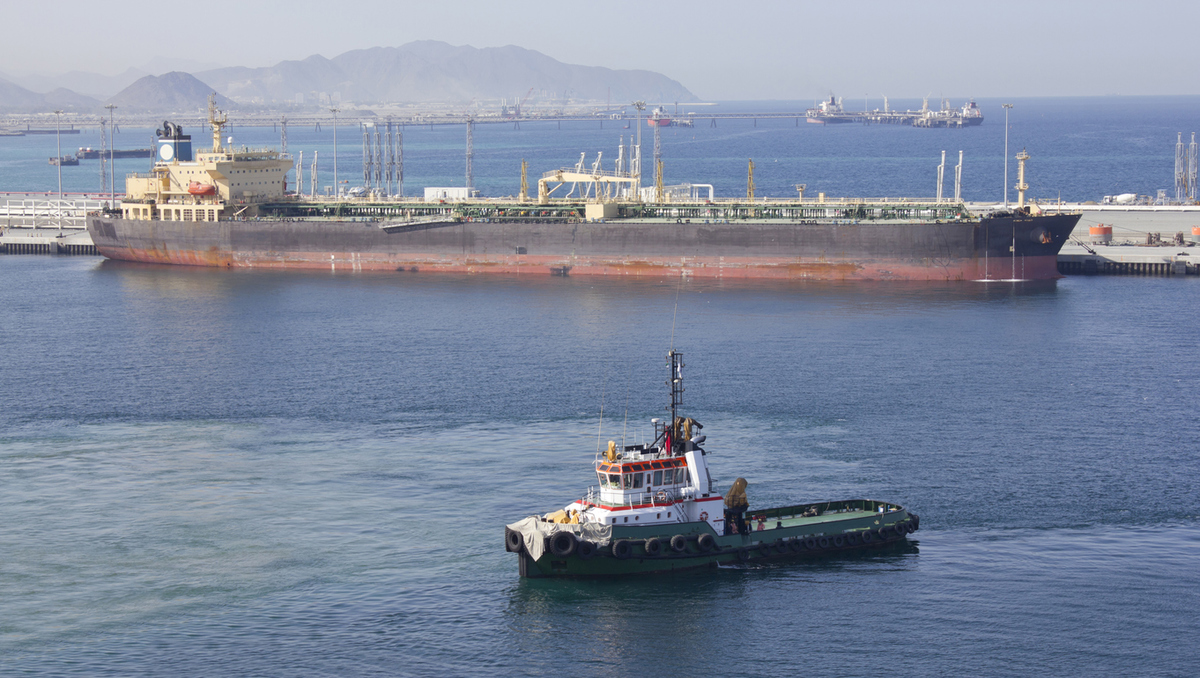 IMAGE: Harbour craft in front of an oil tanker in Fujairah. Port of Fujairah
Changes on the day to 17.00 SGT (09.00 GMT) today:
- VLSFO prices up in Zhoushan ($3/mt), and down in Singapore ($14/mt) and Fujairah ($10/mt)
- LSMGO prices down in Fujairah ($47/mt), Singapore ($20/mt) and Zhoushan ($18/mt)
- HSFO prices up in Singapore ($7/mt), and down in Fujairah ($13/mt) and Zhoushan ($12/mt)
Fujairah’s LSMGO price has fallen by $47/mt, the steepest move among the three major Asian bunker ports. A lower-priced LSMGO 150-500 mt stem has contributed to push the benchmark down. The price now stands at a $379/mt premium over Singapore and a $299/mt premium over Zhoushan. Fujairah’s LSMGO has averaged $1,712/mt so far this month, up from $1,594/mt in September and the highest monthly average since November 2021.
Fujairah’s VLSFO price has averaged $978/mt so far this month, up from $938/mt in September and $806/mt in August, but still below the June average of $1,089/mt.
Fujairah’s Hi5 spread has widened from $224/mt to $227/mt, remaining well above Singapore’s $101/mt and Zhoushan’s $88/mt.
“The Middle Eastern bunker market continues to face supply and operational challenges amid regional security concerns and disruptions to vessel movements,” a Middle East-based source said.
“In the UAE, Fujairah and Khor Fakkan continue to experience supply constraints, particularly for LSMGO, alongside significant price volatility,” the source added.
VLSFO availability in Fujairah has improved even though vessel traffic through the Strait of Hormuz remains disrupted amid US-Iran tensions, a regional source said. Supplies of LSMGO and HSFO are still limited, a regional trader said.
Brent
The front-month ICE Brent contract has lost by $0.20/bbl on the day, to trade at $115.48/bbl at 17.00 SGT (09.00 GMT) today.
Upward pressure:
Brent crude’s price has found support after Yemen’s Houthi militants claimed an attack on one of the biggest oil refineries in Saudi Arabia and US crude stocks declined.
The Iran-aligned Houthis claimed to hit the 550,000 b/d Ras Tanura refinery complex with a ballistic missile. Saudi Arabian authorities have not confirmed the strike.
Besides, US crude oil inventories fell by 2.03 million bbls in the week ending 23 October, according to estimates from the American Petroleum Institute (API).
A decline in US crude stocks usually signals stronger demand and can offer some support to Brent’s price.
Brent futures' gains in recent weeks suggest the market is pricing in “a greater likelihood of re-escalation,” two analysts from ING Bank said.
Downward pressure:
Brent’s price has come under some downward pressure amid fresh diplomatic efforts to end the Middle East conflict.
Qatari mediators presented Iran with a new draft deal to end the war, and Tehran is expected to respond by the end of this week, Reuters reported, citing an official briefed on the negotiations.
The draft deal sets a seven-day timeline of daily confidence-building steps for both sides, the report added.
If the market gets past the US midterm elections on 3 November without renewed strikes on Iran, its risk premium could start to erode, ING Bank’s analysts said.
By Tuhin Roy and Aparupa Mazumder
Please get in touch with comments or additional info to news@engine.online