EU maritime emissions rose in 2025 as more ships entered MRV reporting scope
Greenhouse gas (GHG) emissions by ships on EU-linked voyages increased in 2025, according to EU MRV data, largely due to new ship categories entering the reporting scope.
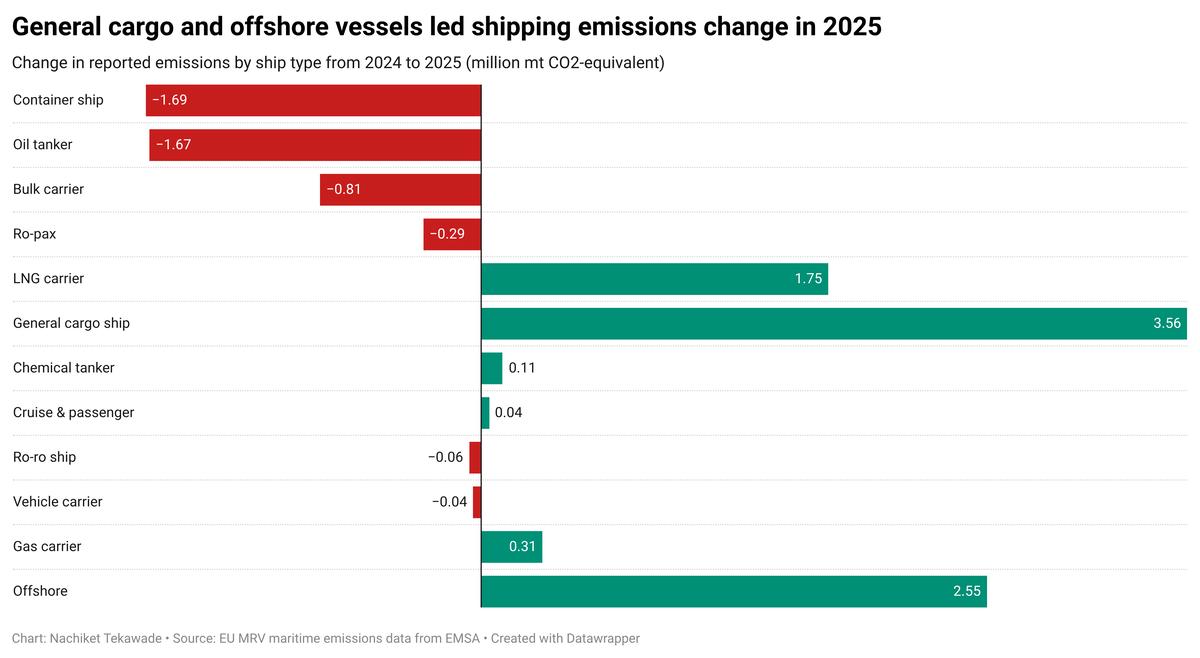
Total GHG emissions rose by 2.1% on the year to 156 million mt of carbon dioxide-equivalent (mtCO2eq) in 2025, according to ENGINE analysis of verified EU MRV data published by the European Maritime Safety Authority (EMSA).
CO2 emissions gained 1.8% from 148 million mt in 2024 to 151 million mt in 2025. Methane emissions rose by 30%, from 66,000 mt to 85,000 mt (about 2.4 million mtCO2eq), while nitrous oxide emissions were up 1.2% to 8,000 mt (about 2.2 million mtCO2eq).
All figures reported to the EU MRV were tank-to-wake emissions, and 2024 was the first year when ships were required to report methane and nitrous oxide emissions.
More ships in scope
The number of ships reporting emissions rose by around 3,000 to 17,000. This coincided with expanded reporting rules. From 1 January 2025, general cargo ships of 400–5,000 gross tonnage (GT) and offshore vessels of 400 GT and above were required to report their emissions for the first time.
The number of general cargo vessels in scope more than doubled from 1,400 to nearly 3,000 in 2025. Offshore vessels were not required to report before 2025, and their count rose from six to 489.
Of those, around 1,500 general cargo vessels and 482 offshore vessels did not report emissions in 2024.
Emissions from these new vessels came to as much as 6 million mtCO2eq. This was almost equal to the net emissions increase from the two categories in 2025, and exceeded the 3 million mtCO2eq headline increase on its own.
That 6 million mtCO2eq figure is an upper estimate. Because the MRV data does not record vessel size, newly regulated general cargo ships cannot be cleanly separated from larger general cargo vessels that were always covered but did not call at an EU port in 2024.
Stripping out an estimate of those larger ships, based on how often unaffected ship types appear in the data for the first time in any given year, brings the figure down to about 4 million mtCO2eq. ENGINE's analysis suggests the true contribution sits between 4-6 million mtCO2eq.
Excluding the general cargo and offshore vessels that did not appear in the 2024 data, total GHG emissions would have fallen by up to 1.8%, or 3 million mtCO2eq, to 150 million mtCO2eq in 2025.
Container vessel emissions dominate
Container ships reported 53 million mtCO2eq in 2025, more than oil tankers, bulk carriers and ro-pax combined, the data shows.
CO2 made up most of container ship emissions, at 52 million mtCO2. This fell by 3.6% from 54 million mtCO2 in 2024.
But CO2 emissions remained much higher in 2025 than the 36 million mtCO2 reported in 2023, before container lines began rerouting away from the Suez Canal in response to Houthi attacks on ships in the Red Sea.
Oil tankers followed container ships with emissions of 17 million mtCO2eq in 2025 and made up around 11% of all emissions.
Bulk carriers (10%) and ro-pax ships (9%) also contributed a sizeable share of total emissions.
Apart from general cargo vessels and offshore vessels, emissions also rose from LNG and other gas carriers, and from chemical tankers.
And notably, cruise ships recorded around 15% of their emissions while berthed in ports in 2025. This share was the highest among all ship types.
By Nachiket Tekawade
Please get in touch with comments or additional info to news@engine.online