Europe & Africa Market Update 28 July
Bunker prices across Europe and Africa have moved in mixed directions, while prompt fuel availability is tight in the ARA.
Changes on the day to 09.00 GMT today:
- VLSFO prices up in Gibraltar ($27/mt), Durban ($23/mt) and Rotterdam ($9/mt)
- LSMGO prices up in Durban ($130/mt), Rotterdam ($30/mt) and Gibraltar ($12/mt)
- HSFO prices up in Gibraltar ($2/mt), and down in Durban ($38/mt) and Rotterdam ($17/mt)
- B30-VLSFO prices down in Rotterdam ($23/mt) and Gibraltar ($7/mt)
Rotterdam’s HSFO price has dropped over the past day. A 500-1,500 mt HSFO stem, fixed at a low price of $522/mt, has put downward pressure on the benchmark.
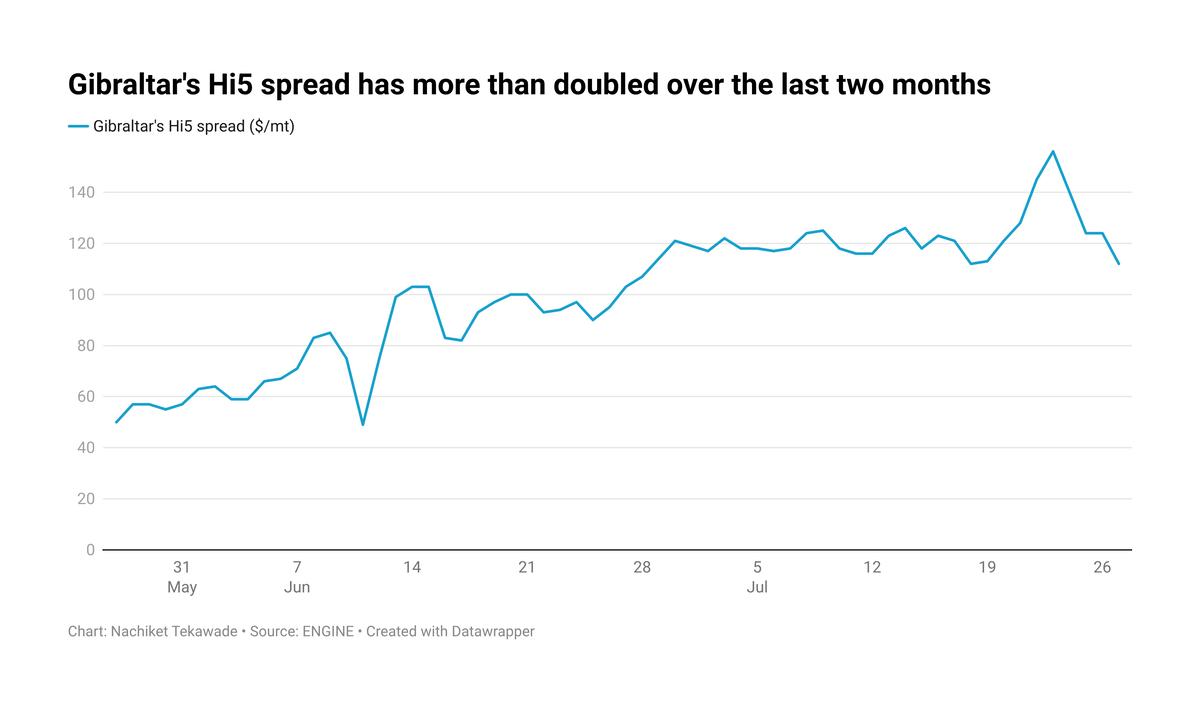
Conversely, the Dutch port’s VLSFO price has edged higher. The diverging movements have widened the port’s Hi5 spread by $26/mt, to $121/mt.
Rotterdam’s LSMGO price has gained more sharply than Gibraltar’s LSMGO price. A higher-priced 50-150 mt LSMGO stem, fixed at $1,207/mt, may have provided support.
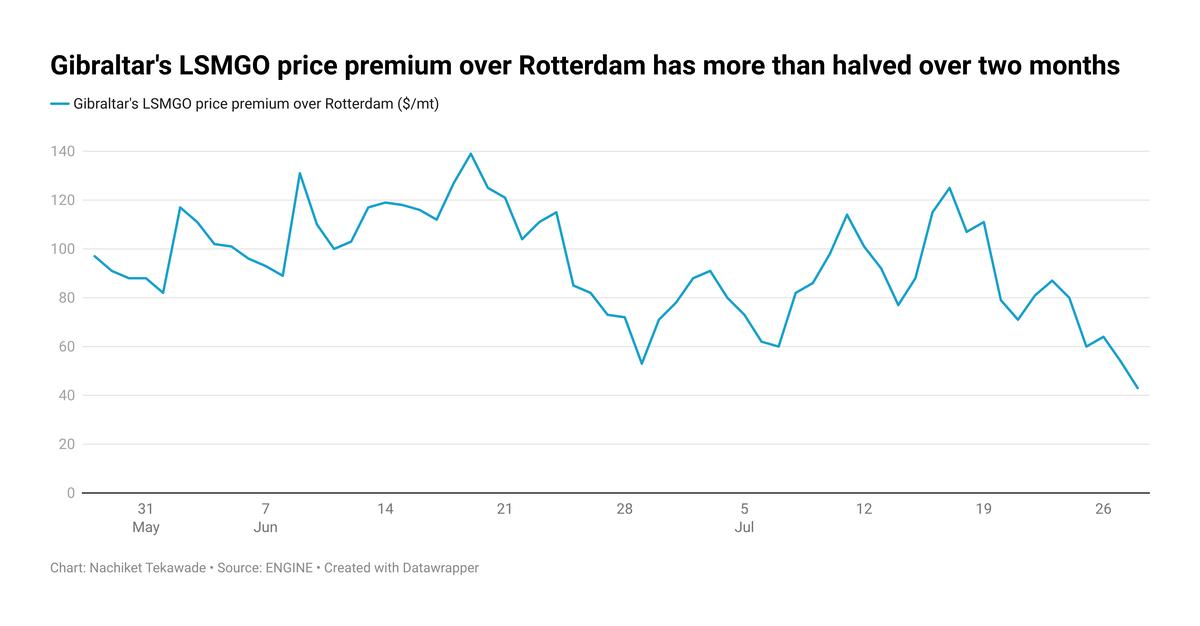
Consequently, Gibraltar’s LSMGO price premium over Rotterdam has narrowed by $18/mt to $43/mt. The price premium has more than halved since 28 May, when the price difference was around $97/mt.
Meanwhile, the B30-VLSFO biofuel blend is priced $151/mt lower than in Gibraltar, widening from a $135/mt discount observed yesterday.
Fuel availability remains tight in the ARA ports for prompt supplies, with buyers advised lead times of between 5-7 days to secure supplies, a trader told ENGINE.
Brent
The front-month ICE Brent contract has declined by $3.68/bbl on the day, to trade at $85.53/bbl at 09.00 GMT.
Upward pressure:
Brent crude’s price has felt some upward pressure as security threats in the Red Sea continue to impact Middle East energy flows.
Yemen's Iran-aligned Houthi militant group said it will maintain its blockade and continue targeting Saudi Arabia-linked oil tankers attempting to transit the Bab al-Mandeb Strait.
“There are still concerns over vessel movements through the Bab el-Mandeb Strait, putting Saudi oil exports from the Red Sea at risk,” two analysts from ING Bank noted.
Riyadh is highly dependent on this alternative route, funnelling about 70% of its crude exports through the Red Sea port of Yanbu to circumvent the Strait of Hormuz.
“When it comes to the Houthis, the risk is not isolated to Saudi shipments, but also to Saudi oil infrastructure,” ING Bank’s analysts said.
Downward pressure:
Brent futures have sold off heavily as the US and Iran continue to refrain from launching further strikes against each other.
US President Donald Trump said Washington and Tehran have resumed talks and that there is a "good chance" of reaching a deal.
“US President Donald Trump said that he decided to pause the strikes to give negotiations another chance,” ANZ Bank’s senior commodity strategist Daniel Hynes noted.
This sell-off was further exacerbated by reports that oil loadings have resumed at the Caspian Pipeline Consortium (CPC) terminal on Russia’s Black Sea coast.
Oil loadings have resumed at both the CPC terminal and the Sheskharis terminal in Russia, according to ING Bank’s analysts.
By Nachiket Tekawade and Aparupa Mazumder
Please get in touch with comments or additional info to news@engine.online