Maersk tests limited Red Sea return with trial transit
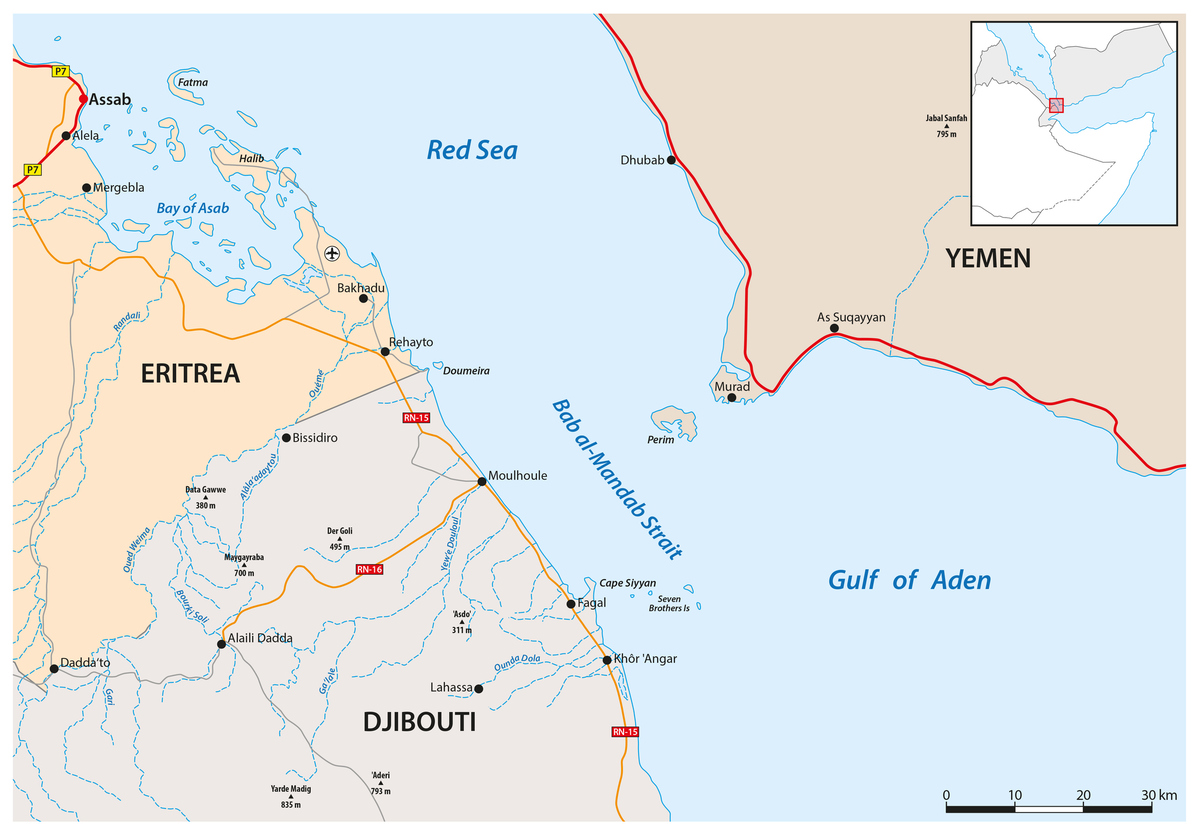
Danish shipping firm A.P. Moller-Maersk has sent one of its container vessels through the Red Sea as part of its planned “stepwise approach” to testing a potential return to the route.
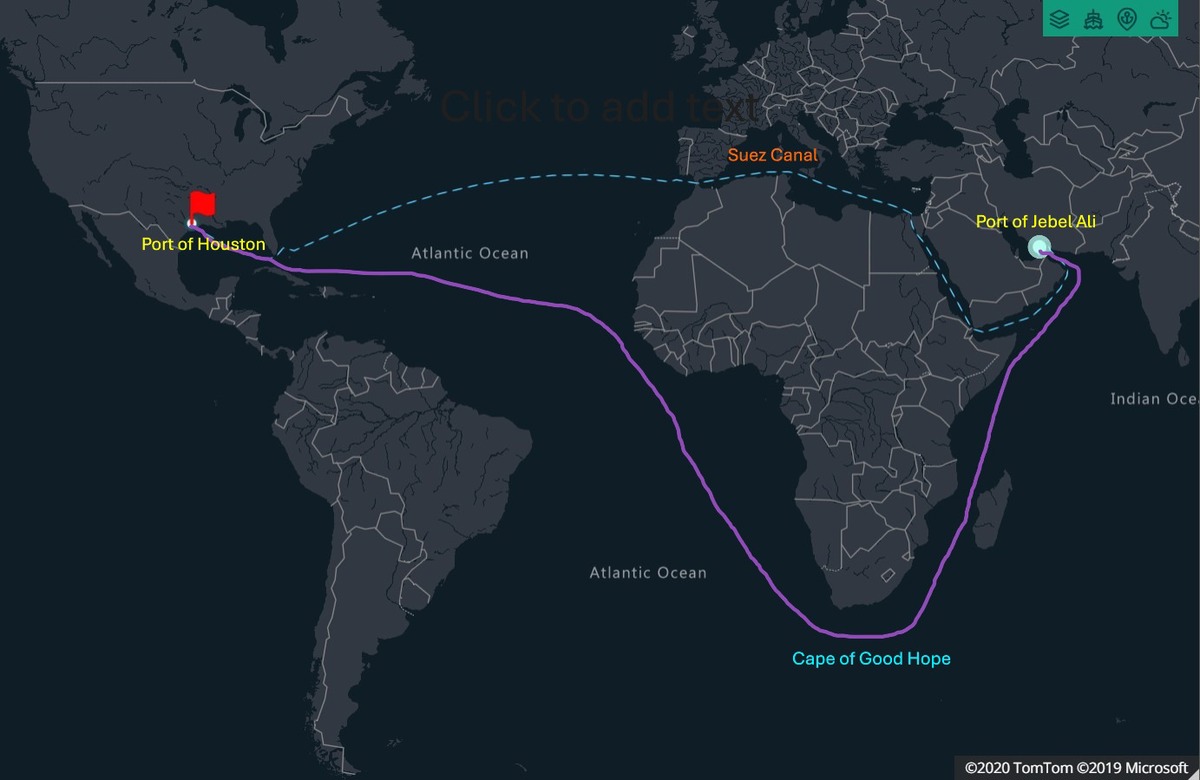 IMAGE: Two different shipping routes from Jebel Ali to Houston. The shorter one runs via the Suez Canal, the longer around the Cape of Good Hope. ENGINE
A.P. Moller-Maersk’s container ship Maersk Sebarok transited the Bab el-Mandeb Strait on 18-19 December, passing through the Red Sea and the Suez Canal.
Maersk stressed that the move should not be read as a broader shift in its network strategy.
“Whilst this is a significant step forward, it does not mean that we are at a point where we are considering a wider East–West network change back to the trans-Suez corridor,” the company said.
The trial follows a similar voyage by CMA CGM’s container ship, CMA CGM Benjamin Franklin, through the Red Sea and the Suez Canal last month.
Container liners’ cautious moves come around a month after Yemen’s Houthi rebel group indicated that it had stopped targeting commercial vessels transiting the Red Sea. But the militant group said its decision was linked to the Gaza ceasefire and warned that renewed attacks on Gaza could lead to a reimposition of a “ban on Israeli navigation in the Red and Arabian Seas.”
Despite the recent trial transits, traffic through the Suez Canal remains well below pre-attack levels.
The Suez Canal route handled an average of 23 cargo ships/day and 11 tankers/day in November, which is less than half of the 51 cargo and 25 tanker ships/day seen during the same period in 2023, according to the IMF’s PortWatch platform.
In contrast, traffic around the Cape of Good Hope has surged. Average daily transits have climbed to 66 cargo ships and 16 tankers/day in November, up from 39 cargo and 10 tankers/day in the corresponding period of 2023, before the disruptions began.
In an effort to lure container traffic back, the Suez Canal Authority has extended its 15% transit fee rebate for container ships until 30 June 2026.
Cape reroutes push up EU-linked emissions
The continued diversion of container vessels around southern Africa has also had measurable emissions impacts.
Maersk’s westbound MECL service typically runs from Jebel Ali to Houston, while the eastbound leg runs from Savannah to Jawaharlal Nehru Port in India. According to its website, rerouting around the Cape of Good Hope extends a one-way voyage to around 50–63 days, compared with 38–45 days via the Suez Canal and Red Sea under normal conditions.
These longer voyages, combined with higher fuel consumption, pushed EU-linked shipping carbon dioxide (CO2) emissions 13% higher in 2024, according to an analysis of official EU data by environmental group Transport & Environment (T&E).
Container ship emissions rose from 37 million mtCO2e in 2023 to 55 million mtCO2e in 2024.
Among these, Mediterranean Shipping Company emitted 15.6 million mtCO2e, followed by Maersk (10.7 million mtCO2e), CMA CGM (8.29 million mtCO2e), Hapag-Lloyd (5.23 million mtCO2e) and COSCO Shipping (5.1 million mtCO2e).
“The first step is this initial sailing, followed by a limited number of additional trans-Suez sailings. However, there are no planned sailings currently,” Maersk added.
While recent trial transits suggest that a handful of operators are testing the feasibility of a limited return to the Red Sea, the data underlines that a sustained shift back to the Suez route will depend on security conditions stabilising over time.
By Konica Bhatt
Please get in touch with comments or additional info to news@engine.online