Marine biodiesel demand to more than double by 2031 without IMO framework - IEA
Global marine biodiesel demand will rise from just under 1 billion litres/year (around 890,000 mt/year) in 2025 to nearly 2 billion litres/year (around 1.78 million mt/year) by 2031, the International Energy Agency (IEA) forecasts.
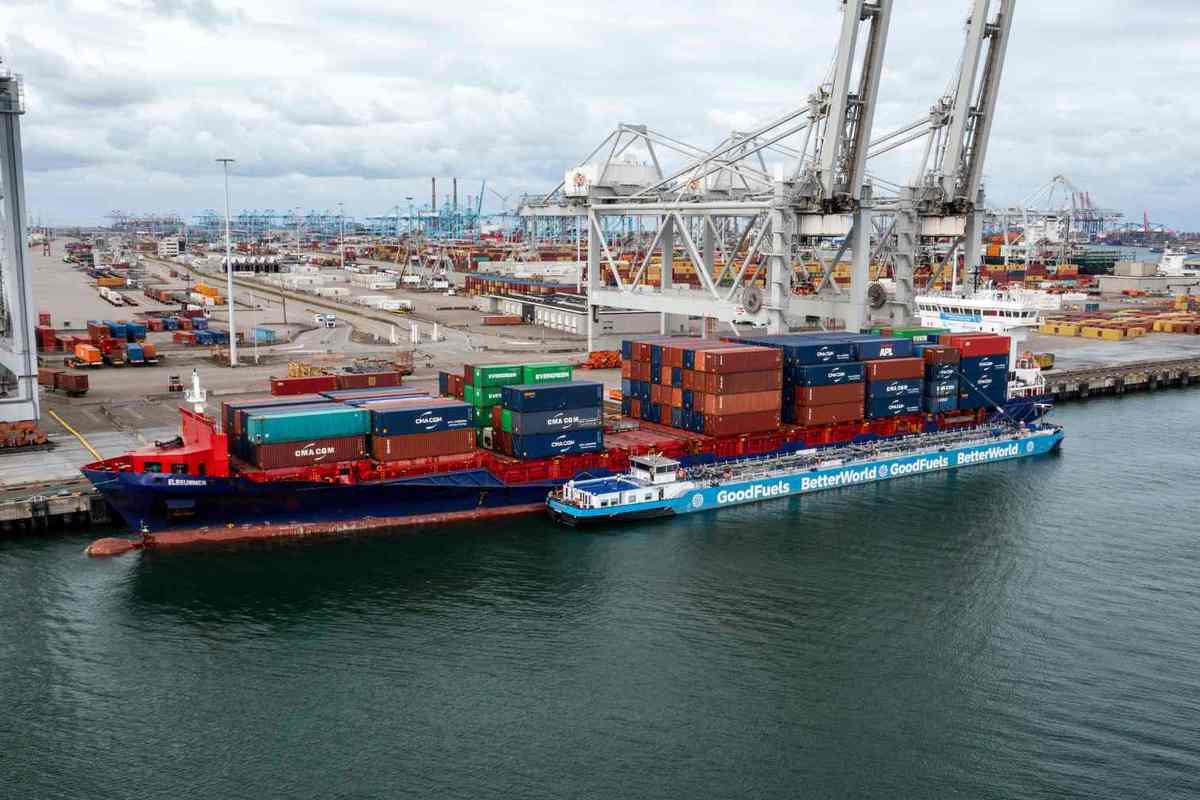 IMAGE: A biofuel bunker operation. FincoEnergies
That estimate assumes the IMO does not adopt its Net-Zero Framework, the global rules it has approved to cut GHG emissions from shipping.
Even so, marine biodiesel would make up only 0.6% of total marine fuel use by 2031, the IEA says.
It will remain the main source of renewable energy in shipping, but it will account for just 1% of the growth in renewable energy use across all transport.
Europe, where the FuelEU Maritime regulation is in place, will drive four-fifths of the growth. The IEA expects marine biodiesel to deliver much of the region’s near-term emission cuts while alternative fuels and energy efficiency measures are scaled up.
Most of the remaining increase will come from Singapore and China, where ports fuel vessels trading to Europe. Growth elsewhere will stay limited because of weak policy support.
FuelEU Maritime took effect at the start of 2025. It requires ships above 5,000 GT calling at EU ports to cut the GHG intensity of the energy they use. GHG intensity is measured well-to-wake and counts emissions from producing and distributing a fuel as well as burning it.
The required cut is 6% by 2030 and 14.5% by 2035. It covers all energy used on voyages within the EU and half of the energy used on voyages into or out of the bloc.
IMO framework would accelerate demand
The report says demand will climb much higher if the IMO adopts its Net-Zero Framework.
In that case, the IEA sees marine biodiesel use rising to more than 12 billion litres/year (more than 10.68 million mt/year) by 2031, or 4% of total marine fuel demand. A vote on the framework was pushed back from 2025 and is now due in December.
The framework would cover roughly 97% of the world’s merchant fleet by tonnage and set two tiers of targets for cutting the GHG intensity of ships’ fuel.
By 2030, ships would pay $100/mtCO2e for emissions above the tougher target of a 21% cut, rising to $380/mtCO2e for emissions above the base target of an 8% cut.
The IEA expects most ships to meet the 8% target by blending lower-emission fuels or buying credits, with marine biodiesel, liquefied natural gas (LNG) and liquefied biomethane (LBM) among the cheaper options available.
The 21% target would be harder to reach, as bio-methanol, e-methanol and ammonia remain scarce and costly, and the penalty for missing it is much lower, the report says.
The IEA assumes marine biodiesel supply would be enough for most ships to hit 8%, but not 21%, with competing road transport demand limiting supply.
Asia Pacific would take the biggest share of that extra demand. Its marine biodiesel use would reach around 6 billion litres/year (around 5.34 million mt/year) by 2031 in this scenario, roughly double Europe’s, according to IEA data.
By Nachiket Tekawade
Please get in touch with comments or additional info to news@engine.online