MEPC 85: Japan tables softer GFI targets and direct contributions
Japan has proposed easing greenhouse gas fuel intensity (GFI) reduction targets from 2030 onwards and replacing the IMO Net-Zero Fund with a "direct contribution" mechanism.
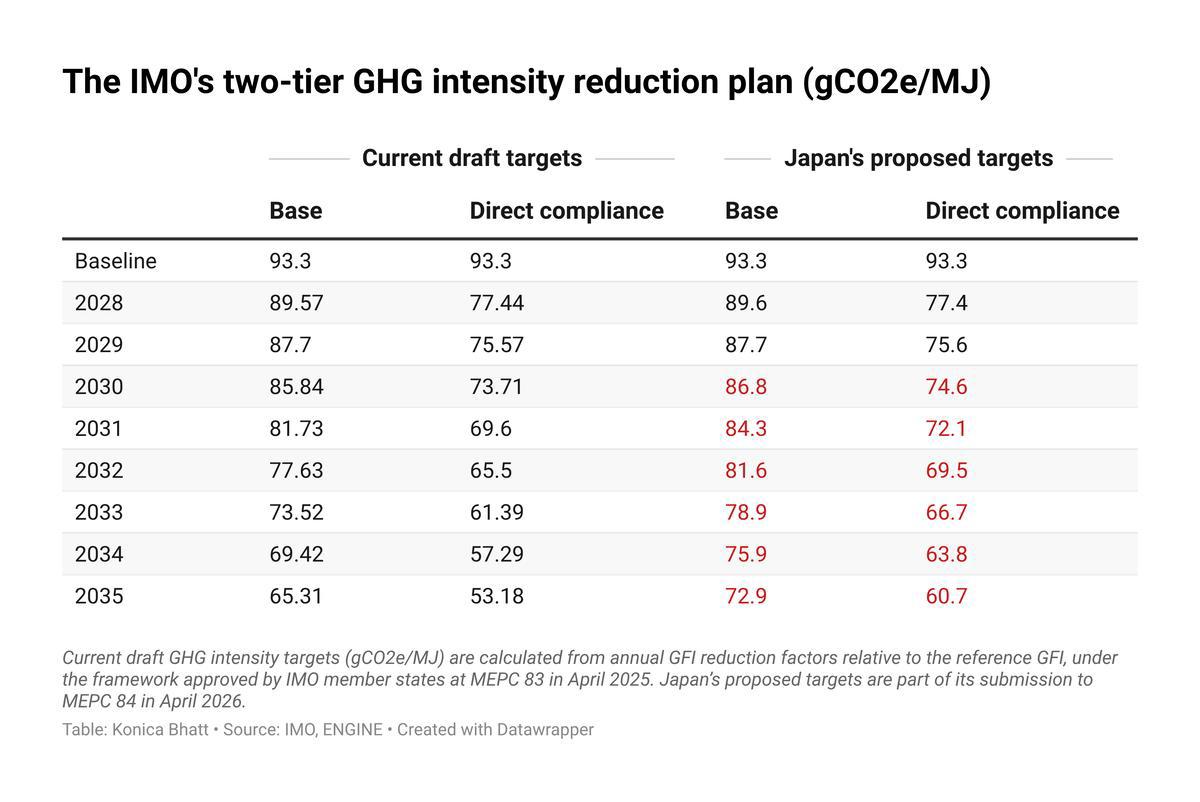
The Net-Zero Framework (NZF) was approved at MEPC 83. It introduced a two-tier GHG fuel intensity (GFI) standard requiring ships to progressively reduce well-to-wake greenhouse gas (GHG) emissions from 2028 onwards, benchmarked against a 2008 baseline of 93.30 grams of CO2-equivalent per megajoule (gCO2e/MJ).
The GFI reduction targets comprise a base target and a direct compliance target, ranging from 4-17% in 2028 and tightening to 30-43% by 2035.
Japan's submission to the IMO's Marine Environment Protection Committee (MEPC 85) proposes easing the reduction trajectory from 2030 onwards while keeping the 2028-2029 targets unchanged.
Japan says the revised draft amendments "do not represent the preferences of Japan" and are intended as a basis for discussion aimed at reaching a convergence acceptable to all member states.
The base target for 2030 should be relaxed from 85.84 gCO2e/MJ to 86.8 gCO2e/MJ. In 2035, it should follow a less aggressive path to 72.9 gCO2e/MJ, instead of 65.31 gCO2e/MJ.
Japan proposes an adjustment to the direct compliance target, easing it from 73.71 gCO2e/MJ to 74.6 gCO2e/MJ in 2030. For 2035, it should be 60.7 gCO2e/MJ instead of 53.18 gCO2e/MJ.
As an alternative, Japan sets out a flat direct compliance target of 72.9 gCO2e/MJ – a 21.9% reduction – for every year from 2028 to 2035. That would be stricter than the current draft's targets through 2030, and looser from 2031 onwards.
It proposes removing the 65% base target for 2040, leaving the 2036-2040 reduction factors to be set by the Committee by 1 January 2032, "taking into account the global availability, affordability and scalability of new fuels and technologies".
In the approved NZF, ships that miss the direct compliance target pay $100/mtCO2e in Tier 1 remedial units, while those that also miss the base target pay $380/mtCO2e in Tier 2 remedial units. Ships that overcomply can earn surplus units to trade or bank for future use.
Japan has suggested removing the opportunity to purchase remedial units entirely.
Ships that fail to meet required GFI targets can purchase surplus units from over-complying ships, or they can make contributions directly to eligible projects of their own choosing, rather than paying into the IMO Net-Zero Fund.
The mechanism largely mirrors the categories of eligible projects in the NZF's revenue distribution provisions, replacing rewards for zero and near-zero fuels with support for the uptake of new fuels and technologies.
It also sets out a governance framework under which flag administrations would nominate eligible projects, the IMO would determine which projects qualify, and the proposing administration would audit the entity implementing the project and report the results back.
The direct contributions would be calculated using the same pricing as the remedial units in the current draft, at a minimum price of $100/mtCO2e for Tier 1 emissions and $380/mtCO2e for Tier 2 emissions.
Japan's proposal has dropped regulation 39 in the approved NZF, which sets the threshold for zero and near-zero GHG emission technologies and fuels ZNZs and provides rewards from the IMO Net-Zero Fund for ships using them.
Japan builds on the proposal it first tabled at MEPC 84. However, under IMO procedures, draft amendments to MARPOL are normally required to be circulated at least six months before they can be adopted. This means a proposal submitted after June would not ordinarily be eligible for adoption at the resumed second extraordinary session (MEPC/ES.2) on 4 December.
In this case, member states could choose to waive that requirement and proceed with adopting the NZF at MEPC/ES.2. Alternatively, they could delay adoption to a later session, such as in 2027, said Tristan Smith, co-lead of the Shipping and Oceans Research Group at University College London.
By Konica Bhatt
Please get in touch with comments or additional info to news@engine.online