Trump renews attacks on IMO Net-Zero Framework
US President Donald Trump has signalled that his administration intends to prevent the IMO from adopting a global emissions-pricing mechanism.
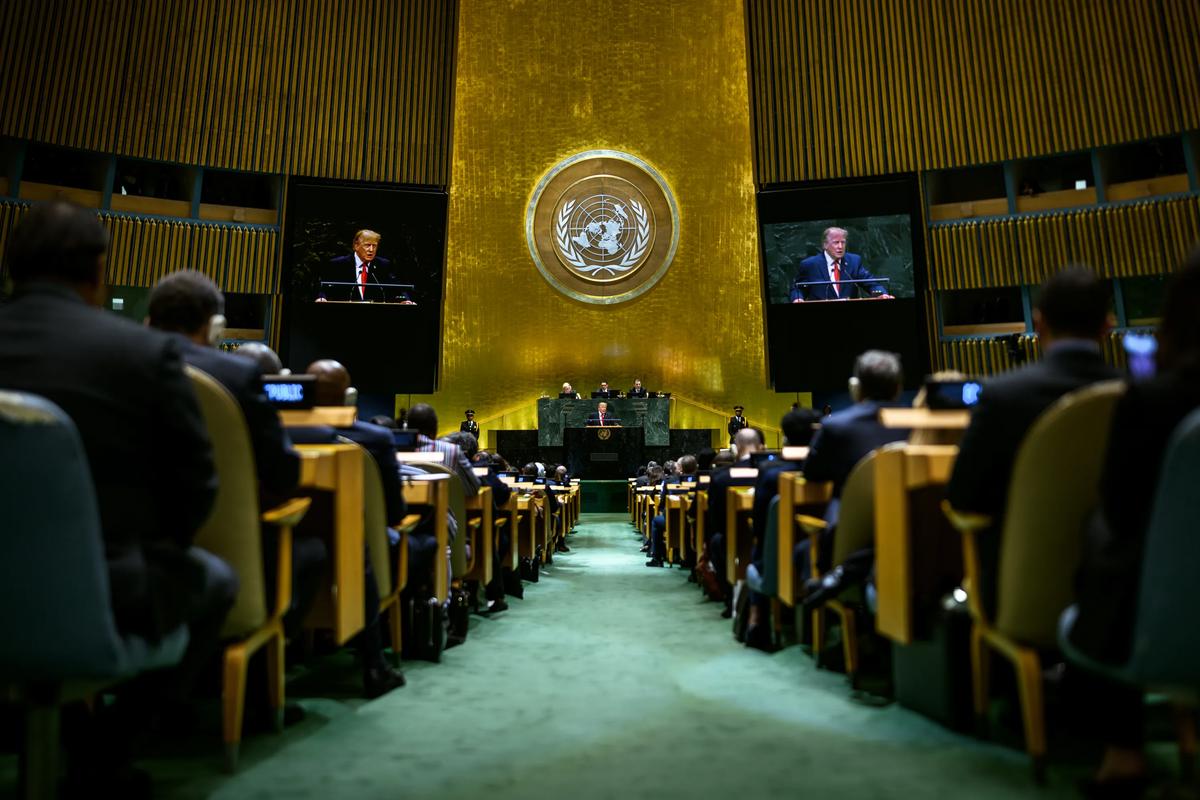 IMAGE: US President Donald Trump addressing the UN General Assembly on 22 September. The White House
"Last year, my administration was forced to intervene to stop an obscure UN body, the International Maritime Organization, from secretly establishing a first-ever global carbon tax, very expensive tax, to raise international shipping costs by 10-20% and maybe more than that," Trump said while addressing the UN General Assembly on 22 September.
"There is no global government - and while I am President, there will be no global taxes," he added.
The US delegation walked out of negotiations at the IMO's 83rd Marine Environment Protection Committee (MEPC 83) meeting in April 2025. The meeting ended with a draft Net-Zero Framework (NZF) being approved by 63 votes to 16, with 24 abstentions.
The draft NZF introduced a two-tiered GHG fuel standard that would require ships to progressively reduce their well-to-wake GHG fuel intensity (GFI) from 2028.
Ships that fall short of the direct compliance target would be required to purchase remedial units to cover their emissions deficit through contributions to the IMO Net-Zero Fund. The Tier 1 remedial unit price is set at $100/mtCO2e for 2028-2030.
Those that fail to meet both the base and direct compliance targets would also need to cover an additional Tier 2 deficit. This could be done by purchasing surplus units from other ships, using units banked from previous years or buying additional remedial units at a higher price of $380/mtCO2e for 2028-2030.
However, formal adoption of the NZF was postponed for one year in October 2025 amid vocal opposition from the US and several other oil-producing countries.
Ahead of MEPC 84 in April, Washington called for an “energy-all” approach in its own submission to the IMO, arguing that proposals should not restrict use of conventional crude or diesel, LNG, nuclear power, biomass-based fuels or other marine propulsion technologies.
It also supported a separate position put forward by Algeria, Bahrain, Iraq, Kuwait, Russia, Saudi Arabia, Somalia and the UAE, which warned that a framework containing economic measures would not secure consensus.
At MEPC 84, the US then joined Liberia, Panama and Argentina in pushing for negotiations on their proposal to remove GHG pricing and revise the GFI reduction trajectory, the US State Department said.
Despite the opposition, 59 member states at MEPC 84 supported using the approved NZF as the basis for the draft terms of reference guiding further discussions at the IMO’s GHG working group meetings in September and November, according to the UCL Energy Institute.
The outcome of those negotiations will be considered at MEPC 85, scheduled between 30 November-3 December. If a final text is agreed, the framework could then be adopted at the resumed second extraordinary session (MEPC/ES.2) on 4 December, subject to confirmation by MEPC 85.
US backs nuclear propulsion
The Trump administration is also working with the UK government to explore nuclear-powered commercial shipping, including the potential for a transatlantic corridor.
More recently, A.P. Moller - Maersk joined Lloyd’s Register and the ports of Charleston, US and Felixstowe, UK, to model operational and regulatory requirements for such a corridor under the bilateral initiative.
By Konica Bhatt
Please get in touch with comments or additional info to news@engine.online