ABS urges IMO rules to reflect fuel access gaps
Class society ABS says the IMO’s mid-term greenhouse gas measures should take the global fleet's operational realities into account.
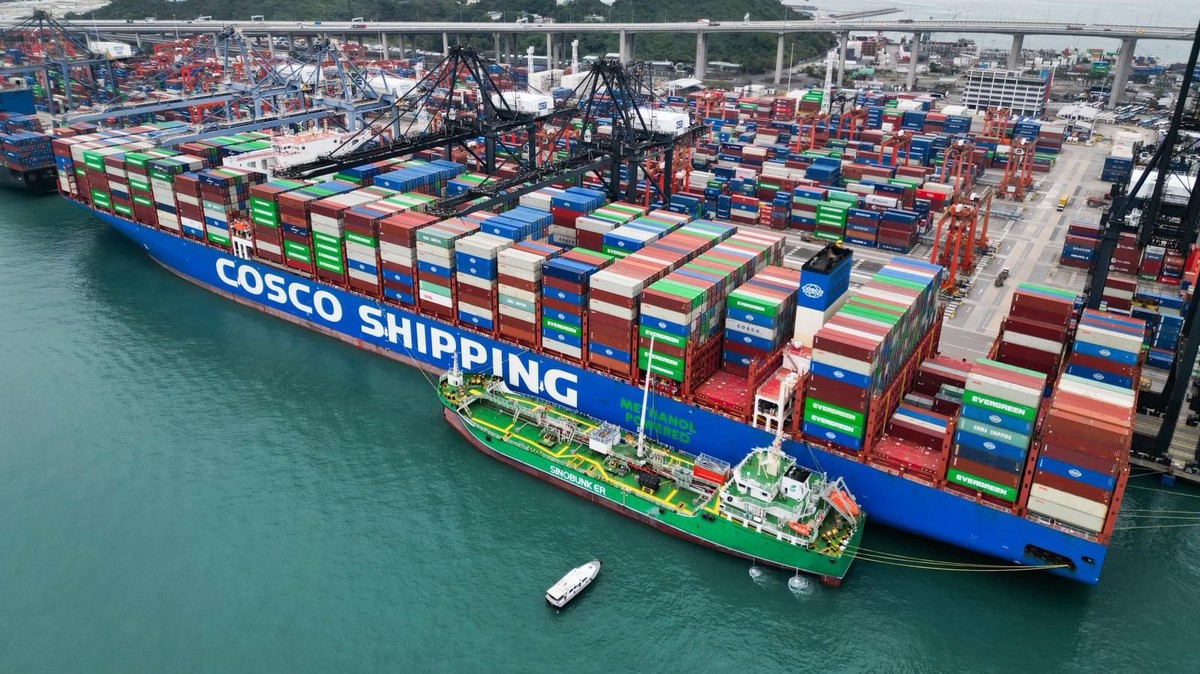 IMAGE: Green methanol is delivered from a bunker vessel to a container ship in Hong Kong. Towngas
In a report, ABS says fuel availability, infrastructure readiness, vessel deployment patterns and commercial structures will all influence the pace of shipping’s fuel transition.
ABS argues that the shipping industry is moving forward with the fuel transition in multiple parallel pathways, as opposed to a uniform trajectory.
It points out that ships operating on predictable and regular routes, including container vessels, ferries and cruise vessels can better access alternative fuel supply chains and structured bunker arrangements.
Meanwhile, vessels involved in tramp trades like bulk carriers and tankers operate on changing routing and commercial conditions, which can be a constraint in regularly accessing alternative fuel supplies, the report says.
Clean fuel pathways
LNG remains the most developed alternative fuel pathway due to its established bunkering network and growing fleet, ABS says. Liquefied biomethane (LBM) and e-LNG are decarbonising the LNG pathway.
Methanol is emerging but faces uncertainty over green supply by 2030. Ethanol could play a complementary role, while ammonia remains a longer-term option because of infrastructure, supply and readiness constraints.
The report says the industry needs incentives to use all of these fuels.
ABS maintains that while several alternative fuels will grow, conventional fuels, including biofuel blends, are likely to remain dominant through 2030.
It warns that the IMO's fuel-switching rules could move faster than the fuel production and bunker system needed to support them.
Rewarding energy efficiency
Proposals submitted to MEPC 84 by countries including Japan, Liberia, the US and Saudi Arabia, should not be viewed as competing plans but as design elements that can be used to build an effective framework. Each plan offers solutions to real industry challenges, ABS says.
The class society also argues that boosting energy efficiency through measures can deliver significant emissions reductions across ship types and trades. It notes slow steaming, voyage optimisation, air lubrication, wind-assisted propulsion and AI and data-driven decisions among these measures.
ABS says the Liberian proposal to MEPC 84 has merit as it seeks to integrate carbon credits for energy efficiency with the greenhouse gas fuel intensity (GFI) structure. This can bridge limited alternative fuel supply, it says.
By Nachiket Tekawade
Please get in touch with comments or additional info to news@engine.online