Americas Fuel Availability Outlook 5 Mar
Houston Ship Channel closed by dense fog
Strong bunker demand in Panama
Zona Comun bunker operations suspended
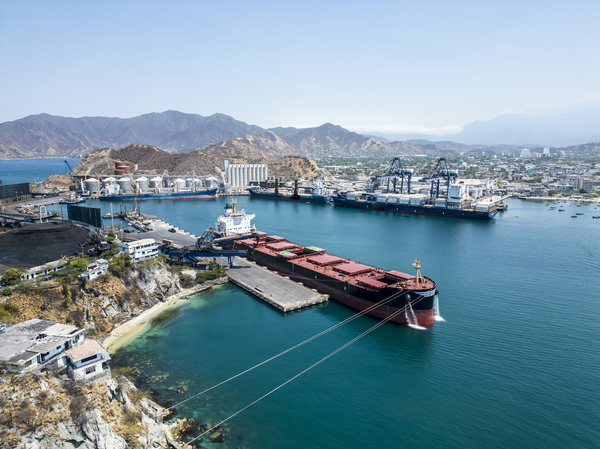 IMAGE: Cargo ship in the port of Santa Marta, Colombia. Getty Images.
North America
In Houston, bunker fuel demand is steady at the port. VLSFO and HSFO are tight for prompt delivery and require at least 7–10 days. LSMGO can be delivered by most suppliers within 5–7 days.
The port is currently experiencing backlogs at its terminals due to intermittent closures of the Houston Ship Channel.
The channel most recently closed on Wednesday and remains shut to all vessel traffic due to dense fog conditions in the region. This is a result of the ongoing US Gulf fog season, which typically runs until mid-March.
Visibility during peak fog periods could fall to around 1–3 nautical miles, potentially disrupting vessel movements and port operations across the region.
The Sabine–Neches Waterway has also been closed due to poor visibility.
Fog conditions are also expected to disrupt bunkering at the nearby Galveston Offshore Lightering Area (GOLA) anchorage. Deliveries are currently underway and are being carried out on a “first-come, first-served” basis.
Lead times at the anchorage are subject to specific enquiry, a source said.
Dense fog is forecast to periodically affect US Gulf Coast ports throughout the week, with several locations including Port Arthur, Corpus Christi, Marsh Island and Lake Charles facing repeated high fog threats, particularly during nighttime and early morning hours.
In New York, bunker demand is normal, with weather conditions easing to support bunkering operations.
HSFO remains slightly tight in New York and requires lead times of at least 7–9 days to secure availability. VLSFO lead times stand at 5–6 days, while LSMGO has good availability and can be delivered within 2–3 days, a source tells ENGINE.
On the US West Coast, the ports of Los Angeles and Long Beach have normal availability, with most suppliers able to deliver all three fuel grades within 7–8 days.
Container traffic is expected to decrease, with 16 container ship arrivals forecast for next week, down from 19 this week, according to the ports’ vessel tracker, Signal.
In Vancouver, Canada, HSFO can be delivered within 5–7 days. VLSFO and LSMGO are available with lead times of 6–8 days this week, a source said.
Latin America and the Caribbean
In Panama, bunker demand has increased significantly over the past few weeks. Supply at the ports of Balboa and Cristobal is currently tight across all three conventional fuel grades and requires lead times of at least five days, a bunker trader tells ENGINE.
In Colombia, VLSFO requires lead times of around two days, while LSMGO requires three days. In ports where HSFO is available, such as Santa Marta and Barranquilla, the earliest delivery dates are around three days.
In Brazil, VLSFO and LSMGO availability is steady in Santos, with lead times of around 5–8 days.
In Rio de Janeiro and Rio Grande, availability is normal for both grades and requires lead times of 4–5 days this week.
In Freeport in the Bahamas, a key supplier has experienced issues with its loading terminal and barge and is currently working through a backlog, a trader said. Until the supplier catches up, prolonged delays are expected.
"They have completed two deliveries to anchorage vessels since the terminal came back online," the trader added.
In St. Eustatius, possible disruptions are expected due to high wind gusts until 9 March. This could lead to delays for anchorage deliveries.
In Argentina’s Zona Comun, bunker deliveries are currently suspended due to high wind gusts exceeding 20 knots. Prolonged delays are expected over the next several days.
Lead times for VLSFO and LSMGO at the anchorage are currently between 7–10 days.
By Gautamee Hazarika
Please get in touch with comments or additional info to news@engine.online