Easing IMO NZF rules could set shipping off GHG targets, UCL warns
Weakening emissions targets or making compliance payments too cheap could undermine the IMO’s climate goals and slow the shift to cleaner marine fuels, according to a report by UCL.
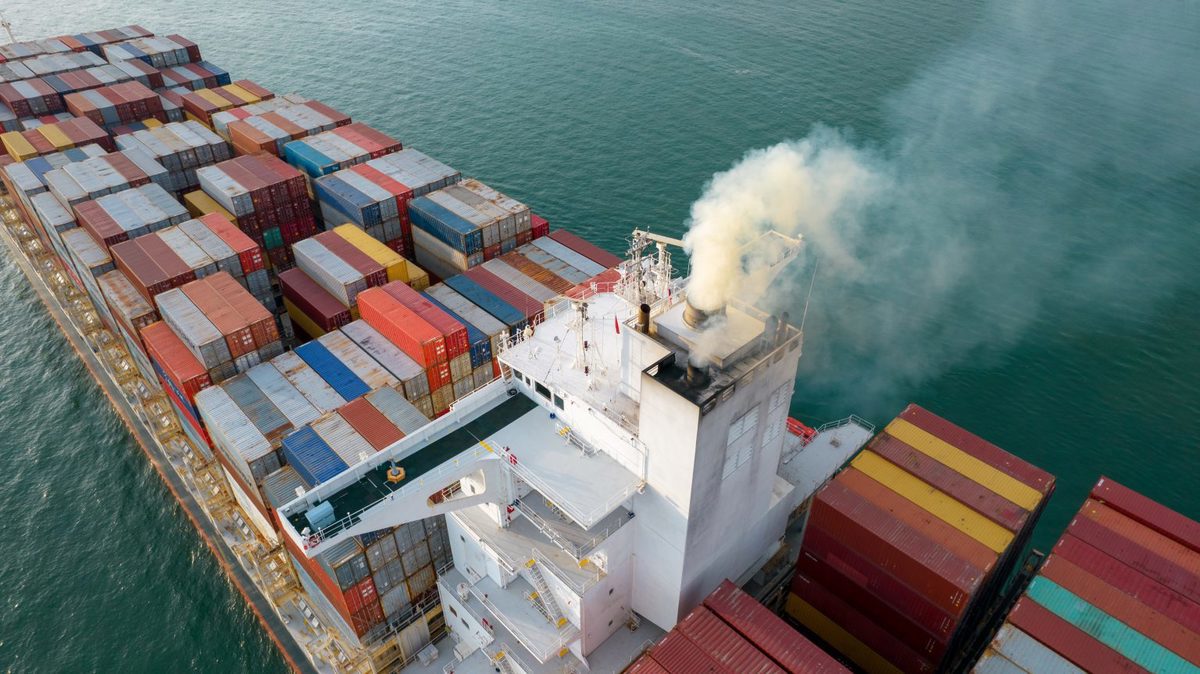 IMAGE: Smoke from a vessel's exhaust. Getty Images
The Net-Zero Framework (NZF), approved by IMO member states in April 2025, produced the best results among nearly 300 policy scenarios tested by University College London’s (UCL) Shipping and Oceans Research Group and the Rocky Mountain Institute.
Only two variants performed as well, and both kept the framework’s original targets.
The researchers carried out the modelling for three papers that the Institute of Marine Engineering, Science & Technology (IMarEST) has submitted to the IMO.
The framework works in two parts. The first is a greenhouse gas fuel intensity (GFI) limit, which caps how much greenhouse gas a ship’s fuel can emit for each unit of energy it delivers. The cap counts everything from producing the fuel to burning it on board, and it tightens every year.
The second part is a system of payments. Ships that miss the limit must buy remedial units, initially priced at $100 or $380 for each mt of CO2e above the limit, depending on how far they fall short. Ships that beat the limit earn surplus units, which they can sell to those that fall short.
How quickly the limit tightens largely decides how much shipping emits in total. Under the approved limits, shipping’s cumulative emissions to 2050 would exceed the tougher "strive" pathway in the IMO’s 2023 strategy by 36%.
Under the next-weakest set of limits tested, that gap doubles to 73%. One step lower, it reaches 118%.
In September, 30 member states said they were open to softening GFI reduction requirements for 2029-2035, according to UCL’s count at the IMO’s GHG working group talks.
The price of remedial units matters just as much as the limits. If paying is cheaper than switching to a cleaner fuel, many owners will simply pay.
The modelling assumes the $380 price rises over time in line with the cost of compliance. If the price stays at $380 instead, the gap widens from 36% to 90%.
The approved text does not yet say how these prices will be revised. IMarEST recommends reviewing them as often as every 12 months, as forward fuel prices offer a reliable guide only about a year ahead.
Japan has proposed letting shipowners send their compliance money directly to projects of their choice, instead of into a central IMO fund.
The researchers warned that if a project passes some benefit back to the owner who funded it, the real cost of compliance falls, possibly to near zero.
In a scenario where owners recover half of what they pay, cumulative emissions would exceed the strive pathway by 169%. Cutting each mt of CO2e would cost $861, against $359 under the approved framework.
That would roughly double the impact on countries’ prices and economic output. Shipowners rather than the IMO would also decide where more than $2 trillion of compliance payments go by 2050.
The proposal would hold back e-fuels, which are made using renewable electricity. Under the approved framework, e-fuels pass 5% of shipping’s energy use around 2036-2037. Under Japan’s proposal, they never reach that level before 2050.
The framework also rewards ships that use zero and near-zero emission fuels, to help cover their higher cost. Without such rewards, oil and LNG would meet nearly all of shipping’s energy demand through the 2030s, with some use of bio-MGO, a second IMarEST paper found.
Rewards aimed at e-fuels, or set at different rates for each fuel, would bring e-ammonia into use during the 2030s. That would build the supply needed for tighter targets in the 2040s.
China has suggested a multiplier as an alternative or addition to rewards. Instead of paying ships, it would count the energy from clean fuels more generously when a ship’s GFI is calculated, lowering the ship’s reported fuel intensity.
The modelling found this would mainly help drop-in fuels that work in existing engines, such as biomethane and biodiesel. It would keep overall uptake of clean fuels low and could even raise cumulative emissions.
Negotiations continue at the IMO’s GHG working group on 23-27 November, followed by MEPC 85 from 30 November to 3 December.
By Gautamee Hazarika
Please get in touch with comments or additional info to news@engine.online