East of Suez Fuel Availability Outlook 24 Mar
Fuel availability tight in Singapore
Bunker demand low in several South Korean ports
Fuel availability tight across all grades in Fujairah
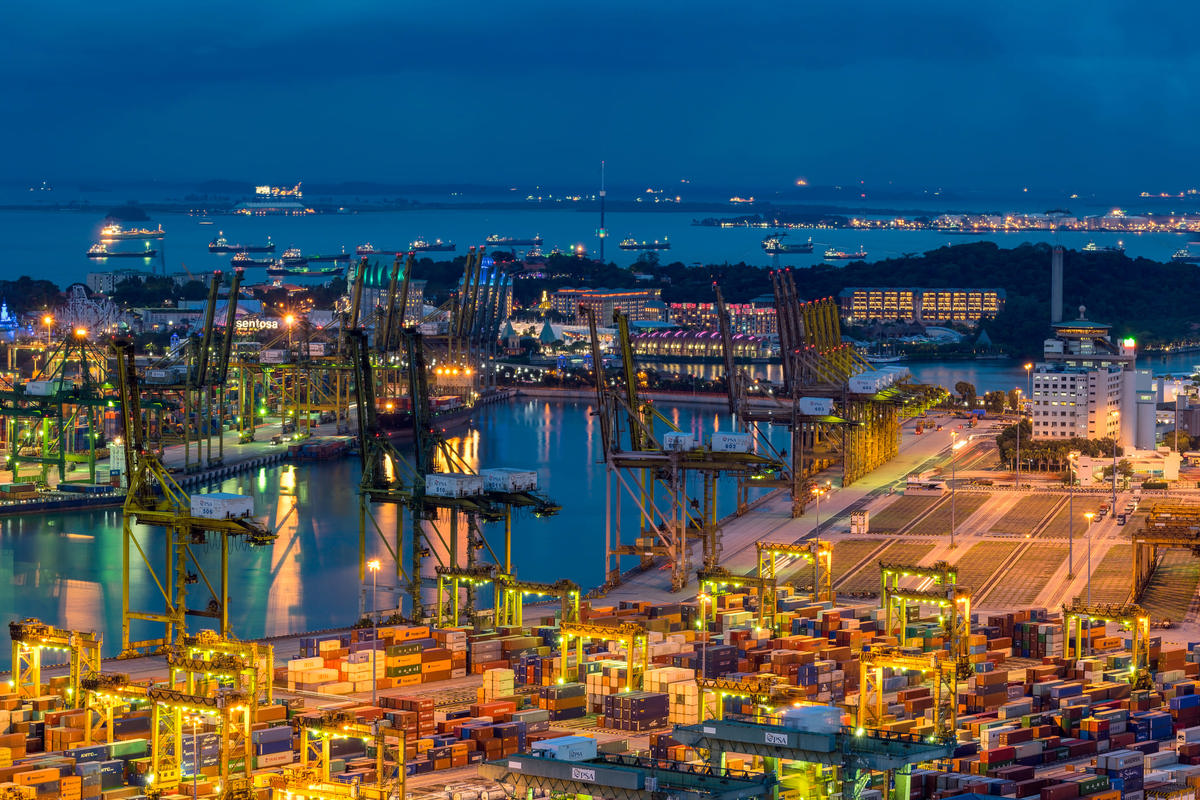
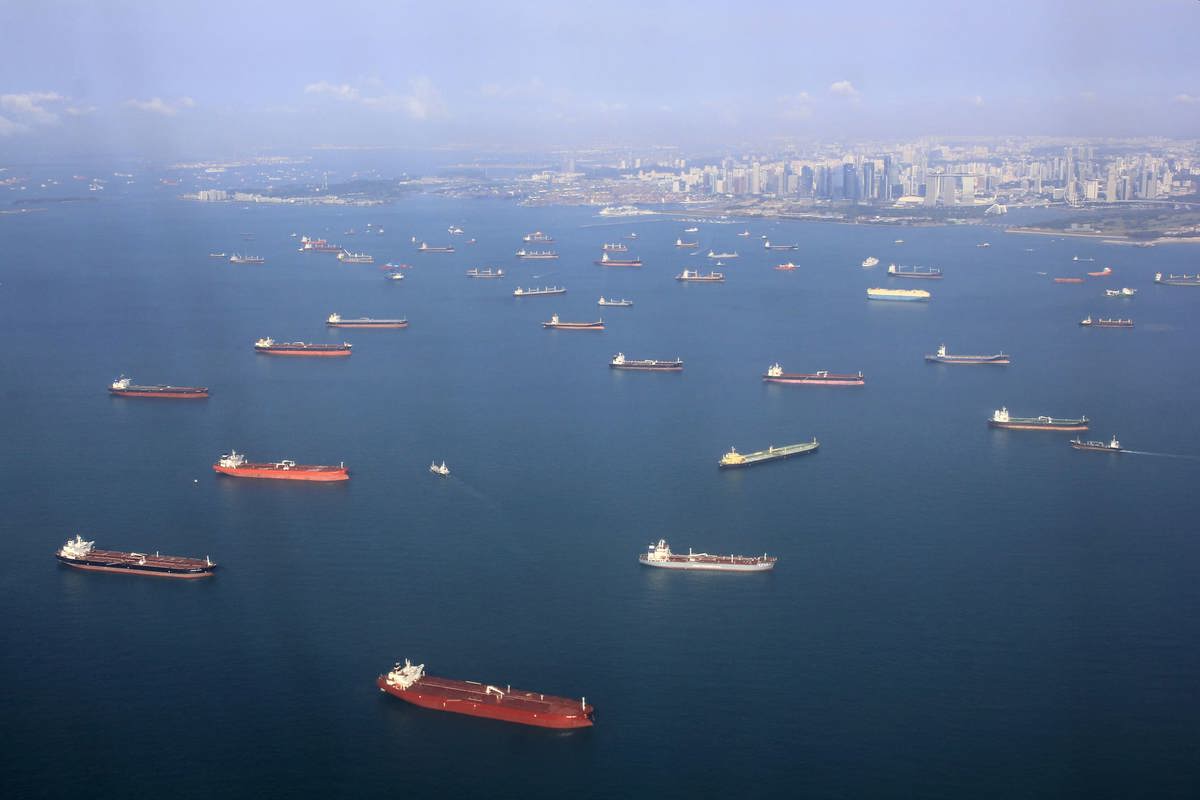 IMAGE: Dense rows of vessels on the waters of Singapore. Getty Images
Singapore and Malaysia
Bunker prices in Singapore have remained firm, largely driven by escalating tensions in the Middle East. The situation has kept Brent crude prices firm and disrupted trade flows through the Strait of Hormuz, a critical corridor for global oil shipments.
In the prompt market, VLSFO remains under pressure with lead times of 8–11 days, while HSFO availability continues to be restricted within a 9–16 day range, largely unchanged week-on-week.
Singapore’s LSMGO price has edged lower this week but remains elevated, supported by tight supply, steady demand and firm gasoil cargo prices. Some bunker suppliers are applying premiums to take advantage of prevailing conditions. At the same time, supply disruptions and uncertainty in Fujairah have redirected LSMGO demand towards alternative hubs such as Singapore, according to a source.
Concerns over securing future gasoil import cargoes into Singapore have added further upward pressure. Meanwhile, the port’s middle distillate stocks averaged 12% lower so far in March.
Lead times for LSMGO have widened from 6–9 days last week to 5–12 days currently.
On the other hand, Singapore’s residual fuel oil inventories have averaged 4% higher so far this month compared to February, according to Enterprise Singapore data. Fuel oil stocks remain above 23 million bbls, supported by a sharp 43% increase in net imports in March. Total imports have risen by 1.13 million bbls, while exports have declined by 271,000 bbls.
At Port Klang, VLSFO availability remains relatively stable, particularly for smaller prompt stems. However, LSMGO supply has tightened, and HSFO availability continues to be limited, making both grades increasingly difficult to secure.
East Asia
Bunker prices across most Chinese ports have climbed sharply, closely following the rise in crude prices amid escalating tensions in the Middle East—particularly around the Strait of Hormuz.
In response, China “imposed a ban on refined fuel exports in March to avoid a potential domestic fuel shortage arising from Middle East tensions,” a source said.
Despite this move, fuel availability across all grades remains steady, according to a Zhoushan-based trader. Most suppliers are now advising lead times of 3–5 days for all grades, easing from 5–10 days last week.
Supply conditions vary across northern China. Dalian and Qingdao report sufficient availability of VLSFO and LSMGO, although HSFO remains limited in Qingdao. In Tianjin, supply is tight across all grades, while in Shanghai, both VLSFO and HSFO stocks are constrained, with LSMGO availability relatively stable.
Further south, supply pressures are more pronounced. VLSFO and LSMGO are tight in Fuzhou, while Xiamen has adequate VLSFO but limited LSMGO supply. Both grades remain constrained in Yangpu and Guangzhou.
In Hong Kong, bunker availability is largely stable, with lead times holding at around seven days for all grades in recent weeks.
In Taiwan, bunker supply has not been significantly affected by Middle East tensions, although there has been a slight increase in bunker calls. Prices, however, have reacted more strongly, as the Brent volatility linked to Middle East tensions has significantly influenced bunker prices, a trader said.
Recommended lead times for VLSFO and MGO in Keelung, Taichung and Hualien are around two days, while deliveries in Kaohsiung require approximately three days due to CPC's MGO barge maintenance.
In South Korea’s southern ports—including Busan, Ulsan, Masan, Onsan, Yeosu and Kwangyang—HSFO supply remains tight, with most offers available only on enquiry. Lead times for VLSFO and LSMGO are generally around 3–4 days, largely unchanged from the previous week.
At western ports such as Incheon, Daesan, Dangjin, Pyeongtaek and Taean, HSFO is similarly offered on a firm enquiry basis. Meanwhile, VLSFO and LSMGO lead times have eased slightly to 2–4 days, down from 3–6 days last week.
Elevated bunker prices have discouraged buyers from sourcing fuel at South Korean ports, resulting in subdued demand, according to a source.
Seasonal winter conditions continue to pose operational risks. Weather-related disruptions are expected to potentially affect Busan and Ulsan on 23–24 March and 27–29 March, and Yeosu on 27–29 March.
In Japan, the domestic bunker market remains under intense strain amid persistent Middle East tensions. Last week, the government initiated the release of both strategic reserves and private-sector stockpiles equivalent to 15 days’ supply in an effort to stabilise the market. However, these crude volumes will take time to be refined into bunker fuels and reach end-users, meaning tight supply conditions are expected to persist through April, a Japan-based trader said.
Major domestic refiners have formally informed suppliers that marine bunker volumes will be reduced by approximately 50% starting in April, as they shift focus toward fulfilling term commitments. As a result, most suppliers have halted spot offers for late March and April, prioritising existing contractual obligations.
Hyundai, leveraging its import tank terminal in Nagoya, appears more flexible than domestic refiners. Depending on cargo arrival schedules, spot enquiries in the Nagoya region remain possible, presenting a rare “chance” in contrast to other regions where availability is effectively zero.
Meanwhile, Japanese refiner ENEOS occasionally retains the ability to issue direct offers. Although its selection process is highly stringent and varies daily, based on internal inventory levels, the opportunity is not entirely ruled out. Beyond these limited channels, spot supply is described as virtually non-existent, the source added.
Consequently, availability across all fuel grades in major Japanese hubs—including Tokyo, Chiba, Yokohama, Kawasaki, Nagoya, Yokkaichi, Mizushima, Kashima, Tokuyama and Oita—is now assessed strictly on an enquiry basis.
In Indonesia, by contrast, supply conditions remain relatively stable. VLSFO availability is steady in Jakarta, Surabaya, Balikpapan and Cigading, with lead times of around 2–3 days. LSMGO supply is also stable across Jakarta, Benoa, Surabaya and Batam, while HSFO stocks are well supplied in Jakarta, Surabaya and Balikpapan, according to a trader.
Oceania
Bunker prices across several Australian ports remain elevated, largely due to constrained availability. Some suppliers are limiting sales to contracted customers, while others are unable to offer spot bunkers altogether, according to an Australia-based trader.
In Western Australia, suppliers in Kwinana and Fremantle typically require about a week’s notice. Deliveries are mainly carried out via barge through a single provider, although LSMGO can also be supplied by truck.
In New South Wales, VLSFO deliveries at Port Kembla can be arranged by truck or pipeline. Sydney suppliers maintain healthy inventories of VLSFO and LSMGO, but HSFO availability remains tight, with lead times of around seven days.
In Queensland, ports such as Brisbane and Gladstone are supplying VLSFO and LSMGO with lead times of roughly seven days. HSFO is available on request in Brisbane. Deliveries of VLSFO and LSMGO are handled by two barges operated by separate suppliers, while HSFO is offered strictly on an enquiry basis.
In Victoria, inventories of VLSFO and LSMGO are adequate in both Melbourne and Geelong, though HSFO availability is limited for prompt deliveries. Bunkering operations in these ports depend on a single barge, with lead times close to seven days.
At the same time, Australia’s northern cyclone season, spanning November to April, is expected to cause intermittent disruptions. Tropical Cyclone Narelle is tracking parallel to the Pilbara coast from Wednesday to Thursday, before turning south–southeast on Friday, with a likely impact on Western Australia’s west coast over the weekend.
Several ports—including Broome, Port Hedland, Dampier, Ashburton, Varanus Island, Port Walcott, Cape Preston, Onslow, Barrow Island and Carnarvon—are moving toward full clearing within 24 hours, according to GAC Hot Port News.
In New Zealand, bunker supply conditions remain stable. VLSFO is readily available in Tauranga and Auckland, with some berths in Tauranga connected by pipeline. At Marsden Point, both VLSFO and LSMGO can be delivered via pipeline to cargo vessels, although truck-based deliveries across South Island ports continue to face limitations.
South Asia
Adverse weather is expected to disrupt operations at India’s Kandla, Sikka and Visakhapatnam ports on 28 March, and at Mumbai on 24 and 26 March, potentially impacting bunkering activities.
Middle East
Despite continued volatility in the Middle East, bunkering operations in Fujairah are ongoing, even after repeated attacks on the port in recent weeks, a source said.
While authorities in Fujairah and Khor Fakkan have not issued official alerts, navigational warnings have been circulated following reports of intermittent GPS spoofing and signal jamming offshore. Such disruptions can result in inaccurate positioning, erratic vessel movements and misleading navigational data, prompting guidance for mariners to treat the area as high risk, according to Inchcape Shipping.
Fuel availability remains tight across all grades, with offers subject to firm enquiry, a trader noted. In Fujairah, bunkering continues “depending on the port and booking conditions, though delays are possible due to vessel rerouting and port congestion,” another source said.
Elsewhere in the UAE, operations at Jebel Ali, Hamriya and Sharjah Port are proceeding as normal. Petroleum terminals in Abu Dhabi, including Ruwais, are also functioning without disruption.
Ras Al Khaimah Ports remain open and fully operational. However, RAK Ports Group will introduce a marine risk surcharge for all vessels calling at its ports, harbours, anchorages and approaches, according to shipping agency Inchcape Shipping.
In Kuwait, both Shuaiba and Shuwaikh ports continue to operate normally.
In Saudi Arabia, no formal alerts have been issued, although bunker availability remains tight in Jeddah, particularly for VLSFO and LSMGO.
In Qatar, port operations and vessel movements remain steady at Hamad, Doha and Al Ruwais, with activity also continuing at Mesaieed and Ras Laffan. However, VLSFO and LSMGO supply is tight in Ras Laffan, while Al Ruwais Port is limited to small craft, including dhows and barges.
“Omani ports like Salalah, Sohar, and Muscat now open,” an Oman-based trader said. Other ports in Oman—including Port Sultan Qaboos, Muscat, Mina Al Fahal, Port of Sohar and Port of Duqm—are operating normally, with prompt LSMGO available across several locations.
In Bahrain, vessel movements are gradually resuming, although operations remain constrained due to a shortage of pilots. The Suez Canal and all Egyptian ports continue to function normally, and conditions remain stable in Jordan. Ports in Pakistan, Iraq, Cyprus and Lebanon are also operating as usual.
Meanwhile, Israeli ports—including Eilat, Ashkelon, Ashdod, Hedera and Haifa—are running at full capacity, the shipping agency added.
By Tuhin Roy
Please get in touch with comments or additional info to news@engine.online