East of Suez Fuel Availability Outlook 31 Mar
Availability tight in Zhoushan
Bunker supply tight across several Indian ports
Operations continue in Middle East ports despite regional crisis
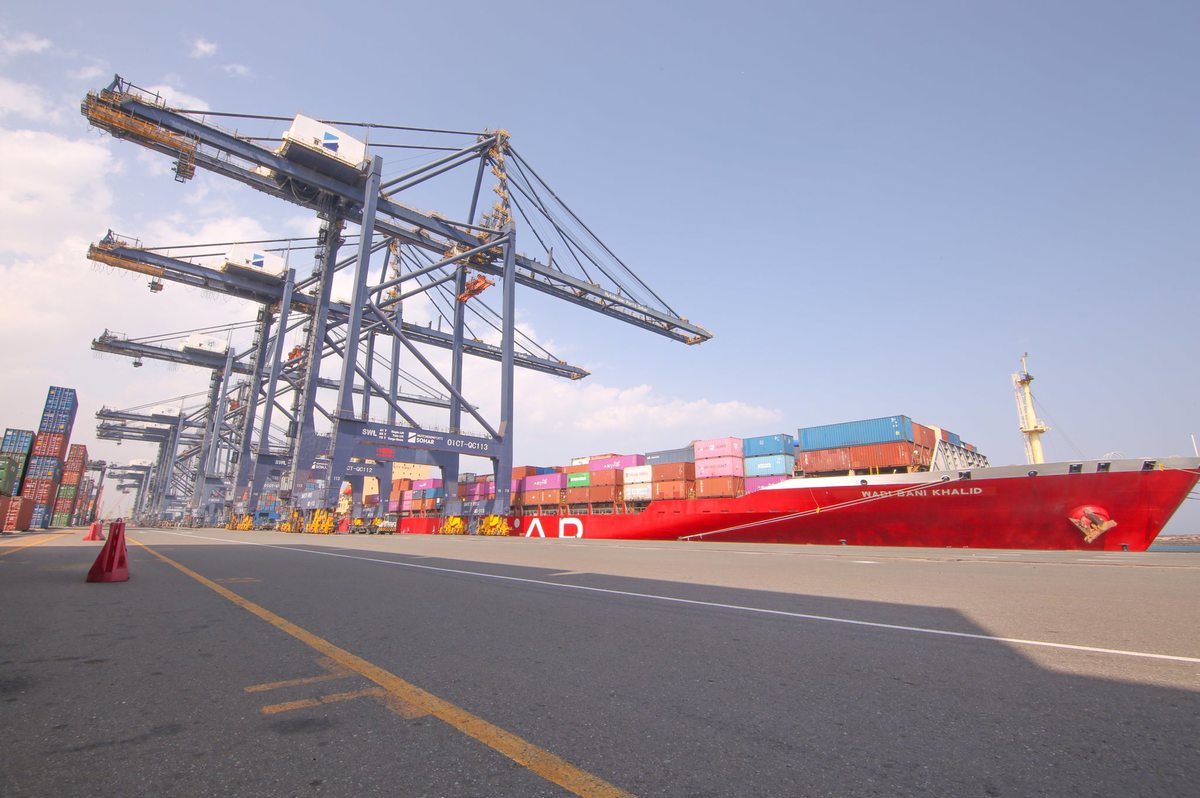 IMAGE: A container vessel in Oman's Sohar port. Asyad Group
Singapore and Malaysia
Bunker prices in Singapore have stayed firm, largely underpinned by ongoing tensions in the Middle East. These tensions have supported Brent crude prices and disrupted flows through the Strait of Hormuz, a key artery for global oil trade.
In the prompt market, VLSFO remains under pressure, with lead times extending to 10–12 days, from 8–11 days last week. HSFO availability is still constrained within a 9–13-day range, compared with 9–16 days previously.
LSMGO prices in Singapore continue to hold at elevated levels, driven by tight supply, steady demand and firm gasoil cargo values. Some suppliers are charging premiums to capitalise on market conditions. At the same time, disruptions and uncertainty in Fujairah have diverted LSMGO demand towards alternative hubs such as Singapore, a source said.
Concerns over the availability of future gasoil import cargoes into Singapore are adding further upward pressure. The port’s middle distillate stocks have averaged 7% lower so far in March.
LSMGO lead times have narrowed slightly to around 5–8 days, compared with 5–12 days last week.
Meanwhile, Singapore’s residual fuel oil stocks have averaged 4% higher so far this month than in February, according to Enterprise Singapore. Inventories are holding at about 24 million bbls, supported by a sharp 51% increase in net fuel oil imports in March. Total imports have risen by 1.33 million bbls, while exports have fallen by 325,000 bbls.
At Port Klang, VLSFO availability remains relatively stable, particularly for smaller prompt stems. However, LSMGO supply has tightened, and HSFO availability remains limited, making both grades increasingly difficult to secure.
East Asia
Bunker prices across most Chinese ports have held firm, tracking stronger crude values amid ongoing tensions in the Middle East—particularly around the Strait of Hormuz.
In Zhoushan, fuel availability across all grades remains stable, with most suppliers still advising lead times of 3–5 days, unchanged from last week, a trader said.
Supply conditions are mixed across northern China. Dalian and Qingdao have sufficient VLSFO and LSMGO availability, though HSFO remains limited in Qingdao. Tianjin is experiencing tight supply across all grades, while in Shanghai, VLSFO and HSFO stocks are constrained, with LSMGO availability comparatively steady.
Further south, tighter conditions persist. Fuzhou is facing limited availability of both VLSFO and LSMGO. Xiamen has adequate VLSFO supply but restricted LSMGO volumes. In Yangpu and Guangzhou, both grades remain under pressure.
In Hong Kong, bunker supply is largely stable, with lead times for all grades holding at around seven days in recent weeks.
In Taiwan, supply has not been significantly affected by Middle East tensions. However, discussions are ongoing that state-owned CPC Corporation may introduce fuel rationing in April to cushion potential impacts from the crisis. Prices, meanwhile, have reacted more strongly. Volatility in Brent crude linked to Middle East tensions has significantly influenced bunker markets, a Taiwan-based trader said.
Recommended lead times for VLSFO and MGO are about two days in Keelung and Hualien, while Taichung and Kaohsiung require slightly longer lead times of around three days.
In South Korea’s southern ports—including Busan, Ulsan, Masan, Onsan, Yeosu and Kwangyang—HSFO supply remains tight, with most offers only available on enquiry. Lead times for VLSFO and LSMGO are typically around 2–3 days, largely unchanged from the previous week.
At western ports such as Incheon, Daesan, Dangjin, Pyeongtaek and Taean, HSFO is likewise supplied on a firm enquiry basis. Lead times for VLSFO and LSMGO stand at around 2–4 days, almost in line with last week.
High bunker prices have dampened buying interest at South Korean ports, leading to weaker demand, a source said.
Adverse weather continues to pose operational challenges. Disruptions are expected to potentially impact Busan and Ulsan on 1 April and 3–5 April, Yeosu on 3–4 April, and Daesan on 4–5 April.
In Japan, the domestic bunker market is facing mounting pressure due to ongoing disruptions to Middle East cargo flows. Last week, the government formally began releasing state oil reserves—equivalent to about one month of domestic demand—following the mid-March release of private-sector reserves. However, these crude volumes will take time to be refined into bunker fuel and distributed, meaning tight supply conditions are likely to persist through the end of April, a Japan-based trader said.
Major Japanese refiners have informed suppliers that spot bunker volumes will be reduced by around 50% from April, as they prioritise term contracts. As a result, most suppliers have withdrawn spot offers for late March and April, focusing instead on existing commitments.
Although the broader market remains closed to spot enquiries, there are limited “windows of opportunity.” Suppliers operating import tank terminals in Nagoya are demonstrating greater flexibility than domestic refiners. Depending on cargo arrival schedules, spot enquiries in the Nagoya area remain feasible. There is a genuine “chance” here, while other regions are showing zero availability.
At times, major refiners may still issue direct offers. Their selection process is highly stringent and varies daily based on internal inventory levels, but the possibility is not entirely ruled out, the source added.
Consequently, availability across all fuel grades in major Japanese hubs—including Tokyo, Chiba, Yokohama, Kawasaki, Nagoya, Yokkaichi, Mizushima, Kashima, Tokuyama and Oita—is now assessed strictly on a case-by-case basis.
Oceania
Bunker prices across several Australian ports remain elevated, largely driven by the ongoing Middle East crisis, according to an Australia-based trader.
In response, the Australian government will cut fuel excise on petrol and diesel by half for three months from 1 April.
Supply pressures are evident, with ports such as Dampier, Darwin, Kwinana and Melbourne nearing depletion of LSMGO stocks, the trader added.
In Western Australia, VLSFO supply at Kwinana and Fremantle generally requires about a week’s notice, with deliveries handled via barge by a single provider.
In New South Wales, VLSFO deliveries at Port Kembla can be arranged through truck or pipeline. Suppliers in Sydney hold ample inventories of VLSFO and LSMGO, though HSFO remains tight, with lead times of around seven days.
In Queensland, ports including Brisbane and Gladstone are offering VLSFO and LSMGO with lead times of roughly seven days. HSFO in Brisbane is available on request. Deliveries of VLSFO and LSMGO are carried out by two barges operated by separate suppliers, while HSFO is strictly offered on an enquiry basis.
In Victoria, VLSFO stocks are healthy in both Melbourne and Geelong, but HSFO availability is limited for prompt supply. Bunkering in these ports depends on a single barge, with lead times close to seven days.
In New Zealand, bunker supply remains stable. VLSFO is readily available in Tauranga and Auckland, with some Tauranga berths connected via pipeline. At Marsden Point, both VLSFO and LSMGO can be supplied through pipelines to cargo vessels, although truck-based deliveries across South Island ports continue to face constraints.
South Asia
Bunker demand across Indian ports has picked up amid the Middle East crisis, as disruptions and uncertainty at key hubs such as Fujairah have redirected enquiries towards alternative locations, a source said.
Supply of VLSFO and LSMGO remains tight across both east and west coast ports of India - including Mundra, Kandla, Mumbai, Tuticorin, Chennai, Visakhapatnam, Cochin and Haldia. HSFO is available in Mumbai and Cochin, though only on a firm enquiry basis.
Adverse weather conditions are expected to disrupt operations at Visakhapatnam on 4 April, which could impact bunkering activity.
In Sri Lanka’s Port of Colombo, supply across all fuel grades remains good, with one supplier advising lead times extending into the first week of April.
Meanwhile, bunker availability remains tight across several ports in Pakistan, the source added.
Middle East
Despite ongoing regional volatility, bunkering operations in Port of Fujairah continue uninterrupted, even after repeated attacks in recent weeks, a source said.
“The Middle East remains volatile, with ongoing security concerns around Hormuz affecting vessel traffic and port operations,” a regional trader noted.
Authorities in Fujairah and Khor Fakkan Port have issued navigational warnings following reports of intermittent GPS spoofing and signal jamming offshore. Such disruptions can cause inaccurate positioning, erratic vessel movements and misleading navigation data, prompting guidance for mariners to treat the area as high risk, according to Inchcape Shipping.
Most terminals and anchorages remain operational without disruption. However, fuel availability in Fujairah is tight across all grades, with offers subject to firm enquiry, a trader said.
Elsewhere in the UAE, operations at Jebel Ali Port, Hamriyah Port and Sharjah Port are proceeding normally. Petroleum terminals in Abu Dhabi, including Ruwais Port, are also functioning without interruption.
Ras Al Khaimah Ports remain fully operational. However, earlier this month, RAK Ports Group introduced a marine risk surcharge for all vessels calling at its ports, harbours, anchorages and approaches, according to the shipping agency.
In a separate incident, the Kuwaiti oil tanker Al Salmi was struck by a drone near Port of Dubai Anchorage earlier today, triggering a fire and raising initial concerns of a major oil spill. While Kuwait Petroleum warned of a potential leak due to hull damage, Dubai authorities later confirmed the fire was contained, with no injuries or oil spill reported, according to media reports.
In Kuwait, both Shuaiba Port and Shuwaikh Port continue to operate normally.
In Saudi Arabia, no formal alerts have been issued, although bunker availability remains tight in Jeddah Port, particularly for VLSFO and LSMGO.
In Qatar, port operations and vessel movements remain steady at Hamad Port, Doha Port and Al Ruwais Port, with activity also continuing at Mesaieed Port and Ras Laffan Port. However, VLSFO and LSMGO supply is tight in Ras Laffan, while Al Ruwais Port is limited to small vessels, including dhows and barges.
At Oman’s Port of Salalah, bunker operations have resumed after a temporary suspension following a drone attack on Saturday. A security source said the port was targeted by two drones, injuring an expatriate worker and causing minor damage to a crane, according to the state-run Oman News Agency.
“The port is currently operational again following a temporary suspension and is running subject to security conditions,” an Oman-based source said.
Bunkering, including LSMGO, remains good in Omani ports such as Muscat, Duqm and Sohar, with prompt lead times, the source added.
In Bahrain, vessel movements are gradually resuming, although operations remain limited under current conditions. The Suez Canal and all Egyptian ports continue to function normally, while conditions remain stable in Jordan. Ports in Iraq, Cyprus and Lebanon are also operating as usual.
Meanwhile, Israeli ports—including Eilat, Ashkelon, Ashdod, Hadera and Haifa—are operating at full capacity, the shipping agency added.
By Tuhin Roy
Please get in touch with comments or additional info to news@engine.online