East of Suez Market Update 26 Feb
Prices in East of Suez ports have moved within a narrow range, and availability is tight across all grades in Fujairah.
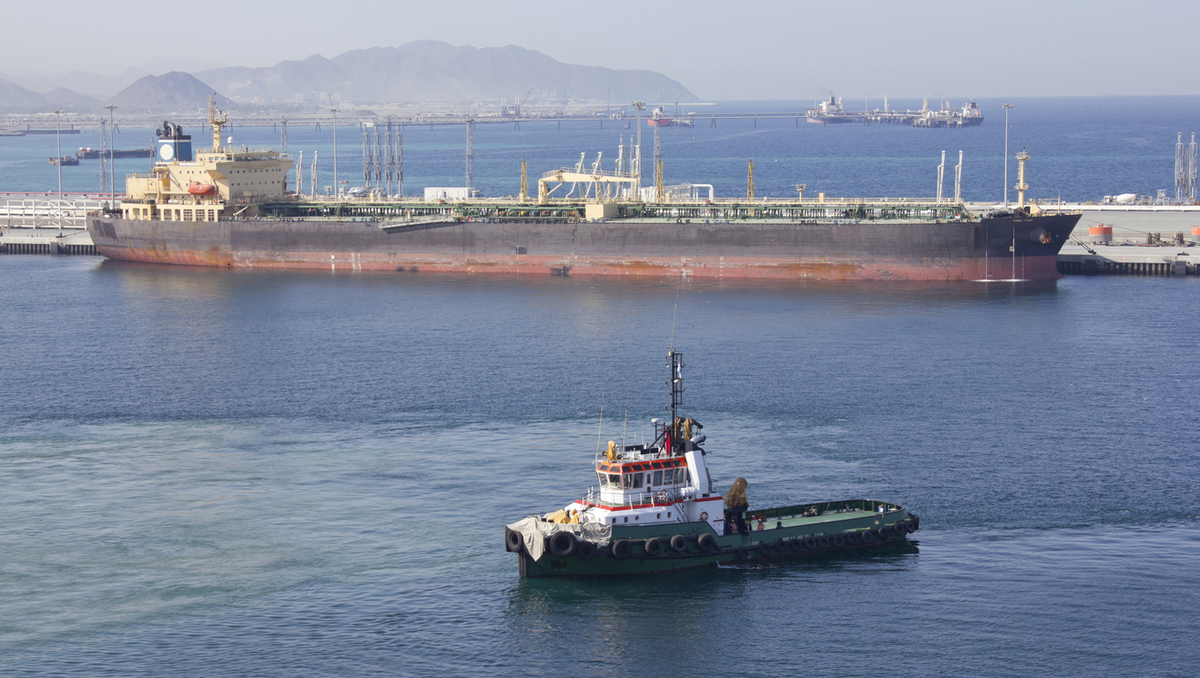 IMAGE: Harbour craft in front of an oil tanker in Fujairah. Port of Fujairah
Changes on the day to 17.00 SGT (09.00 GMT) today:
- VLSFO prices up in Singapore ($5/mt), unchanged in Fujairah, and down in Zhoushan ($1/mt)
- LSMGO prices up in Singapore ($2/mt), Fujairah ($1/mt), and down in Zhoushan ($2/mt)
- HSFO prices up in Fujairah ($2/mt), Singapore ($1/mt), and unchanged in Zhoushan
- B30-VLSFO prices up in Fujairah ($1/mt) and unchanged in Singapore
VLSFO prices across the three major Asian bunker ports have traded within a narrow range over the past day. Fujairah's VLSFO is priced at discounts of $5/mt to Zhoushan and $4/mt to Singapore.
Bunker supply in Fujairah remains extremely tight across all grades. Most suppliers are now offering earliest delivery dates into March, without confirming firm schedules. Lead times for all grades are at least 10–12 days. While a few suppliers can still provide prompt stems, these are typically subject to high premiums.
The supply strain is driven by strong demand, compounded by escalating geopolitical tensions in the region, particularly between Iran and the US. Several suppliers are postponing loading plans until there is greater clarity on the situation, according to a source.
In Basrah, VLSFO and LSMGO remain readily available, whereas HSFO continues to face supply constraints.
Brent
The front-month ICE Brent contract has declined by $0.23/bbl on the day, to trade at $70.83/bbl at 17.00 SGT (09.00 GMT) today.
Upward pressure:
Brent’s price has felt some upward push over supply disruption concerns as US envoys, Steve Witkoff and Jared Kushner, meet representatives from Iran for a third round of indirect talks later today in Geneva.
“It’s a big day for oil markets with all eyes on US-Iran nuclear talks,” two analysts from ING Bank said.
Both countries are expected to discuss Iran’s nuclear capabilities – something Washington has repeatedly opposed.
“The principle is very simple: Iran cannot have a nuclear weapon,” Reuters cited US Vice President JD Vance as saying.
Iran is the fourth-largest OPEC member, producing around 3.2 million b/d of crude oil – which faces disruption threats if a deal is not finalised, market analysts said.
“Longer-term action from the US, with more aggressive retaliation from Iran, would increase supply risks for the oil market. This would make any further price increases more sustainable,” ING Bank’s analysts added.
Downward pressure:
Brent’s price has come under downward pressure after the US Energy Information Administration (EIA) reported a massive increase in US crude stocks.
Commercial US crude oil inventories have increased by 16 million bbls to 436 million bbls for the week ending 20 February, according to data from the EIA.
“The increase was dominated by inventory builds on the [US] Gulf Coast,” ING Bank’s analysts said.
A rise in US crude stocks can indicate lower demand for oil and put some downward pressure Brent's price.
The EIA data comes one day after the American Petroleum Institute (API) reported a staggering 11.4 million-bbl rise in US crude stocks.
By Tuhin Roy and Aparupa Mazumder
Please get in touch with comments or additional info to news@engine.online