Europe & Africa Market Update 3 Sep
Bunker benchmarks in European and African ports have mostly gained, and VLSFO and LSMGO prompt availability is tight off Malta.
Changes on the day to 09.00 GMT today:
- VLSFO prices up in Durban ($4/mt) and Gibraltar ($3/mt), and unchanged in Rotterdam
- LSMGO prices up in Rotterdam ($62/mt) and Gibraltar ($42/mt), and down in Durban ($5/mt)
- HSFO prices up in Gibraltar ($30/mt), Durban ($7/mt) and Rotterdam ($1/mt)
- B30-VLSFO prices down in Rotterdam ($1/mt)
Bunker benchmark prices have mostly gained over the past day, tracking the rise in Brent.
Conversely, the VLSFO bunker price off Malta has dropped $23/mt over the past day.
The price of LSMGO at the offshore bunkering hub has gained $76/mt over the past day, which is much sharper than Gibraltar’s LSMGO price increase. A 150-500 mt stem, fixed off Malta at a high price of $1,533/mt, may have offered support.
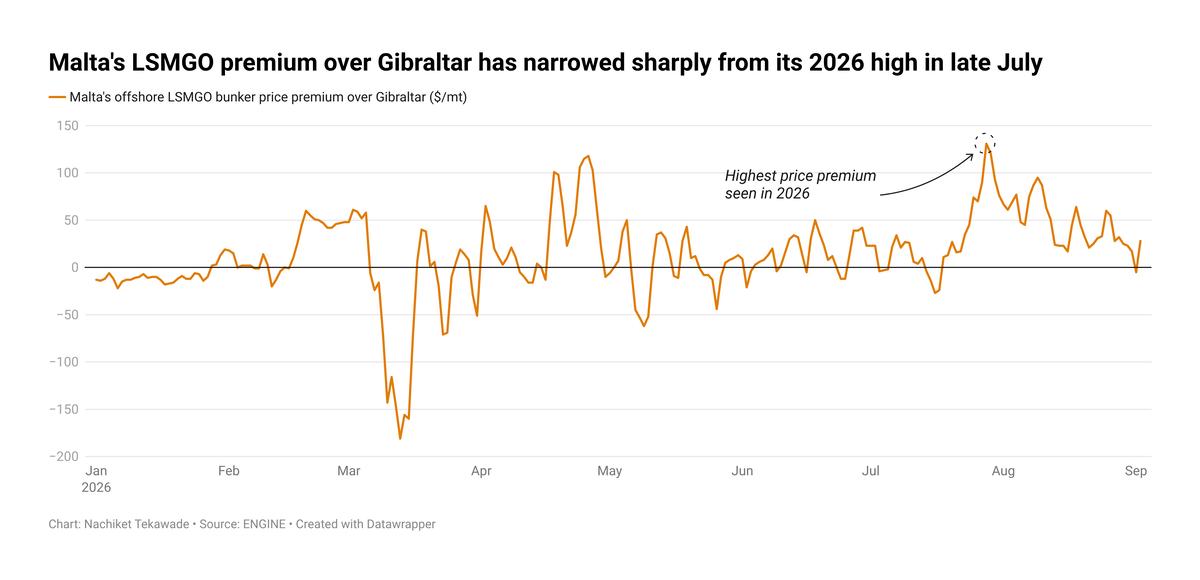
Consequently, Malta’s LSMGO price premium over Gibraltar has widened sharply by $36/mt.
ENGINE's price analysis shows that the premium has narrowed from a 2026 high of $131/mt on 28 July to the current levels.
The narrowing came as Gibraltar's LSMGO price gained $238/mt between 28 July and 2 September, while Malta's offshore LSMGO price rose only $135/mt.
Fuel availability is tight for prompt supplies off Malta, a trader said. VLSFO and LSMGO deliveries off Malta require between 5-7 days of notice, but some suppliers can deliver promptly in 3-4 days, a trader told ENGINE. ULSFO supplies off Malta require at least six days of lead time, the trader added.
Brent
The front-month ICE Brent contract has gained by $1.15/bbl on the day, to trade at $95.92/bbl at 09.00 GMT.
Upward pressure:
Brent crude’s price has moved past the $95/bbl mark after renewed hostilities forced commercial vessels to continue avoiding the Strait of Hormuz.
Saudi Arabia’s Ministry of Foreign Affairs has accused Tehran of attacking the oil tanker Sidr, killing two sailors. The vessel is owned by Saudi Arabia’s national shipping company Bahri.
“Developments in recent days brought risks to regional oil supplies back into focus,” two analysts from ING Bank noted.
As of yesterday, nine vessels attempted to transit the strait, according to market intelligence provider Windward. Six vessels were operating with disabled AIS tracking transmitters.
“We’ve seen oil flow through the Strait of Hormuz despite the stalemate between the US and Iran, but rising tensions clearly put crossings at risk,” ING Bank’s analysts said.
Downward pressure:
While there are no major downward pressures on Brent’s price today, the market found some relief following positive remarks by US secretary of energy Chris Wright earlier this week.
Wright claimed that 17 million bbls of crude oil transited the Strait of Hormuz on Monday, marking the biggest uptick in flows via the narrow waterway in recent months, Reuters reported.
By Nachiket Tekawade and Aparupa Mazumder
Please get in touch with comments or additional info to news@engine.online