Hormuz closure adds energy security driver to shipping fuel transition - Rystad
The Strait of Hormuz closure has made energy security a stronger factor in alternative marine fuel investment, a report by Rystad Energy said.
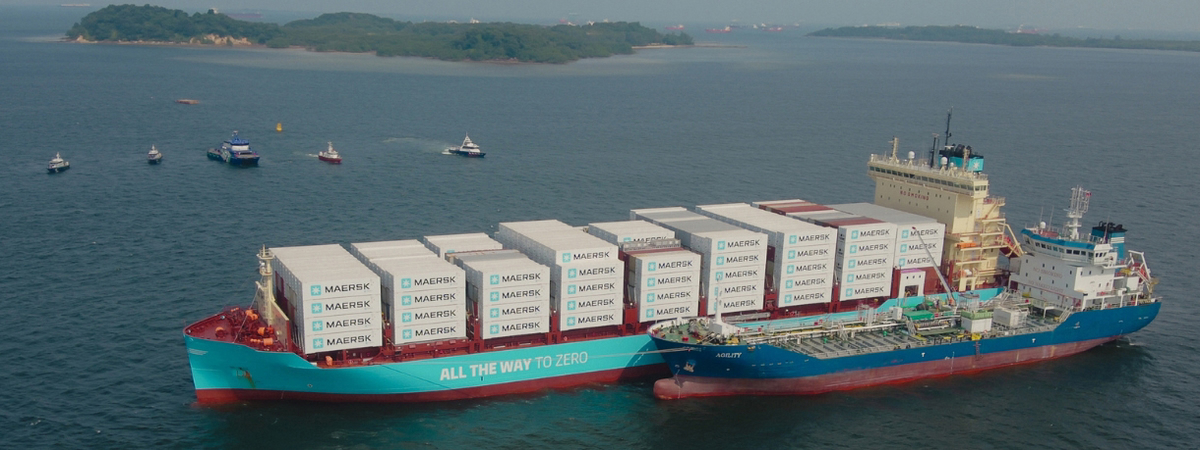 IMAGE: Methanol bunkering of one of Maersk's methanol-capable vessels in Singapore. Maritime Port & Authority of Singapore
The disruption has not created new fuel pathways, but strengthened the case for domestically produced clean fuels, Rystad said. The effect is clearest for fuels that can reduce dependence on geopolitically exposed fossil fuel supply chains, though each alternative marine fuel still faces limits to scale.
Bio-methanol
Bio-methanol economics changed with the price shock. At the height of the Hormuz-driven price spikes in mid-March, Singapore LSMGO price briefly exceeded bio-methanol on an energy-equivalent basis, Rystad said.
Bio-methanol currently trades at around $900-1,000/mt, Rystad said. That is $1,800-2,000/mt on an energy-equivalent basis, according to ENGINE calculations with FuelEU Maritime factors.
Its lower energy density means it is usually more expensive than conventional marine fuel on an energy-equivalent basis under normal market conditions.
Rystad said bio-methanol is currently priced high because it lacks supply and demand. There are not many offtake agreements and supply chains and production volumes are lacking at scale. Government focus on energy security could help demand, it said.
The consultancy said bio-methanol mostly goes to the maritime sector, while biodiesel and liquefied biomethane (LBM) also go to other sectors. Shipping companies buying bio-methanol therefore face less feedstock competition from other sectors than buyers of biodiesel and LBM.
Rystad highlights China’s role in bio-methanol, saying the country has the industrial infrastructure and policy incentive to scale methanol production as part of its domestic energy-security strategy. China has most of the world’s near-term bio-methanol production capacity, it said.
Shanghai hosted China’s first green methanol bunker operation in April 2024. Since then there have been 27 methanol bunker operations totalling 90,300 mt in the port, including seven green methanol operations totalling 17,200 mt, Rystad said.
But bio-methanol remains constrained by supply, cost and vessel readiness. Rystad expects bio-methanol production capacity to reach only around 5 million mt/year by 2030, and the fuel requires specific vessel engines.
Biofuels
Biodiesel and hydrotreated vegetable oil (HVO) remain the most immediately deployable alternative marine fuels because they can be used in existing engines with limited or no modifications. They are already being burnt in pure and blended forms across European shipping corridors.
But biodiesel faces intensifying feedstock competition from aviation. Sustainable aviation fuel (SAF) mandates under the EU’s ReFuelEU Aviation regulation and national mandates are increasing demand for the same feedstocks used in marine biodiesel, including used cooking oil (UCO) and animal fats.
Aviation buyers also show a higher willingness to pay because they have fewer decarbonisation options than shipping, Rystad said.
Second-generation feedstocks such as UCO, animal fats and other waste streams can count towards European RED III targets and make up only around 30% of total biodiesel capacity, according to the report.
Rystad expects global biodiesel nameplate production capacity to reach around 120 million mt/year of VLSFO-equivalent by 2030, compared to a total marine fuel consumption of more than 300 million mt/year.
Liquefied biomethane (LBM)
LBM offers one of the most economically attractive compliance pathways for LNG dual-fuel vessels under FuelEU Maritime’s pooling mechanism, Rystad said. LBM produced from pathways such as manure can have net negative emissions and generate surplus compliance units which can be sold to under-compliant vessels in pools. This helps offset part of LBM’s price premium over fossil LNG.
But LBM uptake is limited by fleet readiness and access to supply. Rystad said LBM is mainly relevant to around 1,100 LNG dual-fuel vessels, excluding LNG carriers.
Many of those ships can already meet FuelEU Maritime’s GHG intensity limits using conventional LNG until 2034, and in some cases 2039. Pooling remains the main driver for LBM adoption.
The Hormuz crisis could accelerate investment in biogas and biomethane production to reduce exposure to fossil gas imports, Rystad said.
But LBM faces competition from other sectors, with around 60% of European biomethane demand absorbed by electricity and heat generation, households and industry. Even in the transport segment, most of the demand comes from the heavy road transport sector.
E-methanol
E-methanol remains a longer-term option, Rystad said. It can be used in methanol-capable vessels and share methanol's bunker infrastructure. But production costs remain high because of green hydrogen and CO2 sourcing costs.
Rystad said the energy security case for e-methanol is stronger as a producer-country story than as a near-term alternative fuel story, Rystad says. Countries with abundant renewable electricity potential, including China and India, have strategic incentives to develop e-fuel production as a form of domestic energy security and to produce surpluses for future energy exports, it said.
E-ammonia
E-ammonia is behind other alternative marine fuels because ammonia bunker infrastructure is mostly absent in ports around the world, Rystad said. The fuel also requires significant capital investment and safety engineering because it is toxic and corrosive.
E-ammonia production capacity is expected to emerge across countries including China, India, the US, Brazil, Australia, Oman, Saudi Arabia, Egypt, Chile and Morocco, the report said. But for shipping, the main constraints remain port-side bunker infrastructure, fleet readiness and cost.
Energy security concerns could accelerate investments in clean fuels, but a global regulatory driver remains unresolved. Rystad said the IMO’s Net-Zero Framework survived MEPC 84 but still faces an uncertain adoption vote this December. This makes it riskier to invest.
By Nachiket Tekawade
Please get in touch with comments or additional info to news@engine.online