Japanese consortium advances development of hydrogen-capable engines for ships
A consortium of Japanese firms has successfully completed hydrogen co-firing trials across all cylinders of a two-stroke hydrogen marine engine.
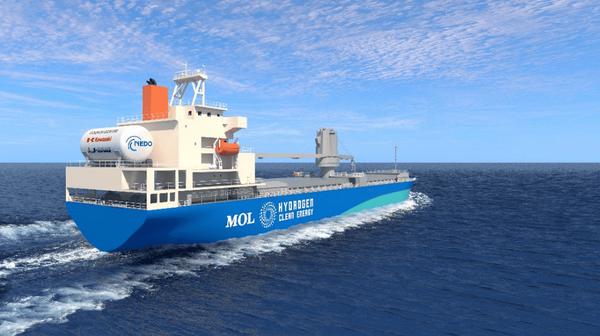 IMAGE: Illustration of 17,500-dwt hydrogen-capable vessel. Japan Engine
The engine achieved a co-firing ratio exceeding 95% at full load, demonstrating both stable performance and significant greenhouse gas reduction. Co-firing refers to the simultaneous use of two fuels within the same system.
The consortium comprises Japan Engine Corporation, Kawasaki Heavy Industries, Mitsui O.S.K. Lines (MOL), MOL Drybulk, Onomichi Dockyard and Nippon Kaiji Kyokai (ClassNK).
Unlike many hydrogen initiatives focused on short-range applications—such as tugboats or sightseeing vessels using compressed hydrogen in coastal areas—this project targets low-speed, two-stroke engines powered by liquefied hydrogen. This will enable longer voyages and supports deployment in larger, oceangoing merchant vessels, according to the joint statement.
Following full-scale validation, the engine is set for delivery in January 2027. It will be installed as the main engine of a 17,500-dwt hydrogen-capable multi-purpose vessel built by Onomichi Dockyard.
The vessel is scheduled to begin a three-year demonstration phase from 2028, operated by MOL and MOL Drybulk, with safety oversight conducted by ClassNK.
By Tuhin Roy
Please get in touch with comments or additional info to news@engine.online