Low emissions marine fuel demand hinges on IMO ruling – DNV
Stronger global regulatory changes will accelerate the uptake of low greenhouse gas (GHG) emissions marine fuels, classification society DNV said in the 10th edition of its report ‘Maritime Forecast to 2050’.
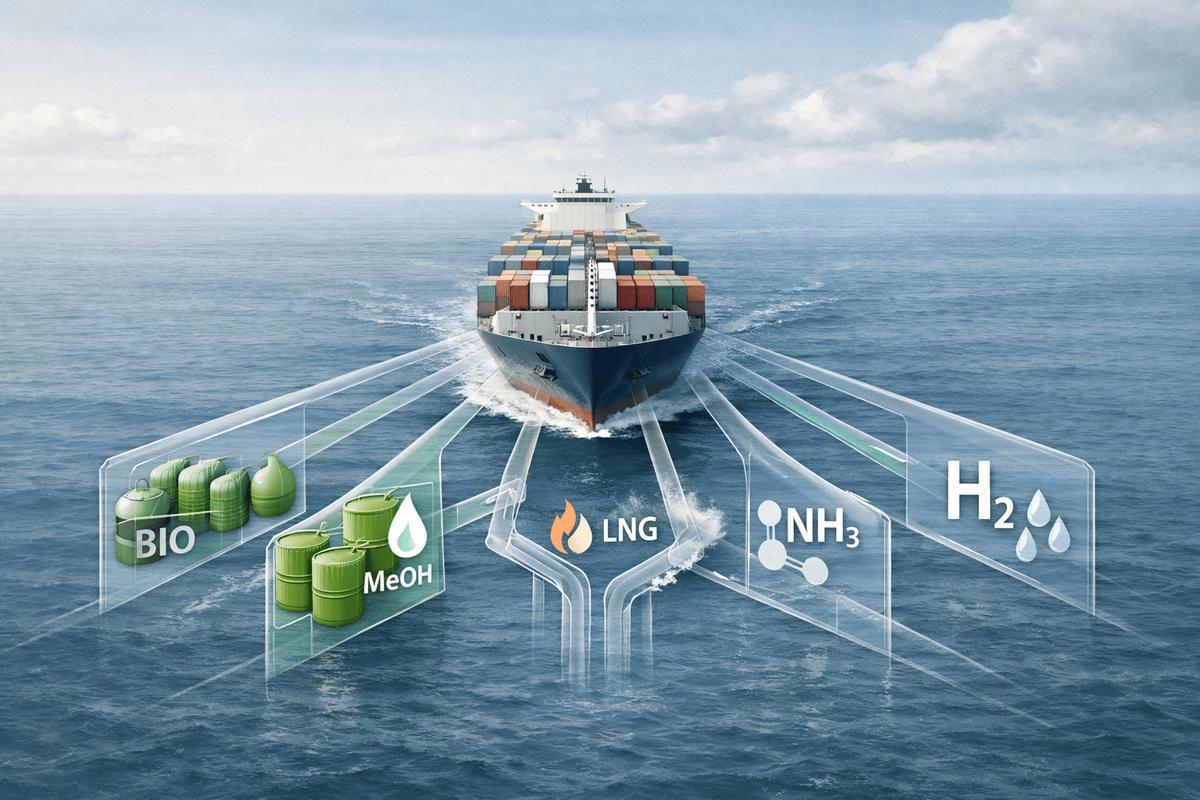 IMAGE: ENGINE via ChatGPT
Global maritime industry’s demand for low-GHG fuels is expected to range from 4-22 million mt of oil equivalent (Mtoe) by 2030 and 33-185 Mtoe by 2050, depending on the regulatory path the International Maritime Organization (IMO) ultimately takes.
The report models four regulatory scenarios, from adoption of the IMO's Net-Zero Framework (NZF) in its current form to its outright rejection, which DNV said could trigger a prolonged regulatory gridlock.
The wide range reflects the industry's fuel-switching pace – directly linked to regulatory outcomes, the future uptake of shore power, plug-in hybridisation, nuclear power, and onboard carbon capture systems, DNV said.
Current project pipelines will supply up to 270 Mtoe of low-GHG fuel by 2030, actual volumes are likely to come in lower because of project delays and other uncertainties, and shipping will be competing with other sectors for the same fuel, the classification society added.
By testing fuel and technology choices against multiple regulatory scenarios, shipowners can find strategies that hold up as regulation, fuel availability, prices, and technologies evolve, lead author of the report Øyvind Sekkesæter said.
Efficiency as a shield against regulatory whims
DNV also said shipowners can use energy efficiency as a lever, regardless of how the regulatory picture settles.
A case study of a hydrodynamic retrofit on a 5,000 TEU vessel projected potential annual fuel savings of 16%, with a payback period of around one to four years depending on future fuel prices. DNV said such retrofits can typically be completed during a standard class-renewal dry-docking.
“Ships ordered today will operate well beyond 2050, but many of the factors shaping their future performance remain uncertain,” DNV's maritime chief executive Cristina Saenz de Santa Maria said.
With strong global regulatory changes and advanced energy efficient technology in place, the world fleet could consume up to 25% less energy by 2050 than under a scenario where regulation is driven mainly by regions, according to DNV.
The cost of cutting emissions varies widely by fuel pathway, DNV said, with abatement costs ranging from about $180/mt to $1,290/mt of CO2 avoided.
“Regulatory requirements are advancing faster than the fuel, infrastructure, and technological systems needed to support them, making long-term investment decisions increasingly complex,” DNV's maritime chief executive added.
By Aparupa Mazumder
Please get in touch with comments or additional info to news@engine.online