LR explores LPG marine fuel as a low-carbon fuel option
A new report from London-based classification society Lloyd’s Register (LR) suggests that liquefied petroleum gas (LPG) holds significant potential to support the maritime industry’s transition to net-zero.
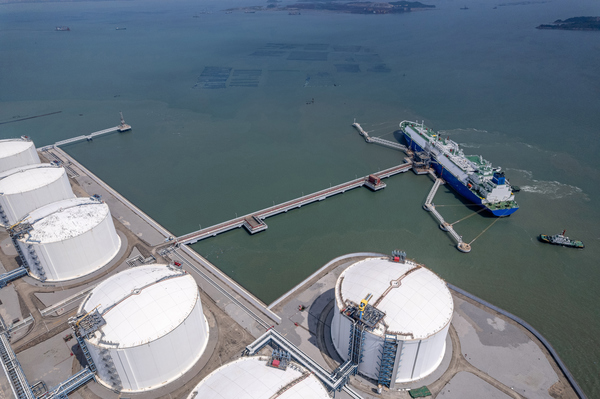
 IMAGE: Docked LPG cargo ship. Getty Images
LR’s report – Fuel for Thought: LPG – asserts that the fuel can substantially lower the shipping industry’s carbon footprint, particularly when paired with onboard carbon capture systems (CCS).
LPG offers marked improvements over traditional heavy fuel oils, emitting about 20% less nitrogen oxides (NOx), 97% less sulphur oxides (SOx), and 90% less particulate matter (PM), while reducing carbon emissions by roughly 20%, the report claims.
It further indicates that LPG can lower well-to-wake greenhouse gas (GHG) emissions by 17% compared to marine gas oil (MGO).
The adoption of LPG-fueled propulsion is already gaining momentum, particularly in the gas carrier sector. LR notes that more than 275 vessels are currently operating on LPG or are on order, confirming that LPG dual-fuel propulsion is “now firmly established within the segment.”
“LPG has become one of the most widely accepted alternative marine fuels globally in the gas carriers segment,” the report states.
Beyond technical gains, LPG benefits from a robust global supply chain. The industry currently utilises more than 1,000 storage facilities and terminals, supported by a global fleet of over 1,600 LPG carriers, providing a distinct infrastructure advantage over many other emerging alternative fuels, according to the classification society.
Looking forward, combining LPG with onboard CCS is expected to cut emissions.
“LPG could offer further benefits in conjunction with onboard carbon capture and once the emerging production of renewable, potentially zero- or near-zero emissions variants is scaled up,” LR highlights.
By Aparupa Mazumder
Please get in touch with comments or additional info to news@engine.online