The Week in Alt Fuels: First dibs on clean LBM
EU regulations are steering ships towards liquefied biomethane (LBM). But low-emission fuel volumes could get snapped up early.
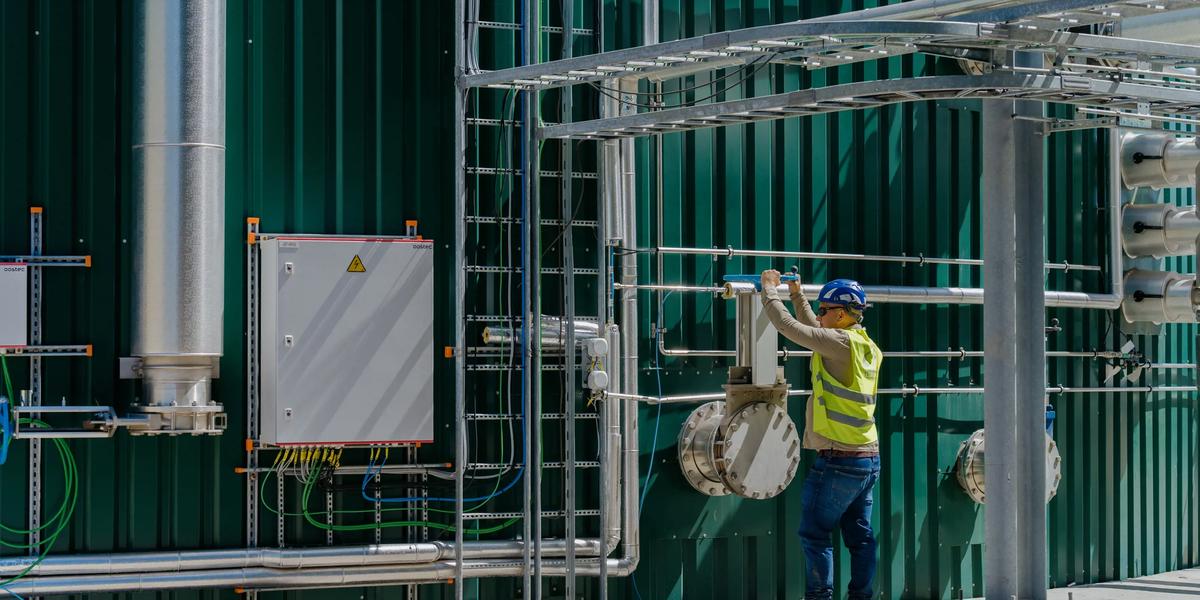 IMAGE: CIP's biogas plant in Tønder, Denmark. Copenhagen Infrastructure Partners
A dual-fuel ship sailing between EU ports and burning LBM with a well-to-tank greenhouse gas (GHG) intensity of -55 gCO2e/MJ will get a default well-to-wake GHG intensity of 1.54-14.43 gCO2e/MJ, depending on engine type.
Both of these are many times lower than the 89.34 gCO2e/MJ target in FuelEU Maritime, and ships sailing on this fuel can sell their compliance surpluses in a pool for $938–1,099/mt with ENGINE's assessed compliance surplus price of €216/mtCO2e.
LBM is treated as zero-carbon in the EU Emissions Trading System (EU ETS), and the effective cost of bunkering HBE-rebated LBM in Rotterdam comes down to $116–277/mt on a VLSFO-equivalent basis.
Calculations like that have already started attracting more buyers, and producers are taking note. Several biomethane developers in Europe are building new capacity with bunkering allocation included in their plans.
Norway’s Havila Biogass plans three LBM plants by 2028.
St1 Biokraft is developing plants in Sweden and Finland. The company expects its total biomethane sales, including to ships, to rise from 1.6 TWh/year (104,000 mt/year) today to 6 TWh/year (390,000 mt/year) by 2030, its head of business development, Johan Zakrisson told ENGINE.
“Combining our business in one portfolio enable us to reach our shipping costumers at different locations,” Zakrisson said.
Copenhagen Infrastructure Partners (CIP) acquired biogas assets in the UK and Finland. It also has two operational facilities, and an expansion project planned in Denmark and two more plants in Spain and Belgium that could come online by 2028, partner Thomas Dalsgaard told ENGINE. He confirmed that output from these plants could be supplied for bunkering.
One of the biggest advantages for European biomethane producers is that they can move volumes for bunkering without physically delivering the fuel to ports. Mass balancing systems allow European producers to inject biomethane anywhere in the bloc’s gas grid, which suppliers can then withdraw as certified green gas.
This has lowered the barrier for biomethane entering the bunker market and helps to grow the market for lower-emission LBM molecules.
Last year, Titan’s Caspar Gooren told ENGINE that mass balancing was the “cheapest and least carbon-intensive” way to meet bunkering demand because the EU treats liquefaction facilities and the gas grid as a single logistical unit.
CIP echoes this view. “Basically we can inject biomethane into the grids anywhere in the EU and then the buyer can take it out at the bunkering facility or port. And then we can just transfer the green certificates. So it's quite easy and practical for the shipping companies to use our fuel, we don't need to move the physical molecules,” Dalsgaard said.
This convenience combines with FuelEU Maritime market incentives to allow producers to plan ahead without guessing. But some are concerned that demand could outpace supply in the medium term.
For instance, DNV expects a flurry of dual-fuel newbuilds in the coming years, with at least 624 additional vessels added to the existing fleet of 833 vessels by 2033.
And many of these vessels are expected to seek compliance gains by blending or switching into LBM, a European LBM supplier told ENGINE.
St1 Biokraft’s Zakrisson believes “there is a lot of untapped biomethane potential in Europe” and that production and liquefaction infrastructure can grow as demand increases. But Dalsgaard warns that “mid-term scarcity issues” could emerge if vessels are delivered faster than biomethane plants are built.
“We have not at all exhausted the resource base. The resource base is basically all the organic waste in Europe that we apply for these kinds of plants, and we are still very far from exhausting it. In other words, there is a big scaling opportunity in biogas and biomethane in the next years. The question is whether we can make enough projects per year to satisfy the increasing demand. So over time I’m sure we will be able to supply what is needed, but there could be mid-term scarcity issues.”
The European bunker supplier added that the tightness may not be for LBM altogether, but for low-emission intensity grades.
“We could get plenty of liquefied biomethane with a carbon intensity of zero or near-zero, but most shipowners want LBM with a CO2 intensity of -60 to -70 gCO2e/MJ. And that’s hard to get. With FuelEU and the expected rise in demand from LNG-capable vessels, biomethane supply could only become tighter in the short term,” the supplier said.
He stressed that policy has made LBM an attractive compliance fuel, but access to the lowest-intensity grades may not be equal. With more owners targeting those grades, the most reliable route may be to secure supply early through long-term agreements of up to 10 years, he said. Dalsgaard added that several shipowners are already exploring 5-7-year deals to secure volumes before CIP's facilities start producing from 2027–2028.
For LBM in the EU, access to cleaner molecules may now be a bigger hurdle than price. Regulations can make the fuel cheap to bunker, but the cleanest volumes may go first to shipowners who lock them in before demand peaks.
In other news this week, classification society DNV has granted approval in principle for a 21,700 TEU ammonia dual-fuel ultra-large container ship design developed by a consortium of maritime firms. The concept features ammonia-capable main engines and oversized ammonia tanks.
Singapore’s Muar LNG has announced that it is developing an integrated LNG storage and reloading facility within Malaysia’s Maharani Freeport Industrial Park. The terminal will support LNG bunkering and transhipment activities and will include full Boil-Off Gas (BOG) management and shore power, the company said.
“November saw ten new orders for alternative-fuelled vessels, all opting for LNG propulsion,” Kristian Hammer, senior consultant at DNV said. Interest in other alternative fuels, including ammonia and methanol, remained muted in November.
Estonian shipping company Tallink will operate one of its vessels, MyStar, on liquefied biomethane (LBM) to generate overcompliance for Gasum’s FuelEU Maritime pooling arrangement. Gasum will supply LBM from its Pori terminal to the Finnish LNG supplier Elenger, which will then bunker the vessel.
By Konica Bhatt
Please get in touch with comments or additional info to news@engine.online