Battery-only propulsion suits no more than 9% of any ship type - MMMCZCS
Hybrids that keep an engine for part of their energy could reach 36% of bulk carriers if batteries store more energy for their weight, a study by the Maersk Mc-Kinney Moller Center for Zero Carbon Shipping (MMMCZCS) found.
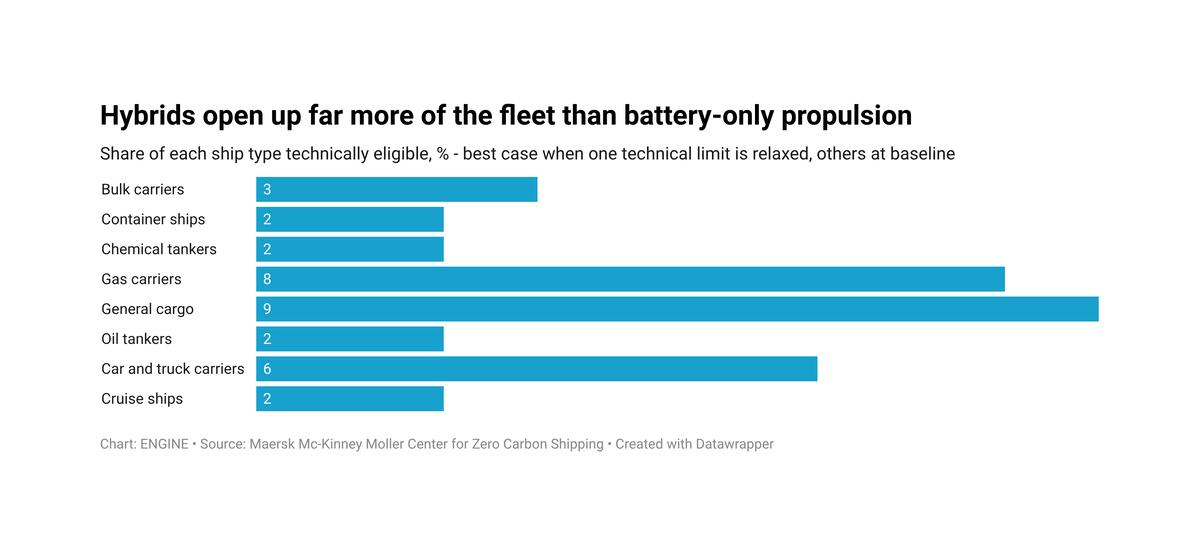
Battery-only propulsion is technically feasible for only a small share of the world's fleet. No ship type exceeds 9%, even when one of four technical limits is relaxed to its most favourable tested value.
The four limits are how much battery weight a ship may carry, how much battery can replace engines and fuel tanks without adding weight, how much energy a battery stores for its weight, and how fast a ship can recharge in port. The centre changed each one in turn while holding the other three at baseline. For most ship types the tested range allowed battery weight of up to 10% of a ship's deadweight and charging power of up to 25 MW.
Who fits
General cargo ships rank highest at 9%, if 200 MWh of batteries can replace engines and fuel tanks without adding weight. Gas carriers follow at 8% under the same condition, and car and truck carriers at 6% if batteries store more energy for their weight. Container ships, chemical tankers and oil tankers stay at or below 2%.
Voyage energy demand matters more than ship size. The best candidates are small ships on short regional trips needing less than about 300 MWh. The study's baseline lets a small ship carry 80-150 MWh, short of the 200-400 MWh the smallest chemical tankers need.
Current projects sit well below that mark. Buquebus's 41 MWh ferry on the River Plate, which can sail up to 1.5 hours on battery power, is the largest marine battery installation in operation, according to battery maker Corvus Energy. A 14 MWh fast ferry from Baleària is due to start sailing between Tarifa and Tangier in summer 2027, and a fully electric barge will run a 100-plus-mile round trip in Vietnam.
Hybrids go further
Hybrids reach much further because the battery is sized to a ship's average rather than peak energy demand. The battery supplies around 80% of energy at sea, and a combustion-based generator running on a low-emissions fuel supplies the rest.
If battery energy density, the energy stored per mt, rises from 0.08 MWh/mt to 0.5 MWh/mt, hybrid eligibility reaches 36% of bulk carriers, 32% of container ships, 27% of chemical tankers and 26% of gas carriers. That is the top of the tested range.
Hybrids already dominate the battery fleet. They make up 68% of more than 2,000 battery-fitted commercial ships on the Maritime Battery Forum's register, against 18% fully electric.
Charging and the grid
Faster charging adds little. Full-battery eligibility stays at about 1% or less of any ship type at the highest charging power tested, because a ship that cannot carry the battery stays ineligible however fast it charges.
Ports must still supply the power. Valencia's planned substation would share 40-90 MW with an existing one. At the lower figure, ENGINE calculated, charging a 151 MWh battery from empty would take nearly four hours, before losses.
Norway tests the niche
State-owned fund Enova awarded Norwegian Krone 236 million ($25 million) to shipowner Hagland Shipping to convert four bulk carriers to run on battery power alone. Each will carry 40 MWh of replaceable batteries, and a battery-swap site in Mandal is planned to start operating towards the end of 2028.
By Tuhin Roy
Please get in touch with comments or additional info to news@engine.online