Biofuel Bunker Snapshot: B30 prices gain in Rotterdam and Singapore
ZRE A ticket price drops
Singapore VLSFO price gain supports B30-VLSFO
Biofuel bunker buyers in feedstock competition with aviation
Rotterdam and Europe
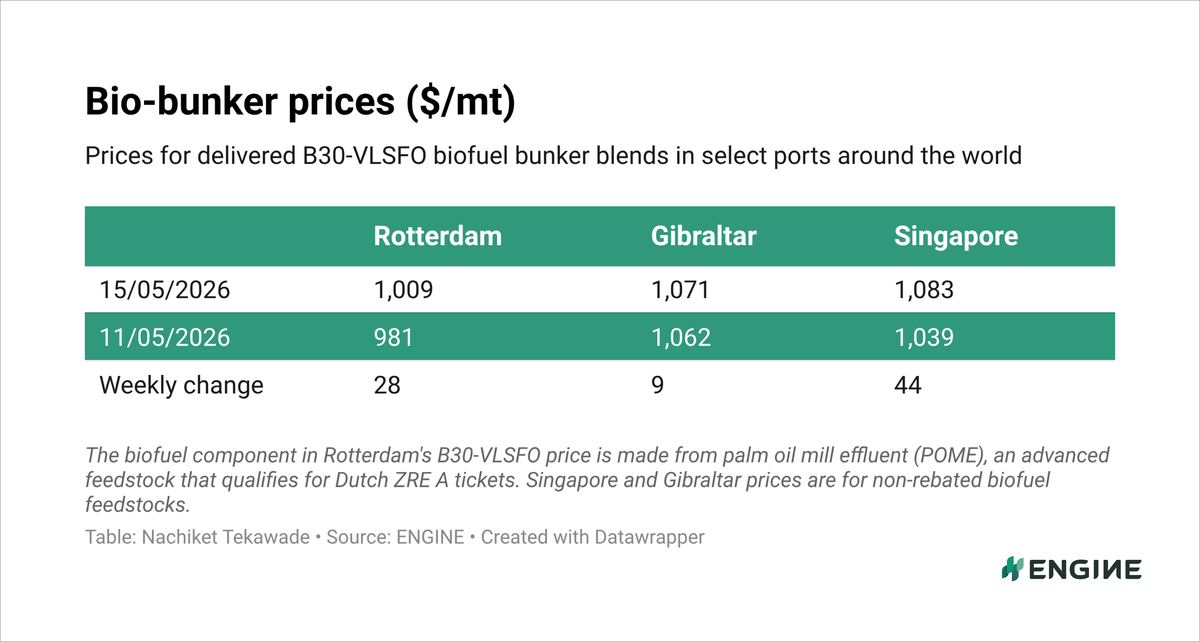
Rotterdam’s B30-VLSFO (POMEME) price has increased by $28/mt since Monday.
Conversely, the port's conventional VLSFO price has remained steady during the week. Prima Markets' assessed POMEME barge price has registered a small gain of around $4/mt over the same period.
Bunker suppliers delivering low-carbon advanced biofuel blends in Dutch ports can generate ZRE A tickets, which can, for example, be sold to conventional fuel suppliers. This helps subsidise the price in Dutch ports compared to other ports.
The price of these ZRE A tickets fell from €125/mtCO2e ($145/mtCO2e) to €115/mtCO2e ($134/mtCO2e) during the week, according to Prima Markets. Prima said prices have been falling lately and that the ZRE market is still small, with only a limited number of participants contributing to price discovery.
But falling ticket prices could indicate an oversupplied market, where demand for biofuel is stronger than compliance demand for the certificates it helps generate. That could partially explain the increase in Rotterdam’s B30-VLSFO (POMEME) price this week.
Rotterdam’s B30-LSMGO (POMEME) price has remained rather steady over the week, despite a $24/mt fall in the Dutch port’s conventional LSMGO price.
Rotterdam’s B30-LSMGO (POMEME) blend offers a steep $119/mt price discount to Lisbon’s B30-LSMGO.
Gibraltar’s B30-VLSFO (UCOME) price has edged $9/mt higher on the week. Its price premium over Rotterdam’s POMEME blend has dropped by $19/mt to $62/mt. But Gibraltar's price is at a narrow $10/mt premium over Lisbon’s B30-VLSFO price.
Singapore
Singapore’s B30-VLSFO (UCOME) price has gained considerably during the week. The gain has been supported by a $49/mt rise in the port’s conventional VLSFO price.
Prima’s China UCOME cargo price has dropped $15/mt over the same period. Chinese UCOME is a key feedstock for Singapore's B30-VLSFO blend.
Spot bunker demand for biofuel blends is very low in Singapore, a trader told ENGINE.
In other news from this week, logistics firm Kuehne+Nagel will claim nearly 3,000 mt of CO2-equivalent greenhouse gas (GHG) emissions reductions from Hapag-Lloyd’s use of biofuel under a new book-and-claim agreement between the two companies. ENGINE’s analysis found the deal would contribute very modestly to Kuehne+Nagel’s Scope 3 emission cuts.
MSC Cruises has tested pure hydrogenated vegetable oil (HVO100) on one of its cruise ships. The fuel was produced from waste-based feedstocks, including used cooking oil (UCO), animal fats and agricultural residues. It was produced at biorefineries in Venice and Gela owned by Enilive, a subsidiary of Italian energy company Eni.
A report by energy consultancy Rystad said while biodiesel remains the most immediately deployable marine fuel, the fuel faces intensifying feedstock competition from aviation. Sustainable aviation fuel (SAF) mandates under the EU’s ReFuelEU Aviation regulation and national mandates are increasing demand for the same feedstocks used in marine biodiesel, including UCO and animal fats.
By Nachiket Tekawade
Please get in touch with comments or additional info to news@engine.online