HD Hyundai’s low-pressure ammonia engine clears Type Approval Test
The new engine uses a low-pressure gaseous ammonia fuel supply system, which HHI-EMD says is simpler than that of high-pressure liquid ammonia engines.
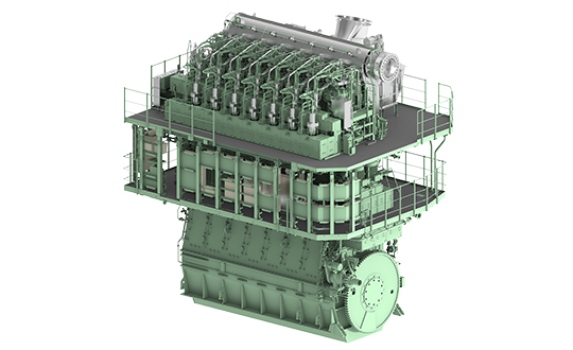
 IMAGE: HD Hyundai's new low-pressure ammonia engine. HD Hyundai Heavy Industries Engine & Machinery
HD Hyundai Heavy Industries Engine & Machinery (HHI-EMD) tested the new engine between 27-29 October at Korean Register’s green ship equipment test centre in Gunsan, South Korea.
Seven classification societies witnessed the tests, which included Korean Register, the American Bureau of Shipping, Bureau Veritas, DNV, ClassNK, Lloyd’s Register and RINA.
The approval follows two earlier ammonia engines from HHI-EMD, featuring a high-pressure liquid ammonia fuel supply system based on the diesel-cycle concept.
They went through type approval tests in 2024 and 2025.
The two designs differ in when the ammonia meets the air. According to HD Hyundai, a low-pressure engine, burns a mixture of ammonia and air, which is then provided to the engine combustion chamber through compression.
Contrary to that, a high-pressure engine compresses air in the engine combustion chamber and then burns it by injecting ammonia with high pressure.
Wärtsilä's four-stroke ammonia engine also uses a low-pressure design, which it developed based on its low-pressure dual-fuel LNG engine designs, the company said.
Wärtsilä said it had chosen the low-pressure concept for safety, efficiency and its potential for reducing greenhouse gas emissions. In April, Wärtsilä raised the power of its four-stroke ammonia engine to match that of its LNG dual-fuel engine.
In September, HHI-EMD had also completed a Type Approval Test for a new LNG dual-fuel engine.
By Gautamee Hazarika
Please get in touch with comments or additional info to news@engine.online