Limited biofuel bunker traction across the Americas
There have been pockets of biofuel bunkering progress in the Americas over the past year, but uptake remains sparse and highly fragmented.
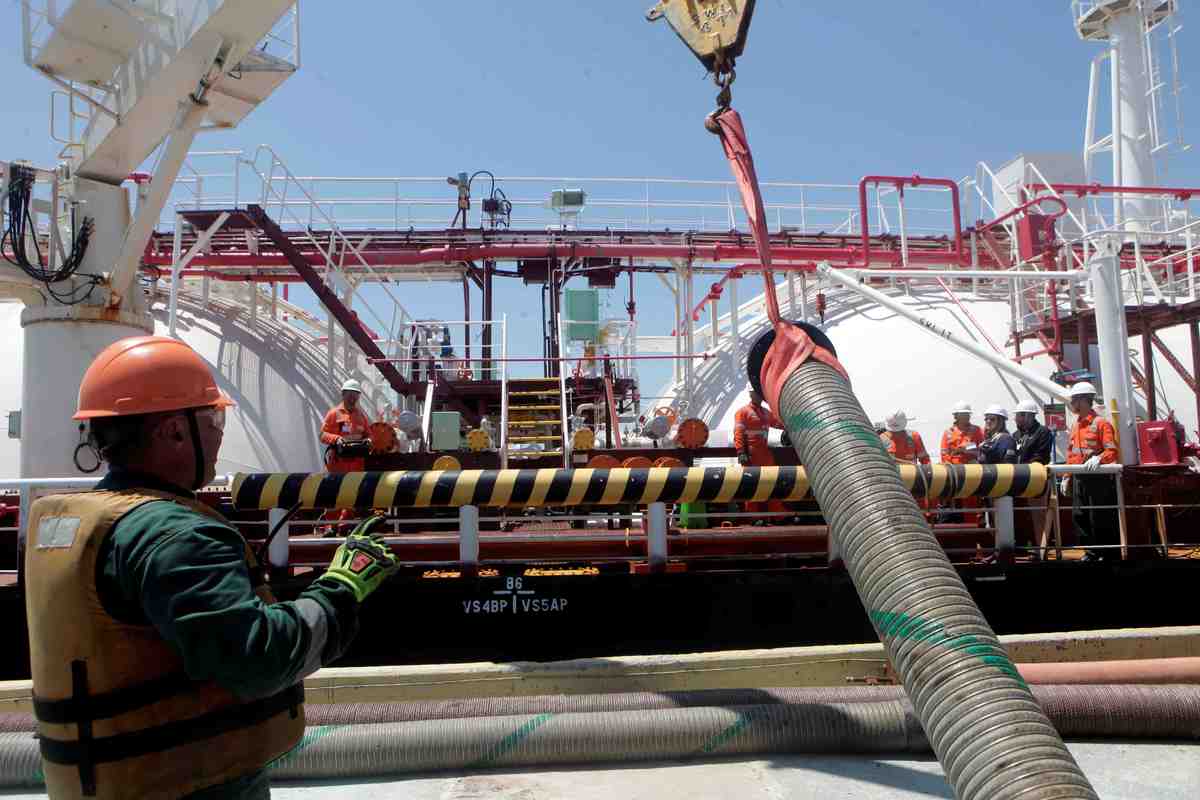 IMAGE: Petrobras bunkering a vessel with B24-VLSFO in Rio Grande. The biofuel was blended at Transpetro's Rio Grande Terminal. Petrobras
Biofuel bunker activity across the Americas accounted for around 5% of global biofuel bunker deliveries in 2025, according to ENGINE’s fuel quality data, which represents approximately 60% of all lab samples globally.
Houston, New York and Panama remain the main options for biofuel bunkering, with some activity also seen in Colombia, but demand on the biofuel side is still fairly sparse, a bunker trader told ENGINE.
A review of biofuel bunker delivery samples across the Americas over the past year shows that activity has been highly concentrated by geography, month and fuel grade, with most ports recording only intermittent deliveries.
US dominates samples, Canada has continuity
By country, the US had the most biofuel bunker lab samples recorded, accounting for about 49% of all deliveries recorded in the Americas in 2025. Activity was spread across the US Gulf Coast, Atlantic Coast and West Coast, but deliveries remained sporadic.
According to ENGINE’s data, Canada accounted for roughly 28% of total Americas biofuel volumes, making it the second-largest contributor by country despite having far fewer bunkering locations than the US.
Most of Canada’s activity was centred on the Great Lakes region, particularly in Port Colborne with 23 biofuel bunker samples.
Port Colborne is seeing an increase in biodiesel availability for marine fuel following the development of a new $33 million dedicated biofuel terminal by Canada Steamship Lines (CSL) announced in late 2024, said Anthony Odak, chief executive of Marine and Energy Consultants.
The facility is a dedicated marine terminal on the Welland Canal, designed with an initial storage capacity of around 7,000 mt/year, which Odak says will be enough to bunker more than 100 vessels/year.
“Construction’s underway after the 2024 announcement, so we’re starting to see more biodiesel moving through for ship trials and early adopters,” Odak added.
A spokesperson for CSL updated ENGINE on the terminal’s construction, “The biofuel terminal is a collaboration between the Hamilton-Oshawa Port Authority, Canada Clean Fuels and CSL. Once fully up and running, it’ll handle up to seventy million liters [61,000 mt] a year, enough for over a hundred vessels, but not quite operational yet.
CSL has been operating their vessels on B100 biodiesel on about half their Canadian fleet for years now, including 8 Great Lakes vessels like the Baie Comeau and Whitefish Bay.
“They [CSL] partner with Canada Clean Fuels for the North American-sourced stuff, made from waste plant material, it’s a drop-in fuel, no engine mods needed, and cuts CO2 by around 23%,” the spokesperson informed.
Odak noted another catalyst for growing demand.
“The big driver is Canada’s Green Shipping Corridor push on the Great Lakes, backed by about $14 million in federal funding. It lets ships switch to lower-emission biodiesel blends without detouring far, and Port Colborne’s spot means near year-round access since the canal stays open longer than most lake ports,” he said.

Limited activity elsewhere
In North America, activity was heavily skewed towards a handful of locations, led by Port Colborne, Galveston, Long Beach and Houston, while most other ports recorded only one or two samples over the year, highlighting the early-stage and uneven development of biofuel supply across the region.
In the US, biofuel bunkering activity was concentrated at a limited number of ports, with deliveries spread unevenly across the East Coast, Gulf Coast and West Coast.
In New York, BunkerOne started offering biofuel blends such as B30-HSFO and B30-LSMGO in May. The B30 blends contain 30% fatty acid methyl ester (FAME) or hydrotreated vegetable oil (HVO) biofuels blended with HSFO or LSMGO. The fuels are sold on ISO 8217:2017 specifications and are ISCC EU-certified.
There were six samples from New York, which accounted for roughly 5% of total biofuel bunker activity in the Americas in 2025.
Colombia accounted for 6% of all Americas samples, driven by samples from Cartagena and Mamonal, while Panama’s Cristobal and Balboa contributed just over 4%. Brazil followed with just over 3%, with activity recorded in Rio Grande and São Sebastião.
Monjasa completed its first ISCC-certified biofuel bunker operation in Cristobal in March.
Only modest biofuel bunker volumes have been recorded on the Atlantic side of the Panama Canal, where Cristobal is the biggest bunker port. Monjasa’s 900 mt biofuel stem in February was the only biofuel to be bunkered last year until October, when sales hit 1,600 mt. That was followed by 2,221 mt in November, while nothing was recorded in December, according to preliminary data from the Panama Maritime Authority.
In Brazil, Petrobras launched biofuel bunkering in Rio Grande at the beginning of 2025, offering B24-VLSFO after securing an ISCC EU certification for its oil and biofuel terminal at the port.
In December, Norwegian chemical tanker operator Odfjell announced the first biofuel-based green corridor between Brazil and Europe. Odfjell will offtake B24 biofuel blends in Rio Grande as a way to secure long-term fuel availability.
In June, Argentina approved biofuel blending for bunkering. However, uptake has been disappointing so far, with ENGINE’s samples not showing a single stem for any ports in Argentina in 2025.
Malcolm Dickson of Antares Ship Agents informed there is a supplier for biofuels in Argentina, from which deliveries can be arranged at certain open berths as they must be made by truck.
“To the best of my knowledge there have been no sales yet,” Dickson added.
Dickson said the supplier does not offer biofuels at Argentina’s popular Zona Común bunker spot. This is primarily because deliveries have to be made by truck, and Zona Comun is an anchorage about 6 miles offshore. Only tankers perform deliveries there and there are no dedicated biofuel delivery vessels.
Pure biofuel in demand
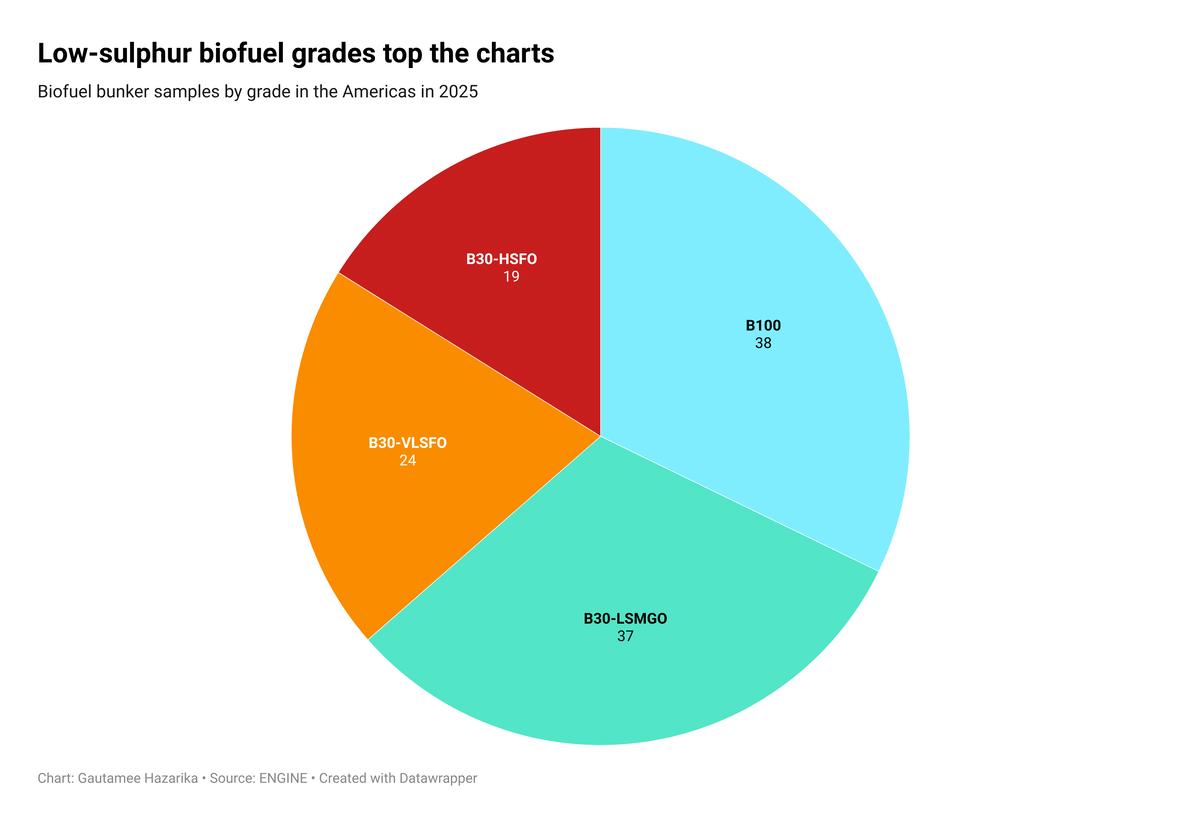
B100 biodiesel was the most popular biofuel grade across the Americas last year, followed closely by bio-LSMGO blends. Both of these grades have less than 0.10% sulphur which make them compliant with the North American and US Caribbean Sea Emission Control Areas (ECAs).
B100 accounted for around 32% of total biofuel bunker samples, while various bio-blends made up about 68%.
Bio-LSMGO comprised for roughly 31% of samples, followed by bio-VLSFO at 20% and bio-HSFO at 16%.
Bio-ULSFO remained marginal, representing less than 2% of total samples.
Seasonal biofuel demand
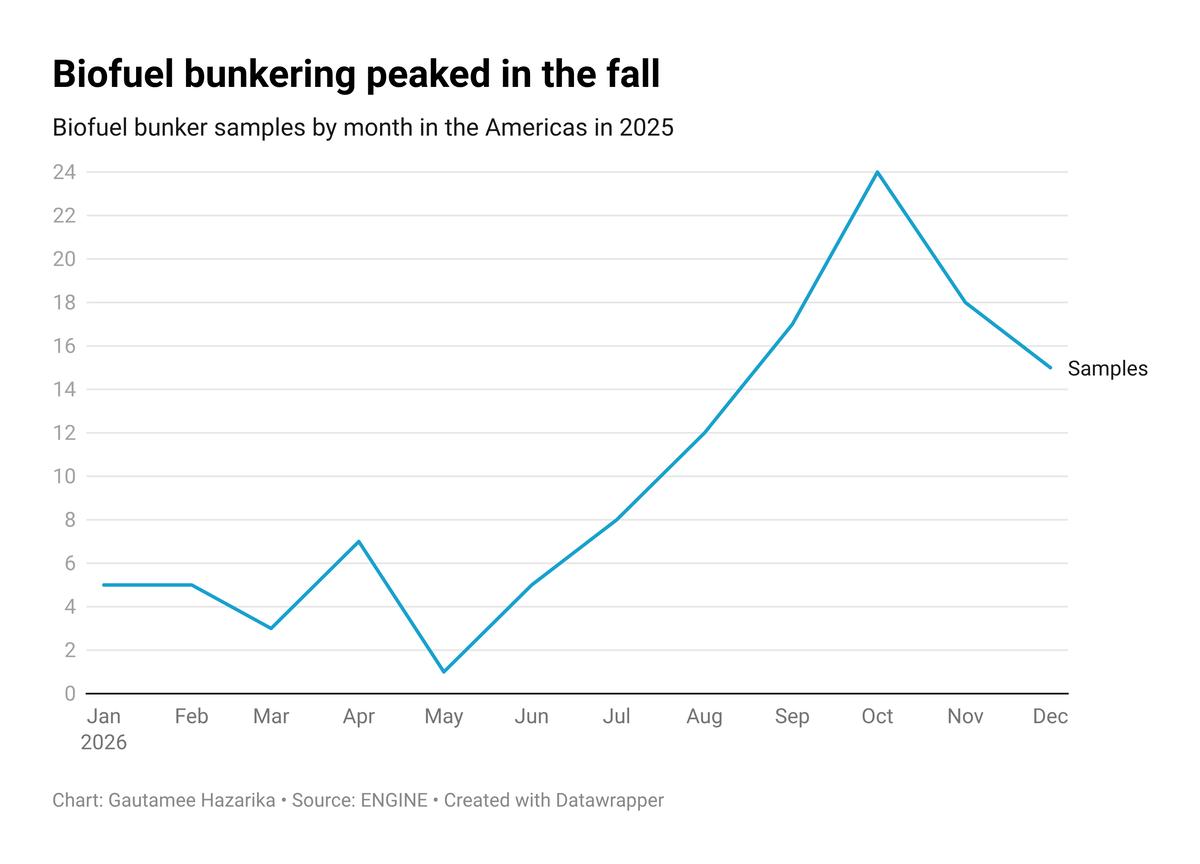
Biofuel bunker activity was seasonal in the Americas, with deliveries heavily concentrated in the second half of the year.
October recorded the highest share of activity with 20% of total biofuel bunker samples, followed by 15% in November at 15% and 14% in September.
Together, September–November made up nearly half of all recorded biofuel bunker activity.
By contrast, activity was notably thin during the late spring and early summer, with May accounting for less than 1% of total samples and March contributing just 2.5%.
The seasonality in demand suggests that bio-LSMGO and bio-ULSFO deliveries were tied to specific vessels trialling biofuels rather than routine bunkering, a trader told ENGINE.
Priced out?
Today, high biofuel costs continue to weigh on uptake in the Americas. It has often been cheaper for operators to bunker in established global biofuel hubs such as Rotterdam or Singapore than in ports like Houston and Cristobal.
At certain days last year, suppliers in Houston priced B30-VLSFO $110-223/mt higher in than in Rotterdam, and $60-271/mt higher than in Singapore, according to ENGINE prices gathered from the market. The biofuel grade was also priced at $106-143/mt premiums in Cristobal over Houston, and $116-176/mt over Singapore.
B100 was priced $266/mt higher in Houston than in Rotterdam, and $73/mt higher than in Singapore on one day. B30-HSFO pricing was closer between the ports, with Houston at a $21/mt premium over Rotterdam and $15/mt over Singapore.
While emissions from voyages from non-EU ports into the EU are covered under the EU ETS and FuelEU Maritime regulations, ports across the Americas generally lack dedicated incentives or port-level mandates for marine biofuels.
As a result, biofuel bunkering in the region has been shaped more by route-specific compliance considerations and individual operator strategies than by local regulatory or commercial drivers, contributing to uneven and selective uptake.
By Gautamee Hazarika
Please get in touch with comments or additional info to news@engine.online