LNG Bunker Snapshot: Singapore’s price gains as global gas markets firm
Rotterdam’s LNG bunker price has stabilised as colder weather lifts European gas markets but falling delivery premiums cap gains, while Singapore’s price continues to rise, tracking firmer global gas benchmarks and tightening LNG fundamentals across Asia and Europe.
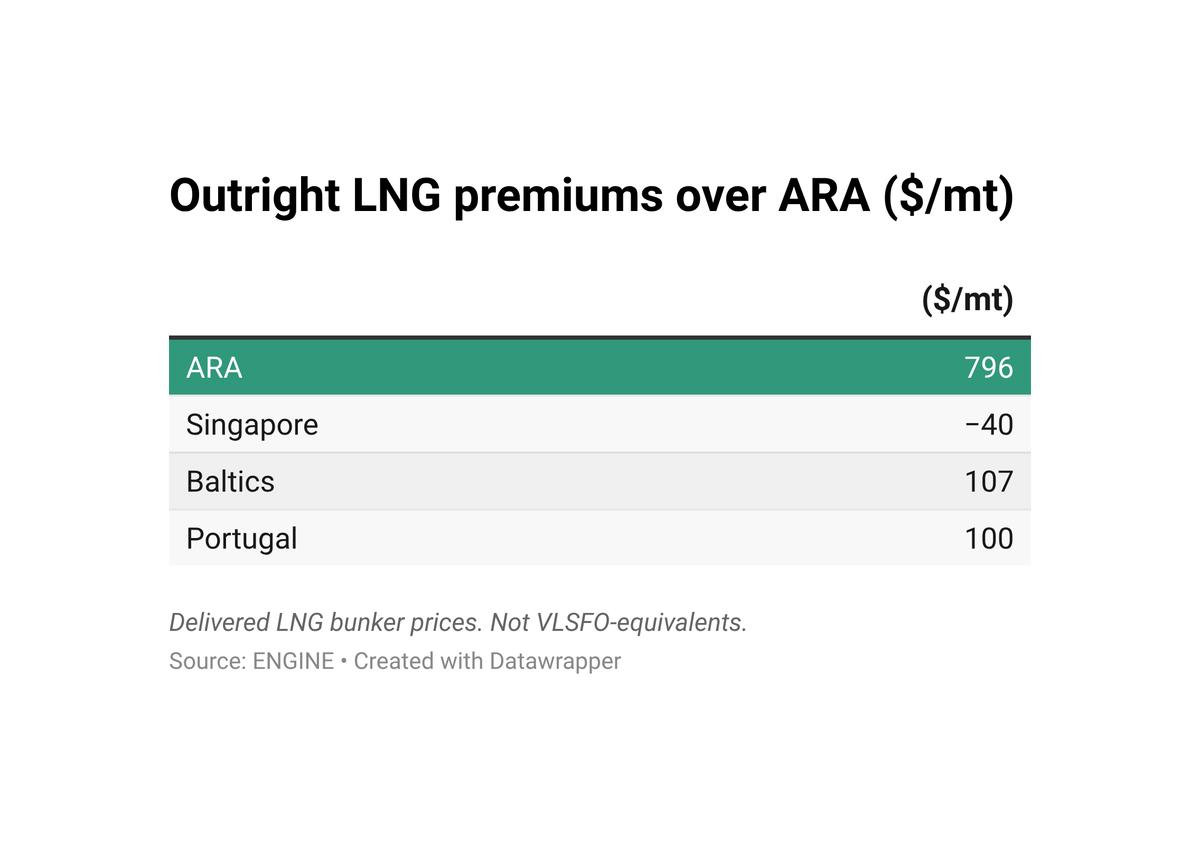
Weekly changes in LNG bunker prices:
- Rotterdam down by $1/mt to $796/mt
- Singapore up by $28/mt at $756/mt
Rotterdam
Rotterdam’s LNG bunker price has steadied after two weeks of sharp gains.
Over the past week, the front-month Dutch TTF natural gas contract rose by $0.56/MMBtu. This upward momentum was partly offset by a roughly 16% fall in the assessed bunker delivery premium, which declined from $194/mt to $164/mt.
The rise in TTF prices came amid “expectations of colder temperatures across Central and Eastern Europe, as well as forecasts of reduced wind power generation in Germany and the UK,” according to the Japan Organization for Metals and Energy Security (JOGMEC).
“Strength was seen in the European market, with colder weather, tighter storage, and speculative short-covering, providing a boost to TTF,” said Warren Patterson, head of commodity strategy at ING.
Short-covering refers to traders buying back assets they had previously sold short, which can add upward pressure to prices.
“Colder weather boosted rescom demand, while lower wind and nuclear powgen boosted gas burn in the power sector. Stronger demand together with low storage levels supported higher gas prices, while short covering from financial players further amplified the upward swing,” echoed Greg Molnár, gas analyst at the International Energy Agency (IEA).
Rescom demand refers to energy use by residential and commercial consumers.
“European gas futures gained… as the rapid depletion of inventories continued,” said Daniel Hynes, senior commodity strategist at ANZ Bank.
EU underground gas storage stood at 41.6% on 30 January, down from 46.1% a week earlier and 23.5% lower year on year, according to data from Gas Infrastructure Europe.
Singapore
Singapore’s LNG bunker price climbed for a fourth consecutive week, settling at $756/mt. The rise was largely driven by higher LNG bunker premiums, which increased from about $141/mt to $157/mt, an 11% gain.
Asian LNG bunker prices typically follow the NYMEX Japan/Korea Marker (JKM), which rose by $0.24/MMBtu over the past week, lifting the front-month contract by $11.53/MMBtu, or roughly $600/mt. Against this backdrop, the Singapore price, which was at a $69/mt discount to Rotterdam a week earlier, has since narrowed to a $40/mt discount.
The increase was driven “by a surge in European and US gas prices driven by a cold snap,” according to the Japan Organization for Metals and Energy Security (JOGMEC). The agency added that prices were further supported by expectations “that cargoes from the Asia-Pacific region would be resold to Europe.”
“In the US, Henry Hub prices soared” to “their highest January average since 2008. Henry spot prices surged to an all-time high… with Storm Fern boosting gas demand by 8% on the month. Rescom demand was up by 17% m-o-m on freezing temperatures, while gas burn in the power sector rose by 5% m-o-m on lower wind and higher space heating demand,” IEA’s Greg Molnár commented.
“Forecasts indicating colder temperatures (in North Asia) have also been bolstering sentiment. Japan expects below normal temperatures into early next week. Persistently cold weather across Asia may drive up competition for LNG with Europe,” said Daniel Hynes, senior commodity strategist at ANZ Bank.
Japan’s LNG inventories for power generation stood at 2.26 million mt as of 25 January, down by 30,000 mt from the previous week, according to data from the Ministry of Economy, Trade and Industry.
Other LNG bunker news
Axpo said it will deploy an LNG bunker vessel to handle physical deliveries along the Italian coast and across the wider western Mediterranean.
In 2025, LNG sales in Shanghai reached about 712,000 cbm, or roughly 318,000 mt, lower than the 571,000 mt sold in Singapore, according to the Shanghai Municipal Office of Port Services, citing Shanghai Port Customs data.
Meanwhile, Galveston LNG Bunker Port has partnered with US ship manager TOTE Services to roll out a fleet of Jones Act–compliant LNG bunker vessels along the US Gulf Coast. Separately, the Port of Barcelona plans to conduct its first barge-to-ship LNG bunkering operations for containerships and other vessels at anchorage this year.
By Tuhin Roy
Please get in touch with comments or additional info to news@engine.online