MEPC 84: Reject proposals to scrap GHG penalties – Clean Shipping Coalition
Proposals that call for removing GHG penalties and weakening technical elements should be rejected by IMO member states, Clean Shipping Coalition president Delaine McCullough told ENGINE.
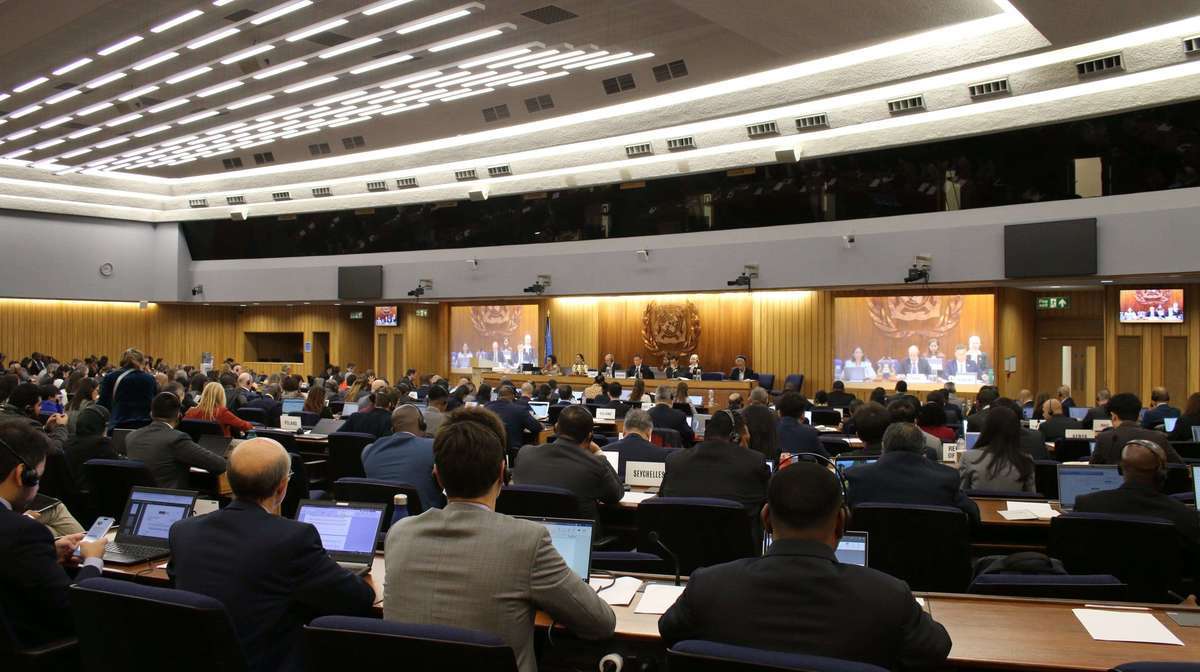 IMAGE: Representatives from member states at the IMO’s Intersessional Working Group on the Reduction of GHG Emissions from Ships meeting in London. X of @IMOHQ
A draft version of the IMO's Net-Zero Framework (NZF) was approved by its Marine Environment Protection Committee (MEPC) last April, but was not adopted last October. The main objections centred around proposed GHG penalties and strict fuel intensity reduction targets set for 2035.
And now, several countries want the framework overhauled with substantial revisions, according to submissions to the IMO’s GHG working committee ahead of the MEPC 84.
The US wants the approved draft scrapped entirely.
Algeria, Bahrain, Iraq, Kuwait, Russia, Saudi Arabia, Somalia and the UAE are pushing to remove any form of GHG penalties.
Argentina, Panama and Liberia want to eliminate GHG pricing and revise the GHG Fuel Intensity (GFI) reduction trajectory. Japan seeks to ease GFI reduction targets for 2030-2035 and remove a requirement for shipping companies to purchase remedial units by paying into the IMO's net-zero fund.
But these technical and economic elements are the backbone of shipping's path to net-zero, Clean Shipping Coalition president Delaine McCullough told ENGINE.
The Clean Shipping Coalition will not back any GHG policy framework without a flat penalty for all emissions exceeding compliance targets, she said.
"A technical measure-only policy framework would eliminate a maritime energy transition that leaves no country behind, undermine the business case for investments in zero-emission fuels and energy, destabilise the shipping market, and, in the end, increase the cost of getting to zero-emission shipping," McCullough said.
There is a clear divergence in proposals submitted to MEPC 84 around the IMO's Net-Zero Framework. With overhaul camp on one side and those backing the existing framework on the other, how do you see these competing positions shaping the final outcome?
Proposals for revising the IMO's Net-Zero Framework (NZF) both reduce its climate ambition, which already falls short of meeting either the Paris agreement or the IMO’s own 2023 GHG strategy goals, and remove the core GHG pricing component.
The GHG pricing that requires ships with emissions above the compliance target to pay a set price into an IMO fund, is essential to providing incentives for the production and uptake of scalable zero-emission fuels and energy technologies. It is also needed to ensure that all countries have the opportunity to fully participate in the shipping energy transition – or at least are not harmed by it.
Out of the gate, the NZF may not be as ambitious as is needed, but it includes all of the critical technical and economic elements to get shipping on a path to net-zero by 2050. It is the outcome of years of negotiations and compromise and broad support by IMO member states. Anything less is a climate failure and a political dead end.
Panama voted in favour of the Net-Zero Framework at MEPC 83. Liberia was also a vocal supporter but abstained from the vote. Both have now shifted their positions and are calling for revision of the framework. Given their status as two of the world's largest flag states, could their shift influence negotiations at MEPC 84?
While we couldn’t say with any certainty how a shift in the position of these countries might influence the negotiations, we can say that their proposal is unlikely to garner enough support to go anywhere.
The only set of policies that has succeeded in getting broad support from IMO member states is the NZF. Business as usual, or worse, proposals like the one from Liberia and Panama should be rejected and the NZF should be adopted in the fall.
Small island states like the Marshall Islands have been among the strongest supporters of the Net-Zero Framework, yet their economies are deeply tied to the US. Is there a risk that US political pressure could erode support in the coalition of small island states?
There is certainly a risk, however, we are still seeing strong support for the adoption of the NZF as is from most of the Pacific Island states.
These countries are not only facing existential threats from climate change, but are also highly dependent on shipping. Their support for the NZF was already a major compromise, and they’re not showing much openness to any weaker set of policies that the US and other NZF opponents would accept.
To what extent can the market mechanisms in the Net-Zero Framework be weakened before it loses its potency as a decarbonisation tool?
The NZF is already a compromise that needs to be strengthened over time, not watered down. Without the GHG penalty fee on ships with emissions above the required target, the framework would no longer work.
To address its significant climate impact, the shipping sector must transform both how it uses energy - dramatically improving efficiency – and the type of energy it uses, shifting to wind propulsion and new zero-emission fuels.
The penalty GHG fee closes the price gap between the dirty fossil fuels the industry runs on [and low- and zero-emission fuels], and sets a clear and predictable price signal for industry actors.
It also generates funds that are needed to incentivize the energy transition and ensure no countries are left behind, particularly small island developing states (SIDS) and least developed countries (LDCs).
In addition to likely putting a just and equitable transition out of reach, removing the GHG penalty price would remove the ability to incentivize the production and uptake of true alternative zero-emission fuels and energy, destabilize fuel market signals, lock in false solutions like LNG and unsustainable biofuels and eliminate certainty for industry investors.
In a submission to the IMO, Japan has proposed to remove mandatory Remedial Unit purchases via payments to the net-zero fund. Can a framework stripped of mandatory RUs realistically drive fuel switching to low- and zero-emission fuels at scale?
Adding to the points made earlier, no it can’t. The penalties are also how the fuel switching and emissions reductions are enforced. No penalties, no enforcement, which means little likelihood of ships actually doing what they are supposed to do. We have already seen this dynamic with the IMO’s other climate regulation – the Carbon Intensity Indicator (CII).
How can the IMO net-zero fund be governed and funds allocated in a pragmatic way?
The details on the IMO Fund’s governance and revenue distribution across a range of potential uses will be determined through the negotiations on the relevant guidelines.
Fund allocation must strike a balance between creating incentives for zero-emission fuel and energy uptake, investing in the sector in other ways, and offsetting the disproportionate negative impacts on developing countries, particularly small island developing states (SIDS) and least developed countries (LDCs).
It must also ensure an equal playing field for these countries to take advantage of the economic opportunities of the energy transition and build their resilience to climate impacts.
Given that the funds will not be unlimited and are likely to fall short of needs, especially early on, the distribution will need to be carefully designed to balance competing needs.
A system that reinforces or exacerbates existing inequalities will not – and should not – be politically viable. Rewards and other incentives must be limited to true long-run scalable zero emission fuels and technologies like wind propulsion.
By Konica Bhatt
Please get in touch with comments or additional info to news@engine.online