Polaris Shipping orders four multi-fuel-capable engine bulkers
South Korean maritime transportation company Polaris Shipping has placed an order for four ethanol- and methanol-capable bulk carriers with Qingdao Beihai Shipbuilding, a subsidiary of CSSC, and China Shipbuilding Trading Corporation (CSTC) in Qingdao, China.
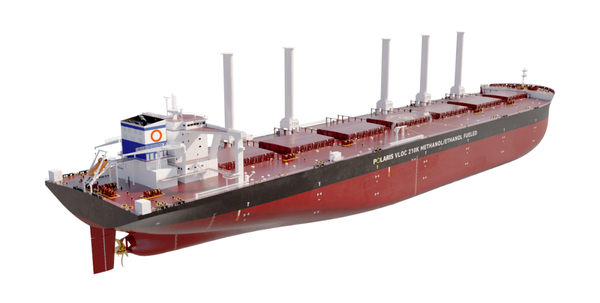 IMAGE: Polaris Shipping’s ethanol- and methanol-capable bulker concept. Polaris Shipping
The vessels will be powered by Swiss engine maker WinGD’s multi-fuel engines, capable of running on ethanol, methanol and conventional fuel oil. They will also be LNG- and ammonia-ready, allowing for future conversion to either LNG- or ammonia-fuelled operation.
Deliveries are scheduled to take place sequentially from 2031. The four bulk carriers will be chartered to Brazilian mining group Vale under a 25-year contract to transport iron ore.
Methanol and ethanol are gaining traction as alternative bunker fuels in the shipping industry. According to DNV data, 154 methanol-capable vessels are currently in operation globally, while another 294 vessels are on order for delivery through 2030.
Developments in methanol-fuelled shipping have continued this month. Japanese engine manufacturer Mitsui E&S completed the Factory Acceptance Test (FAT) for the first methanol dual-fuel WinGD large marine engine built in Japan. Meanwhile, French shipping company CMA CGM took delivery of its latest methanol-capable containership, CMA CGM Roi Arthur.
Ethanol bunkering has also seen recent progress. In July, Danish shipping company A.P. Moller-Maersk’s containership Antonia Maersk was bunkered with an unspecified quantity of 100% ethanol (E100) at the Port of Barcelona in Spain.
Also in July, global bunker supplier Bunker One delivered 500,000 litres of bioethanol to a methanol-capable containership owned by CMA CGM at the Port of Santos in Brazil.
By Tuhin Roy
Please get in touch with comments or additional info to news@engine.online