The Week in Alt Fuels: Policy split threatens fuel switching
The split between the IMO member states around key elements in the Net-Zero Framework (NZF) points to a grim future for shipping’s green fuel transition.
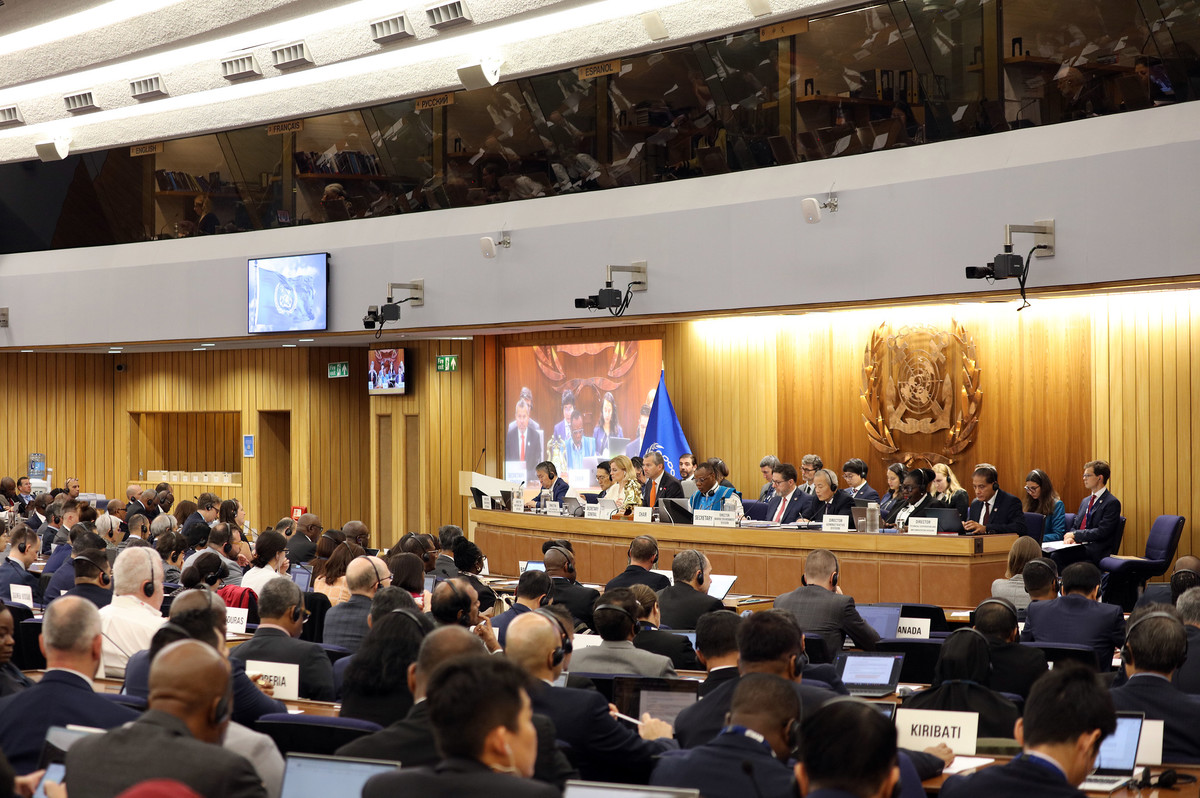 IMAGE: Opening of the IMO Marine Environment Protection Committee 2nd extraordinary session in London. Flickr of the IMO
Proposals submitted ahead of MEPC 84 next month reveal a stark contrast in proposals for the Net-Zero Framework's future, with no clear path to consensus.
The most radical position comes from two separate proposals – one from the US, and another from a joint submission by Algeria, Bahrain, Iraq, Kuwait, Russia, Saudi Arabia, Somalia and the UAE.
The US has called for the approved draft framework to be scrapped entirely and has opposed resuming the second MEPC Extraordinary Session in October this year.
“It is the view of the United States that MEPC 84 can recognize by consensus that the most appropriate and constructive path forward is to end consideration of the flawed IMO Net-Zero Framework proposal and, instead, devote its attention to considering alternative proposals in line with the foregoing policy positions,” its submission states.
Several petrostates are pushing for a complete overhaul of the approved framework, including removing any penalties on greenhouse gas (GHG) emissions.
A separate yet similar proposal by Argentina, Panama and Liberia stops short of a full reset, but seeks to eliminate GHG pricing and revise the GHG Fuel Intensity (GFI) reduction trajectory.
Rather than fixed targets, this group advocates for a system that adjusts over time based on the real market uptake of low-emission fuels, anchored around affordability, availability and scalability.
Japan occupies the middle ground. It seeks to ease GFI reduction targets from 2030 toward 2035 and remove the mandatory requirement to purchase remedial units via payments to the IMO's net-zero fund.
Both Japan and the Argentina-led bloc support the concept of using surplus units, but differ on the mechanism. Argentina, Liberia and Panama favour a flexible system allowing transfer, banking and limited borrowing. Japan proposes scaling up surplus unit supply through a predefined multiplier.
On the other side of the table, separate submissions from countries including China, the UK, Norway, Palau and Vanuatu, Kenya and Brazil signal backing the framework largely as approved.
These submissions focus on refining reward mechanisms for zero and near-zero fuels and governance of the net-zero fund, without altering the NZF's core architecture.
But the US and a group of mostly petrostates have made it clear they will not accept the current version.
“A framework that imposes sudden or unclear financial burdens will not command sustained support from Member States or industry, and risks undermining confidence in the process,” Algeria’s proposal warns.
“The United States will not tolerate an IMO-administered fund of any kind built on revenues from a global carbon tax or penalizing mechanism,” the US proposal says.
Taken together, the submissions leave at least three competing models on the table and no alignment on the mid-term measures intended to drive fuel switching.
As negotiations carry into MEPC 84 this April, the risk extends beyond delay, to a framework completely watered down through compromise or stripped of its economic leverage.
In either case, the absence of regulatory clarity will fail to send credible market signals to fuel producers, suppliers, shipowners, ports and dampen investments in low- and zero-emission technologies at precisely the moment when the shipping industry needs it the most.
In other news this week, HyOrc, a developer of waste-to-green methanol technology, has signed an agreement with Bulgaria’s OnEnergy to develop a green methanol production facility. OnEnergy’s plant will be built near Bulgaria’s Port of Varna and the company aims to target bunkering demand, HyOrc told ENGINE. HyOrc has been appointed as a technology partner for the project, focusing on thermochemical conversion of refuse-derived fuel (RDF) into green methanol.
The Port of Helsingborg will charge a variable “emergency energy surcharge” on vessels calling at the Swedish port, after a sharp increase in the price of hydrotreated vegetable oil (HVO) used in its operations. The charge will apply from 1 April and cover all units handled over quay, whether loaded onto or discharged from vessels.
The European Investment Bank (EIB) has extended a €90 million loan ($104 million) to the Port of Rotterdam Authority for it to fund and install shore power systems across three deep-sea container terminals. As part of the project, eight kilometres of quay will be fitted with shore power infrastructure, including 35 connection points designed for seagoing container vessels.
By Konica Bhatt
Please get in touch with comments or additional info to news@engine.online