Ulsan hosts Lotte Fine Chemical’s ammonia bunkering breakthrough
South Korean chemical company Lotte Fine Chemical has bunkered an undisclosed volume of ammonia to an ammonia-capable vessel built by HD Hyundai Heavy Industries at the Port of Ulsan.
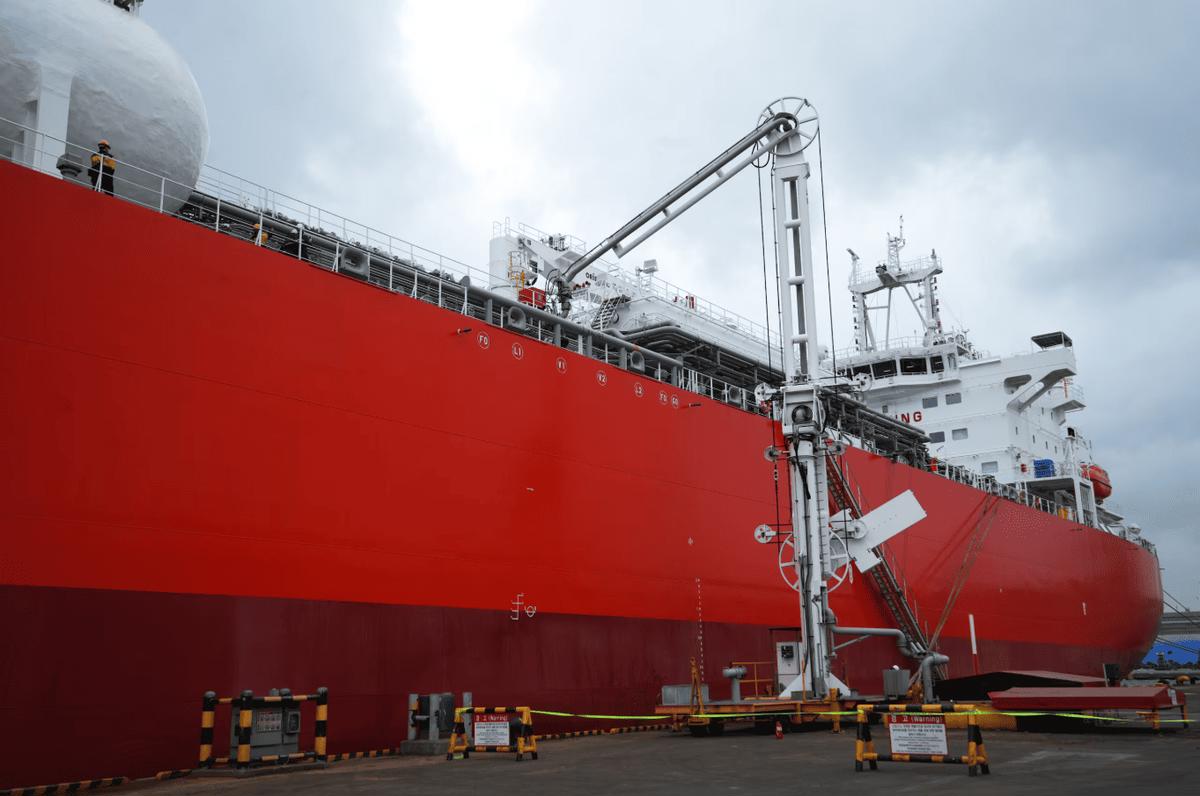 IMAGE: Lotte Fine Chemical delivering ammonia at the Port of Ulsan. Lotte Fine Chemical
The ammonia was produced entirely from renewable energy in Inner Mongolia by Chinese green technology company Envision Energy. It was generated using 100% renewable energy (wind and solar) at its hydrogen and ammonia production complex in Inner Mongolia, China.
In March, Lotte Fine Chemical imported the ammonia through Ulsan Port and stored it at its adjacent ammonia terminal, making the company South Korea’s first registered ammonia marine fuel supplier in 2025.
The operation represents the first full commercialisation of an end-to-end supply chain in which renewable energy from wind and solar is converted into hydrogen and ammonia, transported across borders, and used as marine fuel, the company said.
Support for the operation was provided by the Ministry of Oceans and Fisheries, the Ulsan Regional Office of Oceans and Fisheries, the Ulsan Port Authority, and Korean Register.
However, the company has not disclosed further details, including the vessel’s name, ownership, or the delivery method used.
While ammonia fuel has previously been used in demonstration projects, the company added that this operation marks the “world’s first commercialisation of ammonia bunkering.”
In March 2024, Australian mining company Fortescue successfully bunkered its vessel Fortescue Green Pioneer with 3 mt of liquid ammonia at the Port of Singapore as part of a seven-day trial.
Ammonia is increasingly being adopted as a bunker fuel by shipowners, despite concerns over its high toxicity during handling, storage and bunkering. The global fleet of ammonia-capable vessels currently stands at three, with an additional 46 vessels expected to be delivered by 2030, according to classification society DNV.
A number of ammonia-related developments have unfolded this month.
Japanese classification society Nippon Kaiji Kyokai (ClassNK) granted approval in principle (AiP) to an ammonia-capable Panamax bulk carrier featuring a large tank, developed by Planning and Design Center for Greener Ships.
Japanese conglomerate Itochu has secured exclusive long-term supply of 300,000 mt/year of green ammonia from Indian renewable energy company L&T Energy GreenTech’s proposed production facility in Kandla.
German engine maker Everllence has completed the Factory Acceptance Test (FAT) of its ammonia-capable engine ahead of commercial deployment.
Singapore-based bunker supplier Golden Island and ammonia producer Yara Clean Ammonia have partnered with NYK Bulkship (Asia) to supply low-carbon ammonia for bunkering in Singapore.
Finnish marine engine manufacturer Wärtsilä has increased the power of its four-stroke ammonia dual-fuel engine to match that of its LNG dual-fuel engine.
German energy firm MB Energy has secured a permit to build and operate a new ammonia import terminal in Hamburg.
Belgian gas transportation company Exmar will take delivery of two dual-fuel ammonia-capable medium-sized gas carriers (MGCs) this year.
Australia-based company Energy ONE has placed an order with Indian shipbuilder Swan Defence and Heavy Industries for the construction of four ammonia dual-fuel bulk carriers.
By Tuhin Roy
Please get in touch with comments or additional info to news@engine.online