Carriers to pass higher EU ETS costs on to customers
Major global container liners have informed customers of higher tariff surcharges due to changes in the EU Emissions Trading System (EU ETS) regulation in 2026.
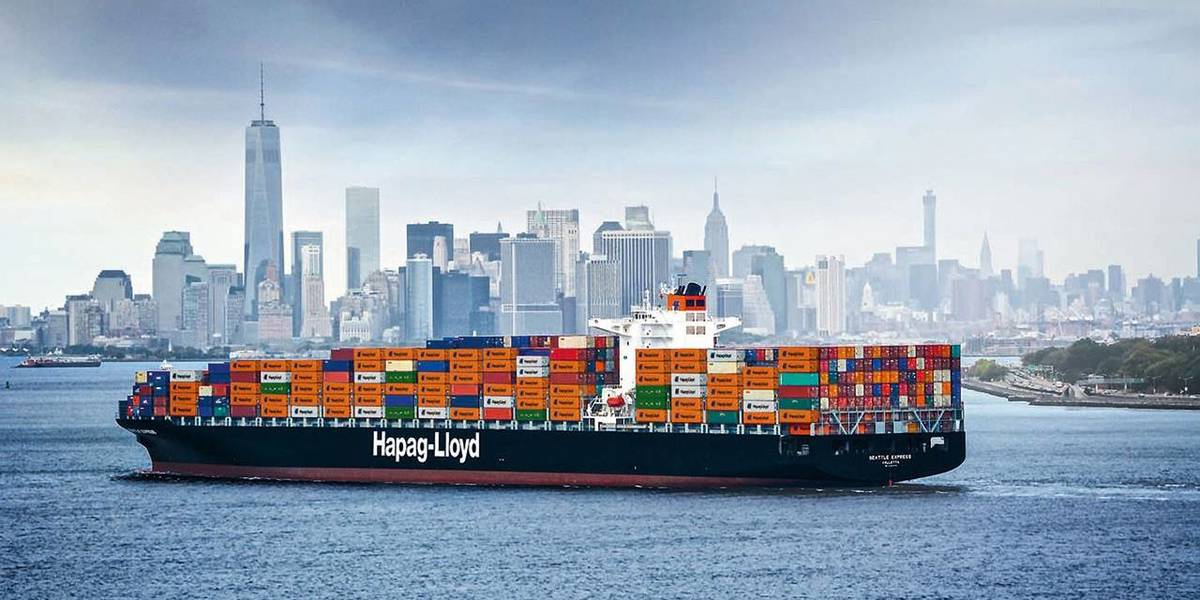 IMAGE: Hapag Lloyd's container ship. Hapag Lloyd
The shipping companies applying EU ETS-linked tariff surcharges include CMA CGM, A.P. Moller Maersk, Hapag-Lloyd, Ocean Network Express, Mediterranean Shipping Company (MSC) and Swire Shipping.
The EU ETS has reached its final phase of “phasing in” this year, which means a vessel sailing between two EU ports now has to pay for 100% of its emissions, up from the 70% coverage in 2025. A vessel sailing between EU and nonEU ports has to cover 50% of its emissions, up from 35%.
The regulation has also started penalising methane and nitrous oxide emissions from this year.
ENGINE’s assessment shows that EU ETS changes from 1 January have raised estimated costs on EU–EU voyages by $103–106/mt for conventional fuels and $95–169/mt for LNG.
Shipping and logistics firms have warned that higher compliance and bunker fuel costs could lead to increased operational costs and higher cargo tariffs.
“We expect the surcharge to increase by approximately 45% as a result of this regulatory update,” Hapag-Lloyd said.
Maersk has applied a similar level of surcharge increases.
For instance, its tariff surcharge on the Far East Asia to North Europe route has risen by $54 over the past quarter, to $168/40-foot dry container (40DRY) and by $36 to $113/40DRY on the return from North Europe to Far East Asia route.
The Danish firm added that compliance costs associated with the EU’s FuelEU Maritime regulation also contribute to the higher tariffs.
“… FuelEU compliance costs are increasing due to biofuel price trends—rising biofuel costs combined with declining fossil fuel prices make low-emission compliance more expensive. Together, these factors contribute to the higher Emissions Surcharge,” Maersk explained.
The tariff surcharge is also expected to result in higher sea freight fees in Europe and an add-on to road freight costs because of increased ferry charges, according to logistics firm ColliCare.
DHL Global Forwarding has also said it will increase logistics fees this year.
Some shipping and logistics companies will offer up to a 100% rebate on this surcharge if their customers opt for green shipping services.
These services typically allow customers to pay a premium to move their shipments on vessels using alternative fuels, or to use book-and-claim schemes to purchase equivalent emission reductions linked to alternative fuels like biofuels or other low-emission fuels across a carrier’s fleet.
By Konica Bhatt
Please get in touch with comments or additional info to news@engine.online