Future Fuel Talks: What EXMAR learned from bringing the world's first ocean-going ammonia-fuelled vessel to sea
“We are 100% sure that what we are doing is safe and that our crew is working in the same safe environment as they would on a conventionally fuelled ship,” EXMAR’s Kristof Coppé told ENGINE, discussing the work required to use ammonia safely as a bunker fuel on a gas carrier.
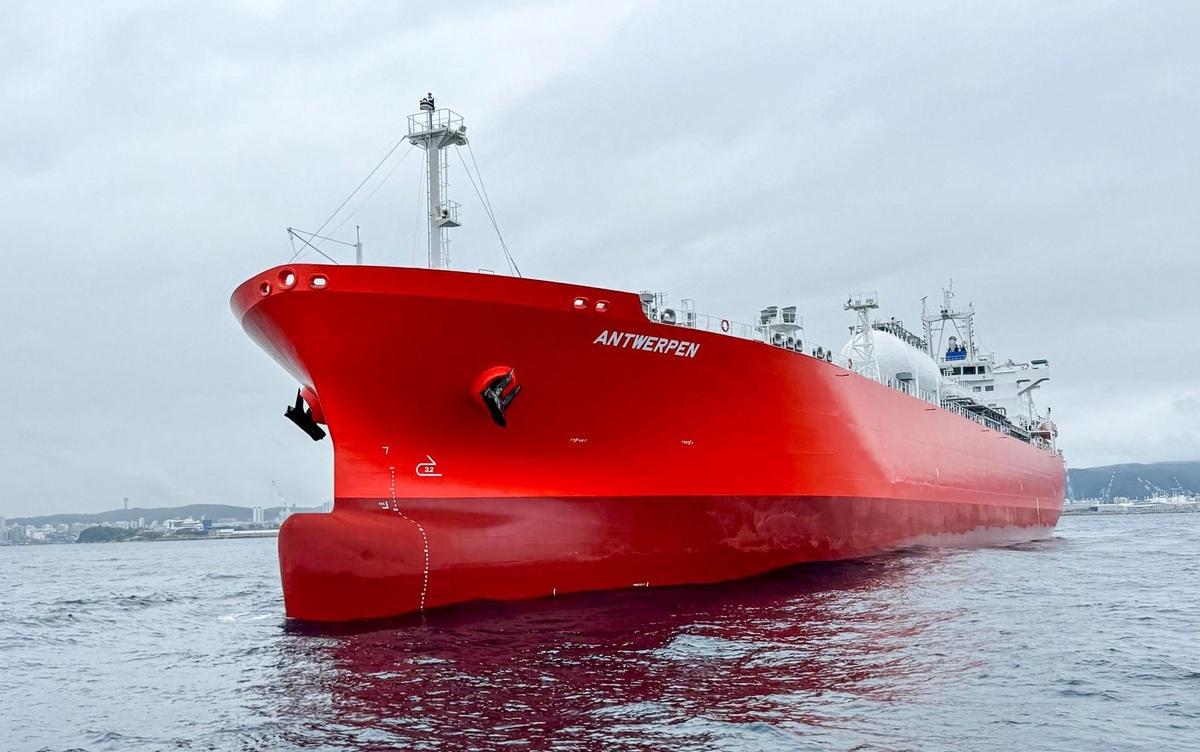 IMAGE: The ammonia-capable gas carrier Antwerpen. EXMAR
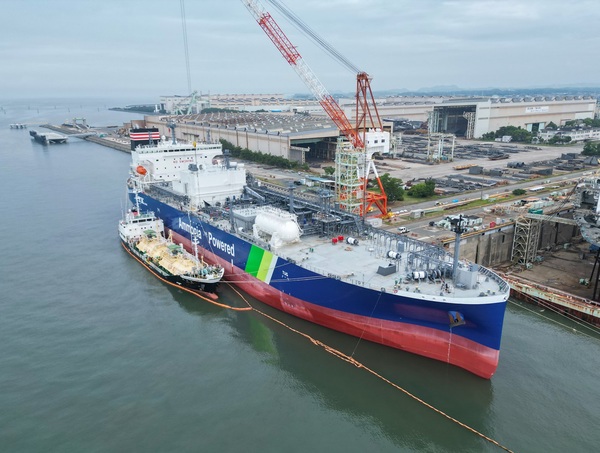
Belgian gas shipping company EXMAR recently took delivery of the world's first ocean-going ammonia-capable dual-fuel vessel, pioneering ammonia propulsion from concept to entry into the commercial fleet.
The 46,000-cbm gas carrier Antwerpen will carry ammonia as cargo and use it for propulsion.
But bringing the vessel from concept to commercial reality required far more than installing a new engine. It required proving that ammonia could move safely from cargo tank to engine room.
EXMAR’s four-decade-long experience in handling and shipping ammonia as cargo has been one of its biggest advantages in developing an ammonia-capable vessel, Kristof Coppé, director of fleet operations and technical business development at EXMAR, told ENGINE.
At the time the vessel was being developed, using toxic fuels on gas carriers was not permitted.
The International Code for the Construction and Equipment of Ships Carrying Liquefied Gases in Bulk (IGC Code) applies to gas carriers designed to carry liquefied gases as cargo. The International Code of Safety for Ships Using Gases or Other Low-flashpoint Fuels (IGF Code) applies to non-gas carriers operating on gaseous or other low-flashpoint fuels.
The Antwerpen falls under the IGC Code as an ammonia carrier. Its ability to use part of its ammonia cargo as fuel required the development of dedicated guidance for ammonia-fuelled gas carriers.
EXMAR worked with classification society Lloyd's Register and the Belgian flag state to support the development of guidelines governing ammonia as a bunker fuel on gas carriers.
“Of course, along the way, we encountered some challenges during the ship's design. Unexpected may be too strong a word, but there were issues that needed to be solved, which is normal when designing something new.”
The design included additional safety measures and modifications to the vessel such as creating a dedicated ammonia fuel supply room on deck.
“Apart from that, the testing went quite well. Nothing spectacular came out of it, and we were able to test everything as planned,” he added.
Familiar commercial ground
Vessel insurance has not been a barrier for the ship.
A shipowner must insure a vessel once it is delivered. Since ammonia has never been used as a fuel, insurers or P&I clubs can be expected to approach ammonia differently from other bunker fuels.
But that was not the case for Antwerpen, because the vessel is already designed to carry ammonia as cargo.
The same has been true for charter party arrangements.
“The main requirement is that there is an agreement with the charterer if part of the cargo is used as fuel. But that is no different from vessels using LPG cargo as fuel or LNG cargo as fuel,” he explained.
Addressing toxicity concerns
Much of the industry's concern around using ammonia as a bunker fuel has centred on toxicity, leak risks and crew safety. EXMAR’s approach was to ensure that its dual-fuel ammonia carrier achieved the same level of safety as a conventional ammonia carrier.
“Safety has been the top priority throughout the vessel's design and development,” Coppé said.
EXMAR carried out extensive hazard identification (HAZID) and hazard and operability study (HAZOP) risk assessments and safety studies to ensure that the ammonia fuel system could be operated safely and that the engine room was safe to work in.
Safety measures include double-walled piping systems in the engine room and gas detection systems installed throughout the ammonia fuel supply system.
Ammonia fuel supply equipment is located within areas already designed to handle ammonia. Part of the fuel supply system is installed in a dedicated ammonia fuel supply room on deck, rather than in a compressor room arrangement more commonly seen on LPG-capable vessels.
The fuel supply room remains unmanned during normal operations. Crew members only enter it for maintenance and only after the equipment has been shut down and checks have confirmed that no toxic vapours are present.
Training before technology
For crew safety, EXMAR has developed its own training programme covering the handling of ammonia as both cargo and fuel. All seafarers joining the vessel must complete a two-day course before deployment.
“In addition, engine room personnel undergo specialised training on the ammonia-fuelled engine itself, as it is a new engine type. Beyond that, all crew members receive broader safety training covering the general concept of using ammonia as a marine fuel,” Coppé said.
EXMAR also plans to make the training programme available to third parties, as the company wants to share its safety concepts and operational experience with the wider industry and help ensure that seafarers can work safely on ammonia-fuelled vessels.
Automation as a safety layer
The vessel relies on a “high level” of automation. It features automated start-up and shutdown procedures and systems designed to monitor ammonia fuel supply continuously.
If the fuel supply system encounters a problem, or if gas detection systems identify ammonia in an area where it should not be present, the vessel automatically switches from ammonia to diesel operation. This allows operations to continue without interruption, Coppé said.
Built-in fuel supply
EXMAR’s vessel avoids what many consider ammonia's biggest near-term challenge: underdeveloped bunkering infrastructure.
“One advantage of this vessel design is that it can use part of its cargo as fuel,” Coppé said.
The vessel is fitted with 46,000-cbm cargo tanks as well as dedicated fuel tanks. Those fuel tanks can be replenished directly from the ammonia cargo carried on board. This means that the vessel does not require dedicated ammonia bunkering infrastructure to begin operating on ammonia.
This is similar to LNG and LPG carriers that consume part of their cargo as fuel.
EXMAR intends to operate on ammonia during the vessel's initial voyages to build operational experience. But whether ammonia is used continuously in the future will depend on trading patterns, chartering arrangements and commercial realities, Coppé said.
Coppé expects some early challenges as EXMAR gains operational experience with a new vessel and a new engine type.
"When we start operations, we will of course have more operational experience and will be better placed to elaborate on the operational feedback, how it actually works and what we have learned from it. We know it's a new ship and a new engine type. We have worked with new engine types before. When we started using LPG as fuel, we learned that when you do something new, there are always teething issues,” he said.
But he believes the company is well-prepared for the learning curve.
“We have carried out sufficient tests with all the partners and shipyards to make sure that everything works and that everything is safe. Now we need to see how it performs in real operational life. We are convinced that what we are doing is safe. That is also the reason we carried out the testing.”
By Konica Bhatt
Please get in touch with comments or additional info to news@engine.online