The Week in Alt Fuels: Ammonia and methanol bunkering gain ground
The list of successful alternative-fuel bunker operations keeps growing, as seen over the past week.
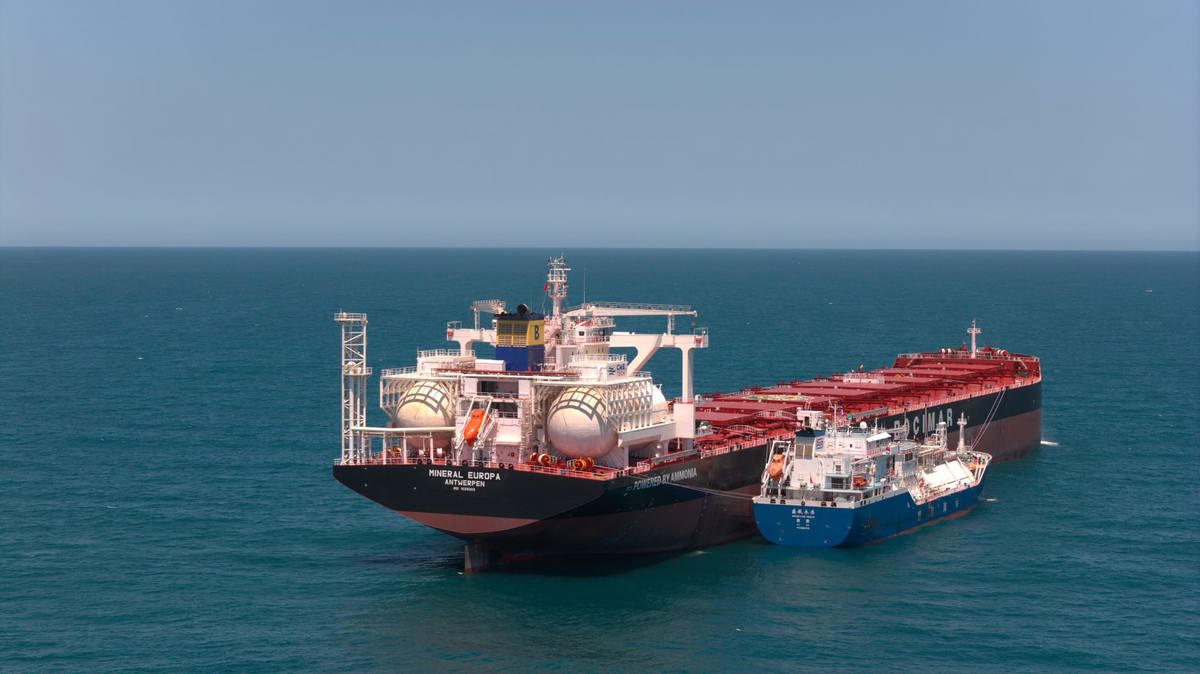 IMAGE: Ship-to-ship ammonia bunkering of the ammonia-capable bulk carrier Mineral Europa by Port Hedland. Pilbara Ports
Two ammonia-capable vessels received green ammonia in different parts of the world. In South Korea, Eastern Pacific Shipping’s Terra Clove was bunkered at Ulsan. The fuel came from Envision Energy's production facility in Inner Mongolia and was delivered by South Korean supplier Lotte Fine Chemical.
CMB.TECH’s Mineral Europa was bunkered with an unspecified quantity of green ammonia in a ship-to-ship bunker operation at Australia’s Port Hedland. The fuel was delivered by the ammonia bunker vessel Shenghang Yongle in a trial that the port authority said builds on its 2024 ship-to-ship ammonia transfer pilot.
In China, OOCL’s methanol-capable container ship OOCL Grace received 983 mt of bio-methanol at Yantian.
These operations demonstrate that alternative fuels can move through diverse supply chains and into ships’ bunker tanks. But making such deliveries routine is another matter.
Some ports are now looking at ways to build more consistent demand rather than relying on individual bunker stems.
Singapore and Qingdao, for instance, have laid the groundwork for more methanol bunkering along their shared shipping corridor. Singapore’s port authority and Qingdao Port will also explore ways to pool methanol bunker demand between the ports.
Aggregating demand could help suppliers justify regular deliveries and investment in bunker and storage infrastructure, even if the two sides have yet to disclose a timeline for the proposed pilots.
The potential scale of future demand is becoming clearer too.
A feasibility study by the ports of Los Angeles and Long Beach estimates that methanol bunker demand at the two ports could be 64,000-250,000 mt/year by 2030. LNG demand could be 65,000-115,000 mt/year, the study added.
Those figures offer a glimpse of the market that bunker suppliers may need to serve. But demand forecasts are only one side of the equation. Availability of bunker infrastructure remains another important consideration.
For instance, only 29 ports worldwide offered some type of methanol bunkering in April, according to Clarksons Research data cited in a report by the Global Maritime Forum and University College London.
Availability of ammonia bunkering is even more limited, with only a handful of major ports having conducted ammonia bunker operations.
In comparison, DNV counts 171 methanol- and ethanol-capable vessels in operation and another 292 on order for delivery through 2031. It counts eight ammonia-capable vessels in operation and 42 on order for delivery by 2030.
More ports around the world are gaining practical experience with alternative-fuel bunkering. But turning these individual operations into regular commercial deliveries and wider fuel uptake will require sufficient fuel availability, storage capacity and supporting infrastructure.
In other alt fuels news this week, DNV recorded 53 alternative-fuel vessel orders in October, 30 of them LNG-capable. Four ammonia-capable vessels were also ordered, ending a two-month spell without new orders for the fuel.
Japanese marine engine maker Japan Engine Corporation has won an order for four 60-bore ammonia-capable main engines, one for each car carrier in a project that seven Japanese companies announced on 27 October. The car carriers, due in 2030, are expected to be supplied by a planned ammonia bunker vessel.
Denmark’s European Energy has partnered with Canadian ethanol producer Greenfield Global to develop a plant in Québec that could produce up to 48,000 mt/year of e-methanol. The companies are targeting ships as one of the potential users of the fuel, European Energy said.
By Konica Bhatt
Please get in touch with comments or additional info to news@engine.online