The Week in Alt Fuels: The billion-dollar signal
Rising alternative fuel vessel orders show the industry means business. The question is whether the global regulator does too.
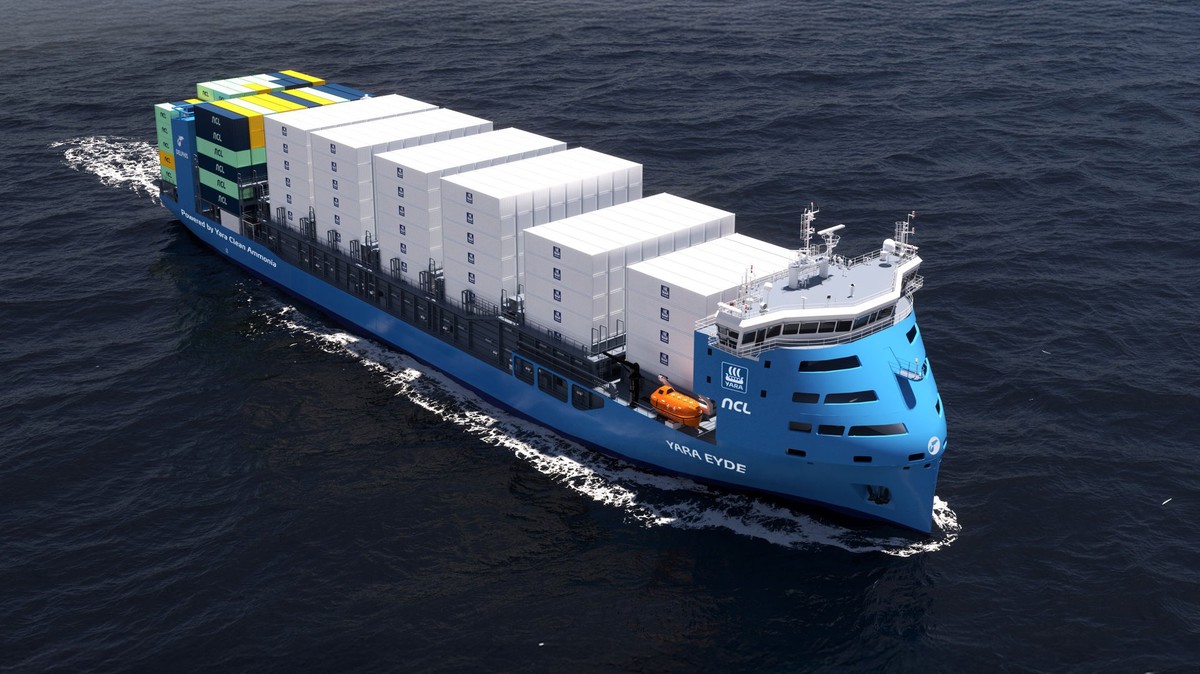 IMAGE: Concept design of the Yara Eyde, which could become the first commercial container ship capable of burning ammonia when it is scheduled for delivery later this year. Yara Clean Ammonia
In a joint statement issued last month ahead of MEPC 84, major shipping associations including BIMCO, the International Chamber of Shipping, the Cruise Lines International Association, Intercargo, Interferry, Intertanko and the World Shipping Council called for global regulatory clarity from the IMO.
They said shipowners remain “committed” to meet the IMO’s 2023 GHG ambition and have invested “billions of dollars” in alternative fuel technologies. They also urged the IMO to deliver on its promise to adopt the Net-Zero Framework.
DNV recorded 38 alternative fuel-capable vessel orders in April, a sharp jump from just five in March.
LNG continued to dominate, accounting for the bulk of newbuild orders across car carriers, container vessels, crude tankers and cruise ships. There are now 933 LNG-capable vessels in operation and another 681 on order for delivery by 2033.
LPG also showed momentum with 14 new orders in April, bringing the total orderbook to 122 vessels scheduled for delivery through 2029.
Ammonia ended a three-month order drought, with four new vessels in April. Total ammonia-capable orders now stand at 46, with deliveries expected towards 2030.
The global methanol-capable fleet has grown to 129 vessels and the orderbook stands at 317 scheduled for delivery through 2030.
The industry showed its hand. And the IMO offered a cautious but meaningful response at MEPC 84.
UCL Energy Institute noted that 59 member states supported using the Net-Zero Framework as the basis for a draft terms of reference - a document setting out the framework's working mandate. That reversed the “simple majority that was the basis of the adjournment” at the extraordinary session in October.
The 59 states include Angola, Belize, China, Colombia and Kenya, all of which had previously supported delaying adoption, alongside 10 countries that abstained during the October vote.
The draft terms of reference will now be discussed during working group meetings scheduled for September and November ahead of MEPC 85, which is due to take place from 30 November to 3 December. If a final text is agreed, adoption could follow at the second extraordinary session scheduled for 4 December.
The timeline remains tight and dependent on political convergence, something that has so far proven elusive.
Some shipowners have invested in vessels with low- to zero-emission potential. But the stakes extend beyond them.
For instance, green ammonia and green methanol producers have repeatedly called on the IMO to provide regulatory clarity so they can scale up fuel production in time to supply the vessels now entering the orderbook. Scaling up investment, they argue, cannot be justified without demand certainty.
Engine makers including Wärtsilä and Everllence have echoed those concerns, calling for global regulations that can strengthen the commercial case for alternative fuels.
But demand certainty remains difficult to establish without the regulatory framework needed to make low- and zero-emission fuels commercially viable.
Not just shipowners, but fuel producers and technology firms have also signalled their willingness to lean into the transition by investing in alternative fuels like ammonia and methanol. The question now is whether the IMO can provide the certainty needed, and do so in time to unlock the next wave of investment.
In other news this week, Titan Clean Fuels, a subsidiary of Molgas, has completed its first FuelEU Maritime pool. Its pool for the 2025 compliance period was verified by DNV. Titan has placed its own ships in the pool, including the bunker vessel Optimus which consumed 73% LBM mass-balanced with LNG last year.
Global bunker supplier Fratelli Cosulich launched the IMO Type 2 bunker vessel Lucia Cosulich, which can carry and deliver methanol to receiving vessels.
Japan's Nippon Biofuel is betting on jatropha-based biofuel grown on its own African farms as a low-carbon bunker fuel. The company's chief executive Makoto Goda spoke to ENGINE about how the fuel is produced, its supply chain, and why he sees jatropha not just as a decarbonisation tool but as a strategic answer to Japan's energy security concerns.
By Konica Bhatt
Please get in touch with comments or additional info to news@engine.online