The Week in Alt Fuels: Building the bunker menu
Bunkering activity came in many flavours this week, with biofuels, LNG, LBM, methanol, ethanol and ammonia featuring across several major ports – and sometimes with multiple fuels at the same port.
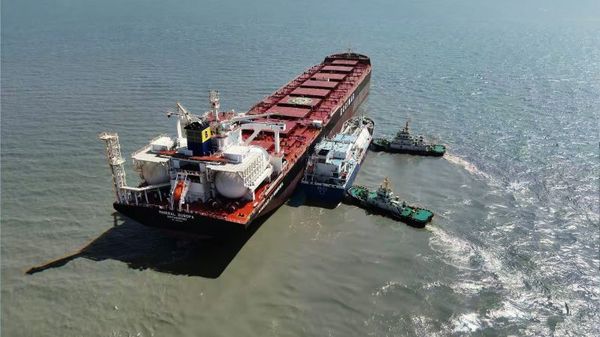 IMAGE: STS ammonia bunkering of Mineral Europa in Zhoushan. CMB.TECH
China's Ningbo-Zhoushan port offered perhaps the clearest illustration of this variety.
On 30 September, three bunker vessels supplied LNG, methanol and B24 biofuel to different ships at three terminals on the same day. It was the first time three different marine fuels had been supplied on the same day at the port, according to the Ningbo Maritime Safety Administration. The names of the receiving vessels and fuel suppliers were not disclosed.
The volumes were substantial. Around 3,300 mt of LNG, 7,500 mt of methanol and 3,000 mt of B24 were delivered across the port.
Ammonia bunkering also took place in China in the past week. Belgian shipping company CMB.TECH’s first ammonia-capable bulk carrier, Mineral Europa, was bunkered with 1,000 mt of green ammonia in a ship-to-ship (STS) transfer at Zhoushan. The operation was carried out by the ammonia bunker vesselShenghang Yongle.
Singapore also had a busy week on the alternative fuels front.
Bunker supplier Golden Island is set to deliver bio-ethanol at Pasir Panjang Terminal in an operation involving shipping company Maersk and terminal operator PSA Singapore.
French shipping company CMA CGM partnered with the Maritime and Port Authority of Singapore (MPA) and Singapore LNG (SLNG) to explore LBM bunkering. The agreement follows Shell’s recent import of mass-balanced LBM into Singapore and the arrival of its chartered LNG bunker vessel Macoma at the SLNG terminal.
The MPA also introduced new technical guidelines for ammonia bunkering at the port, covering custody transfer, bunkering procedures, safety measures and crew training.
Vitol Bunkers is preparing to enter the physical LNG bunker supply market in Singapore and other Asian ports later this year, following sea trials of its 12,500-cbm bunker vessel Vivit Asia LNG.
The LNG activity has not been confined to Singapore. The LNG-capable car carrier AICC Fenghuang recently received around 2,600 cbm of LNG at the Port of Hong Kong before sailing for the Mediterranean. The STS transfer was carried out by CLPe and CNOOC (Shenzhen) International Marine Clean Energy.
In Spain, Axpo completed its first LNG bunker delivery in Valencia, with LBM accounting for more than half of the fuel supplied.
Beyond the physical deliveries, bunker infrastructure was also in focus.
CMA CGM and energy company ENGIE are planning a biomethane production plant at Haropa Port in Le Havre, France. The facility is expected to produce around 7,000 mt/year of biomethane from 2029, with CMA CGM planning to take the entire output for its LNG dual-fuel fleet.
CMB.TECH is developing an ammonia bunker terminal at Walvis Bay in Namibia. Construction is scheduled to begin in 2027, with completion expected in late 2028 or early 2029.
Investors in bunker infrastructure face “location-specific” commercial risks, CMB.TECH’s chief technology officer Roy Campe told ENGINE. Unlike dual-fuel vessels, which can continue running on conventional fuels while the ammonia market develops, a terminal depends on sufficient demand at a particular port.
CMB.TECH expects its own fleet to provide initial demand at Walvis Bay, but third-party customers will be needed to support the terminal's commercial viability.
In other news this week, logistics firm DSV will use CMA CGM’s biofuel bunkering service to claim around 12,000 mtCO2e of well-to-wake emissions reductions for its ocean freight operations.
The Biofuel Company of Saudi Arabia (TBFCO) plans to work with local bunker suppliers in Qatar to arrange physical deliveries of 100% biofuel (B100) to vessels at Qatari ports, a company spokesperson told ENGINE.
Swedish shipping company Wallenius Marine will explore how ships can be better designed to harness wind power, rather than retrofitting conventionally designed vessels with wind-assisted propulsion systems. The research project will run from 2026 to 2029 and examine how a vessel’s shape and deck layout influence the performance of wing sails and other wind propulsion technologies.
By Konica Bhatt
Please get in touch with comments or additional info to news@engine.online