Biofuel Bunker Snapshot: Rotterdam’s B30-LSMGO down $60/mt in two weeks
Rotterdam’s B30-LSMGO extends decline
German cabinet approves EU RED III
Chinese UCOME margins remain thin
Rotterdam
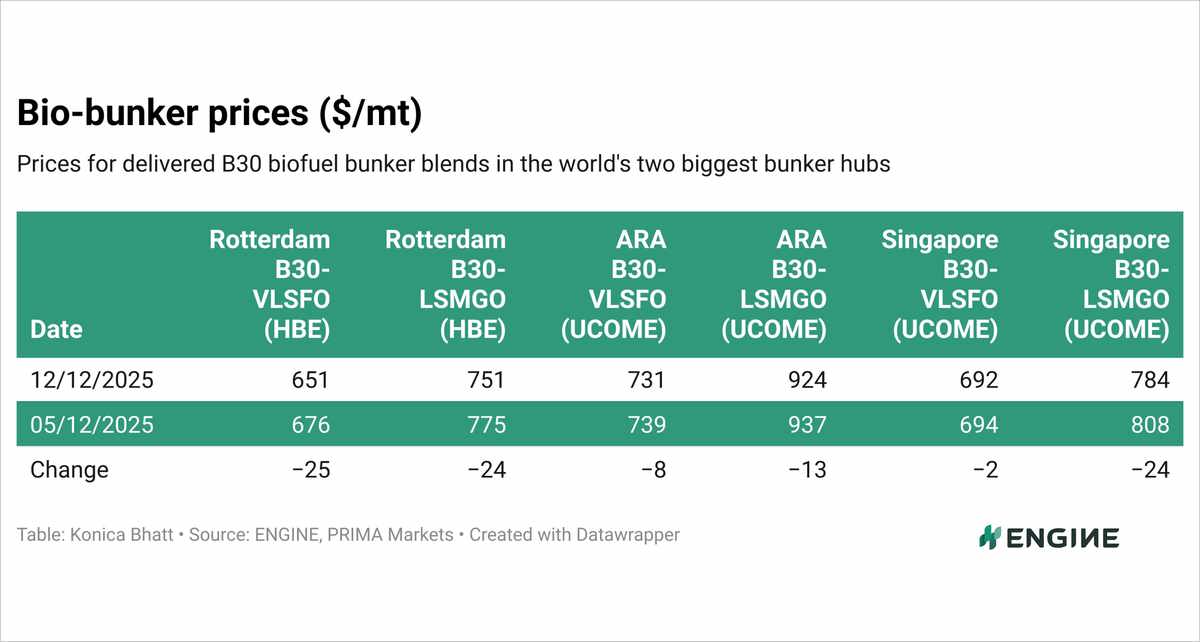
Rotterdam’s HBE-rebated B30-VLSFO and B30-LSMGO prices have fallen by $24–25/mt over the past week. The declines have come amid a $10/mt drop in Prima Markets’ assessed ARA POMEME barge price, along with $9–19/mt declines in conventional VLSFO and LSMGO benchmarks.
Dutch HBE rebates for marine B30 and B100 have increased by $7/mt and $23/mt respectively over the same period, adding further downward pressure on prices.
Prima Markets has noted that Dutch HBE certificate prices have posted large daily gains, driven by a sharp rise in German certificates.
Germany’s cabinet approved legislation on 10 December to implement the EU’s Renewable Energy Directive (RED III) into national law.
POME-based biofuels will be excluded and certification requirements for advanced biofuel imports will become stricter with the new laws, which are set to take effect from 2027. This will further constrain biofuel supply, Prima said, adding that European market sources have seen the framework as mostly positive and expect it to improve UCOME’s competitiveness again.
Singapore
Singapore’s B30-VLSFO price has been largely stable, edging down by $2/mt on the week. Its B30-LSMGO has fallen by a sharper $24/mt. Price movements have broadly tracked declines of $5–23/mt in the port’s VLSFO and LSMGO benchmarks.
Prima’s UCOME FOB China assessment has dropped by $30/mt on the week. But a rise in freight rates for UCOME cargoes from China to Singapore - up by $2.50/mt to $22.50/mt - has helped offset some of the downside.
Demand for Chinese UCOME in the spot market remains sluggish, Prima said, citing local traders.
“Prices of Chinese UCOME on a FOB China basis and in bulk currently hold a roughly $70/t [mt] premium over standard UCO FOB China in bulk, which fails to give a comfortable margin buffer for producers,” Prima added.
Other bio-bunker news
The Dutch Ministry of Infrastructure and Water Management lowered CO2 reduction requirements for marine fuel suppliers. While the reduction eases immediate compliance pressure, it also means the sector will deliver materially lower CO2 reductions next year than planned under the third Renewable Energy Directive (RED III), effectively delaying part of the Netherlands’ near-term emission reduction effort for hard-to-abate transport sectors.
Bunker supplier ScanOcean and Finnish pool maker Ahti have created a “pool-in-pool” structure to to deliver compliance surpluses to third-party vessels using biofuels. In practice, this can allow ScanOcean’s customers in the Nordic region to generate compliance surpluses by bunkering physical biofuel, and sell these surpluses to vessels participating in Ahti’s pool.
Greek fuel supplier EKO supplied a Norwegian Cruise Line vessel, Norwegian Viva, with a waste-based biofuel blend in Piraeus.
Japanese oil refiner Idemitsu Kosan partnered with trading house Kanematsu to supply ships with biofuel blends in Kokura. The partners aim to supply a total of 5,000 mt of biofuel by March next year - both to ocean-going ships and to coastal vessels. That is equivalent to the amount of fuel consumed by a 300,000 dwt vessel operating for approximately 50 days, the company noted.
By Konica Bhatt
Please get in touch with comments or additional info to news@engine.online