The Week in Alt Fuels: Methanol bunkering gathers steam
Methanol bunkering infrastructure is beginning to follow the growing fleet as sales rise and new port activity emerges.
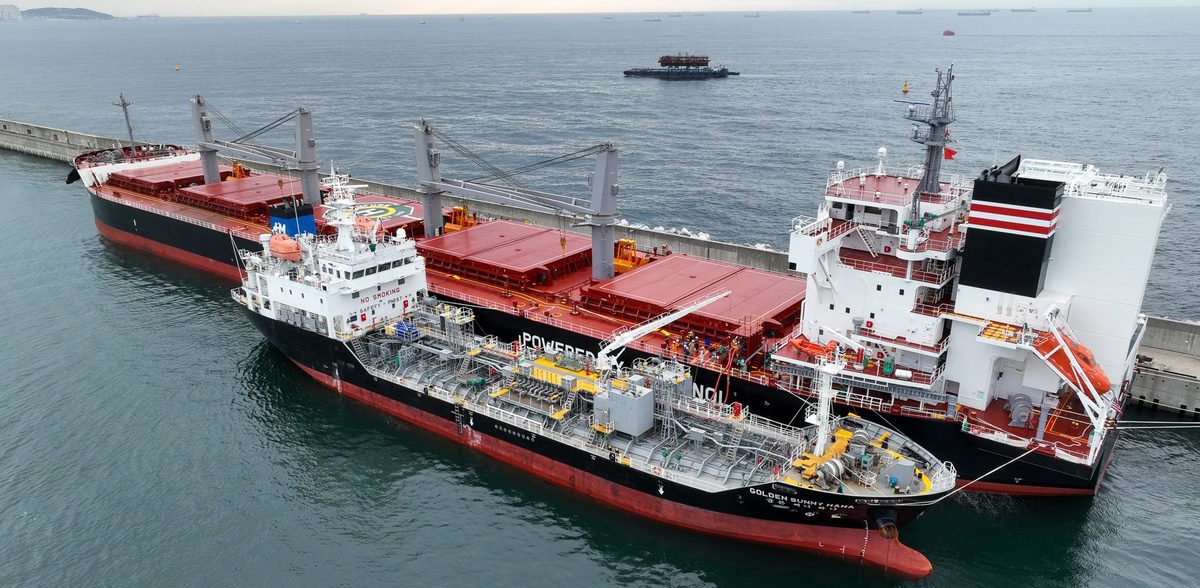 IMAGE: Methanol bunkering operation at Ulsan port in Korea. Itochu
The number of methanol-capable vessels in operation has risen to 112, up from 106 at the end of 2025, according to DNV data. A further 337 vessels on order are expected to join the global fleet by 2030.
Global methanol bunkering activity has started to broaden as the methanol-capable fleet expands, with higher volumes recorded at major hubs and early activity emerging in smaller ports.
Methanol bunker sales in Singapore rose from nil in December 2025 to 300 mt in January 2026. Bio-methanol sales in Rotterdam reached 12,000 mt across 2025, almost three times the volume recorded a year earlier.
The Spanish port of Barcelona plans to host a methanol bunkering pilot in 2026.
Earlier this month, Spanish oil storage operator Exolum, Canadian methanol producer Methanex and Danish renewable energy group Ørsted introduced bio-methanol bunkering at the Port of Immingham in the UK. Under the agreement, Exolum will provide storage and fuelling infrastructure at its Immingham facility and Methanex will supply the bio-methanol for Ørsted's offshore wind farm maintenance vessels.
In Asia, Mitsui O.S.K. Lines and its partners completed Japan's first ship-to-ship methanol bunkering at anchorage in the Port of Yokohama. The Chinese government has outlined plans to develop 1 million mt/year of methanol and biofuel bunkering capacity in Shanghai by 2030.
On the supply side, bunker vessel capacity is also expanding.
Spanish bunker supplier Vilma Oil Med started operating a methanol dual-fuel IMO Type 2 chemical bunker tanker at the Port of Ceuta, adding dedicated capacity for methanol bunkering in the western Mediterranean.
Separately, Hercules Tanker Management took delivery of the second vessel in a planned series of 10 methanol bunker tankers. The 7,700-dwt vessel, Hercules Elisabeth, can carry conventional bunker grades as well as alternative fuels including methanol and biofuels up to B100.
Recent activity suggests that methanol bunkering infrastructure is beginning to respond to fleet growth.
But the scale is uneven and access remains largely concentrated in a small number of major ports, with Rotterdam leading by volume. Early activity is emerging across a number of smaller ports, but availability beyond the established hubs is still limited and fragmented.
In other news this week, methane industry body Gasnam has highlighted that the Iberian Peninsula is likely to overtake the Netherlands as a bunkering hub for liquefied natural gas (LNG) and its low-emission variants.
The International Maritime Organization (IMO) is working towards allowing the certification of marine engines operating on non-carbon bunker fuels under draft amendments to its nitrogen oxides (NOx) rules, DNV reported.
Marine fuel cell developer Genevos will develop a modular solid oxide fuel cell (SOFC) power unit for commercial vessels and cruise ships. The application will be first used on a research vessel operated by the German Aerospace Centre, Genevos said.
By Konica Bhatt
Please get in touch with comments or additional info to news@engine.online