The Week in Alt Fuels: The cold feet conundrum
The energy sector is developing zero-emission bunker fuel supply and infrastructure to meet the IMO’s 2030 target of 5-10% uptake. But vessel orders and commercial demand are struggling to keep pace.
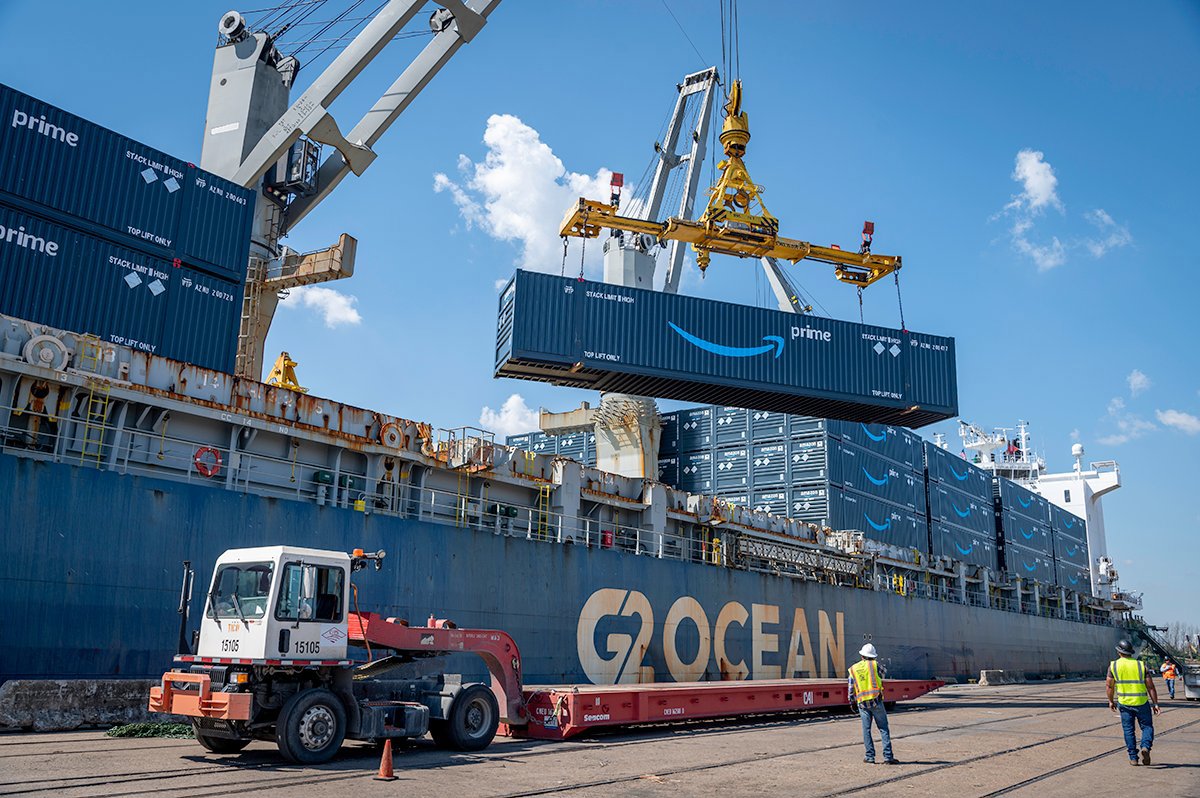 IMAGE: G2 Ocean's Star Lygra cargo ship carrying Amazon's containers. X of @Port_Houston 2
The IMO wants zero- or near-zero-emission energy to account for at least 5% of international shipping’s energy consumption by 2030, striving for 10%.
But the shipping industry still has a long way to go to meet this ambition, probably even further than two years ago.
In September 2024, researchers at the UCL Energy Institute and the Getting to Zero Coalition, run by the Global Maritime Forum (GMF), found that fuel supply was partially on track but demand was lagging. Two years later, their September 2026 report suggests little has changed.
“In several cases, progress has not only slowed relative to previous years but regressed,” the 2026 report said.
The assessment focuses on e-methanol and e-ammonia as scalable zero-emission fuels (SZEF) with a well-to-wake GHG intensity below 19 gCO2e/MJ. It excludes e-methane because of its methane slip, as well as blue fuels produced from fossil feedstocks with carbon capture and storage.
The report said production of SZEF still has the potential to catch up by 2030, but weakening demand from shipowners and cargo owners risks leaving that potential untapped.
More ships, but where’s the demand?
DNV data shows that five ammonia-capable vessels are now in operation, up from two in September 2024, with another 41 on order for delivery by 2030, compared with 28 two years ago.
The operational methanol- and ethanol-capable fleet has roughly tripled from 53 to 160 vessels over the same period, but its orderbook has barely moved from 294 to 299.
"The 2024 shift away from conventional fuels thus appears to have been a one-off pulse driven by a few large operators rather than a structural break in ordering behaviour," the GMF and UCL report noted.
But more fuel-capable vessels do not necessarily translate into higher green fuel consumption. The GMF and UCL report's authors found that actual SZEF consumption on dual-fuel ships remains "negligible".
Based on the current fleet and orderbook, vessels would have the capacity to consume only around 12 million mt/year of e-methanol and e-ammonia by 2030, measured in heavy fuel oil-equivalent. This falls short of the 15 million mt/year minimum needed to meet the IMO’s 5% target.
Cargo owners tighten purse strings
The other side of the demand equation doesn’t look much better.
A Boston Consulting Group (BCG) survey of 125 cargo owners, published in April, found that the average green premium they were willing to pay fell to 3% in 2025 from 4.5% in 2024. The share of respondents prepared to pay more than 20% extra for low-emission fuels dropped to zero from 3% over the same period.
Only 45% expected to be willing to pay a premium within the next five years, down from 65% in 2024.
High fuel costs relative to their commercial benefits were the most frequently cited barrier, combined with wider regulatory and economic uncertainty.
But waning willingness to pay does not mean all cargo owners have stopped paying for emissions reductions. Some are paying a premium for emissions reductions through book-and-claim arrangements, even if their own cargo travels on a conventionally fuelled vessel. These arrangements could help create demand for e-fuels.
For instance, DP World will use Hapag-Lloyd's biofuel-based service to claim around 4,700 mtCO2e of emissions reductions. Gap will use Maersk's biofuel- or bio-methanol-based service to purchase reductions for its European trade lanes.
Pooling demand offers another route.
The Zero Emission Maritime Buyers Alliance (ZEMBA) pools demand from cargo owners including Amazon, DSV, Google and Microsoft. Its second tender will support Hapag-Lloyd's planned e-methanol deployment and North Sea Container Line's e-ammonia-powered service.
Together, the shipping companies are expected to cut GHG emissions by around 120,000 mtCO2e over three years from 2027, with ZEMBA members purchasing the reductions through book-and-claim.
How ready is ready?
Shipowners are also keeping their fuel options open. Fuel-ready tonnage accounts for 2.48% of the active fleet, against just 0.77% already SZEF-capable, the GMF and UCL report's authors found.
Höegh Autoliners recently ordered six LNG dual-fuel car carriers with notations for future conversion to ammonia and methanol, without specifying their level of readiness.
But fuel-ready does not mean fuel-capable. Höegh’s vessels will run on LNG or conventional fuels until converted. Other fuel-ready ships may continue using conventional fuels. Shipowners could also choose not to convert them at all.
And until the conversion takes place, these vessels cannot use the intended zero-emission fuels.
"The failure to adopt the NZF [Net-Zero Framework] was the single most transition-regressive event we've seen in the five years this report has been running," said Pinar Langer, research fellow at the UCL Energy Institute.
Regulatory certainty this year is what it will take to win back vessel orders and investment, Langer argued. The IMO's next chance to adopt the Net-Zero Framework comes in December.
In other alt fuels news this week, US President Donald Trump has signalled that his administration intends to prevent the IMO from adopting a global emissions-pricing mechanism. "There is no global government - and while I am President, there will be no global taxes," he said.
Class society American Bureau of Shipping has granted approval in principle to the design of a 22,000-cbm ammonia bunker vessel.
Singapore-based global shipping company Eastern Pacific Shipping has taken delivery of an LPG dual-fuel very large ammonia carrier from China's Jiangnan Shipyard.
By Konica Bhatt
Please get in touch with comments or additional info to news@engine.online