The Week in Alt Fuels: From promises to timelines
More concrete timelines are making ammonia bunkering look less like a pipe dream. But recent leaks underscore the safety concerns as plans move closer to reality.
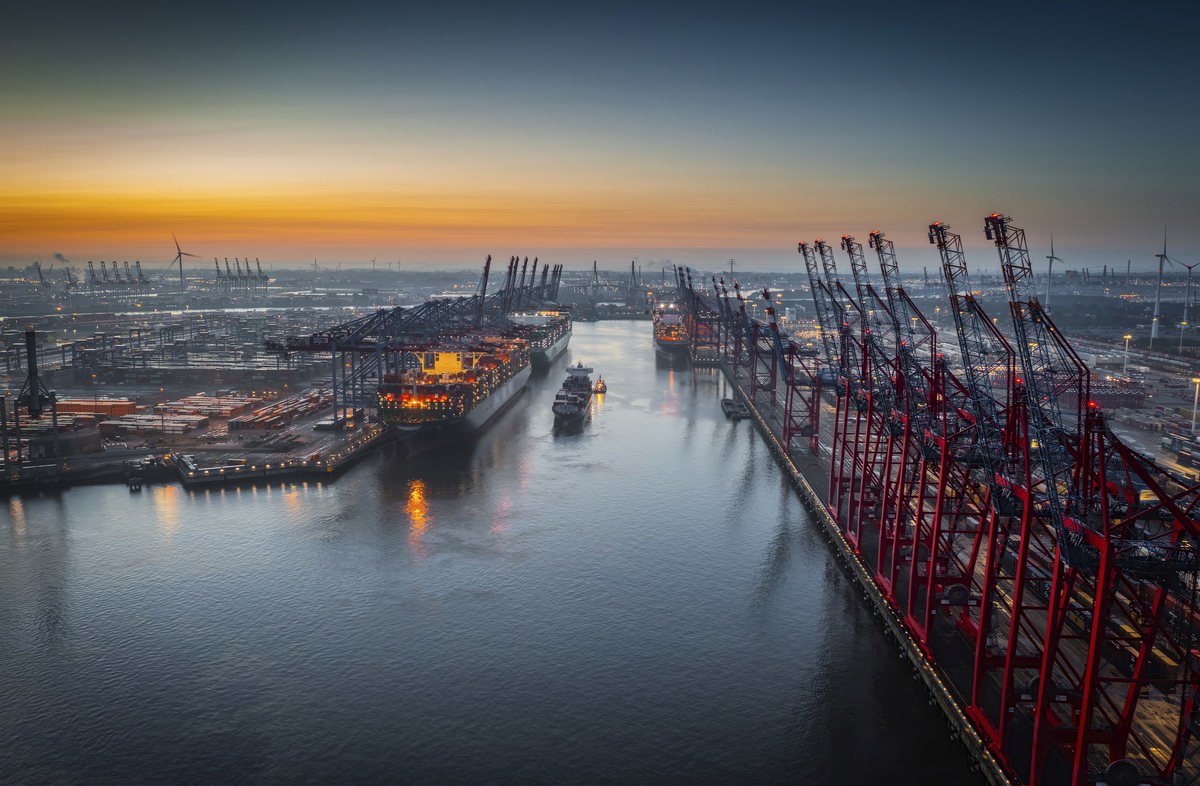 IMAGE: Aerial view of the Port of Hamburg in Germany. Getty Images
Chinese shipping firm Shenghang Shipping's converted ammonia carrier has achieved operational readiness as a bunker vessel after receiving certification for ship-to-ship ammonia bunkering from China Classification Society.
The 5,500-cbm vessel, Shenghang Yongle, was originally built as a liquefied gas carrier and has been converted to deliver liquid ammonia to other vessels through ship-to-ship bunkering. The companies have not disclosed where the vessel will be deployed or which port will host its first commercial ammonia bunker operation.
The Shenghang Yongle, described as the world's first operational ammonia bunker vessel, has put the fuel back in the spotlight. But the bigger picture is taking shape across several regions, with ports setting dates for bunker pilots, suppliers lining up fuel, and infrastructure being developed.
Asia is furthest along, with ammonia already delivered to vessels at two ports.
Lotte Fine Chemical has bunkered ammonia to vessels in South Korea's Port of Ulsan, and signed an agreement with Amogy in September to explore further ammonia bunkering there. A port tugboat was also bunkered with green ammonia at COSCO's Dalian terminal last year.
Pilbara Ports plans to carry out an ammonia bunker pilot this year. Rotterdam, which completed a pilot transfer last year, expects its first ammonia bunker deliveries in 2026-2027.
In Singapore, Itochu plans live bunker demonstrations in the fourth quarter of 2027, using a vessel due for delivery that September. Yara and Golden Island are expected to supply the fuel.
Terminal operator Azane Fuel and bunker supplier Equinor plan to start truck-to-ship ammonia deliveries in Norway in the second half of this year.
Azane Fuel and producer Yara Clean Ammonia are developing their first ammonia bunker facility at Fjord Base in Florø, Norway. The terminal will include one of Azane's floating bunker barges, capable of carrying 650 mt of ammonia. It has received a permit for up to 416 bunker transfers/year.
The Florø facility will be followed by bunker infrastructure in Risavika and Mongstad by 2029.
MB Energy has a permit to build a large-scale ammonia import terminal at the Port of Hamburg, with commercial operations planned for 2029. The project will include a new tank for temporary ammonia storage and upgraded vessel and barge berths that could eventually support ammonia bunkering. Planned throughput is around 600,000 mt/year.
Fertiglobe will look at supplying ammonia through the terminal, and may take a stake in it. Hamburg Port Authority has meanwhile introduced safety and operational guidelines for ship-to-ship ammonia bunkering and is considering adding an ammonia bunker barge.
Trafigura, CF Industries and TFG Marine are targeting ammonia bunkering in the US Gulf Coast and Northwest Europe. Elsewhere, India's VO Chidambaranar Port and Oman's Sohar are also gearing up for ammonia bunker operations later this decade.
Belgian shipping firm CMB.Tech is also developing ammonia storage and bunker infrastructure at Walvis Bay in Namibia.
The company has not disclosed when the terminal is expected to become operational, but said it will support its planned fleet of more than 40 ammonia-capable vessels. “The facility will provide critical infrastructure for green ammonia producers, off-takers, and traders, lowering barriers to entry and supporting the development of a robust green ammonia value chain in Southern Africa,” it said.
But despite the more concrete timelines and growing confidence around ammonia bunkering, some hurdles still stand between these early pilots and a mature bunker market.
Ammonia has been loaded and unloaded as cargo for decades, giving the shipping industry experience it can draw on.
But bunkering could involve more frequent transfers in a wider range of locations and operating conditions than conventional cargo handling. Its toxicity therefore means bunker operations will require careful handling, crew training and robust safety and emergency procedures.
Recent industrial accidents have offered stark reminders of those risks.
An ammonia leak at a seafood processing facility in Tamil Nadu in June killed 18 of the 83 workers affected. A more recent leak in Jordan's Aqaba industrial area injured 11 people and prompted a precautionary evacuation at the industrial complex.
On 13 September, an ammonia leak at a fertiliser plant in Basra's Khor Al-Zubair industrial area in Iraq killed two and injured 114 people, including workers and nearby residents.
Another hurdle is fuel supply.
Bunker buyers will need access to sufficient supplies of low- and zero-emission ammonia for the fuel to deliver meaningful emissions reductions. Whether enough green ammonia will be available by 2030 to meet demand from the future fleet remains an open question.
So while questions around safety, fuel availability and real-world operating experience remain, more concrete timelines are bringing ammonia bunkering much closer to reality.
In other alt fuels news this week, class society American Bureau of Shipping (ABS) has approved the concept design of a 22,000-cbm LNG bunker vessel developed by Hanwha Power. It will be able to carry both LNG and ammonia.
US-based startup Demeter Energy plans to build a 100,000 mt/year bio-methanol production plant at the Port of Manatee in Florida. The fuel is expected to be produced from woody biomass and other organic waste and go to bunkering and other sectors.
Class society Lloyd's Register (LR) has partnered with South Korea's K Shipbuilding to develop a 50,000 dwt ethanol-capable tanker.
By Konica Bhatt
Please get in touch with comments or additional info to news@engine.online