The Week in Alt Fuels: Keeping tomorrow open
Several shipowners are leaning towards LNG while keeping the door open for lower-emission bio- and e-methane as future-fuel uncertainty clouds shipping's green transition.
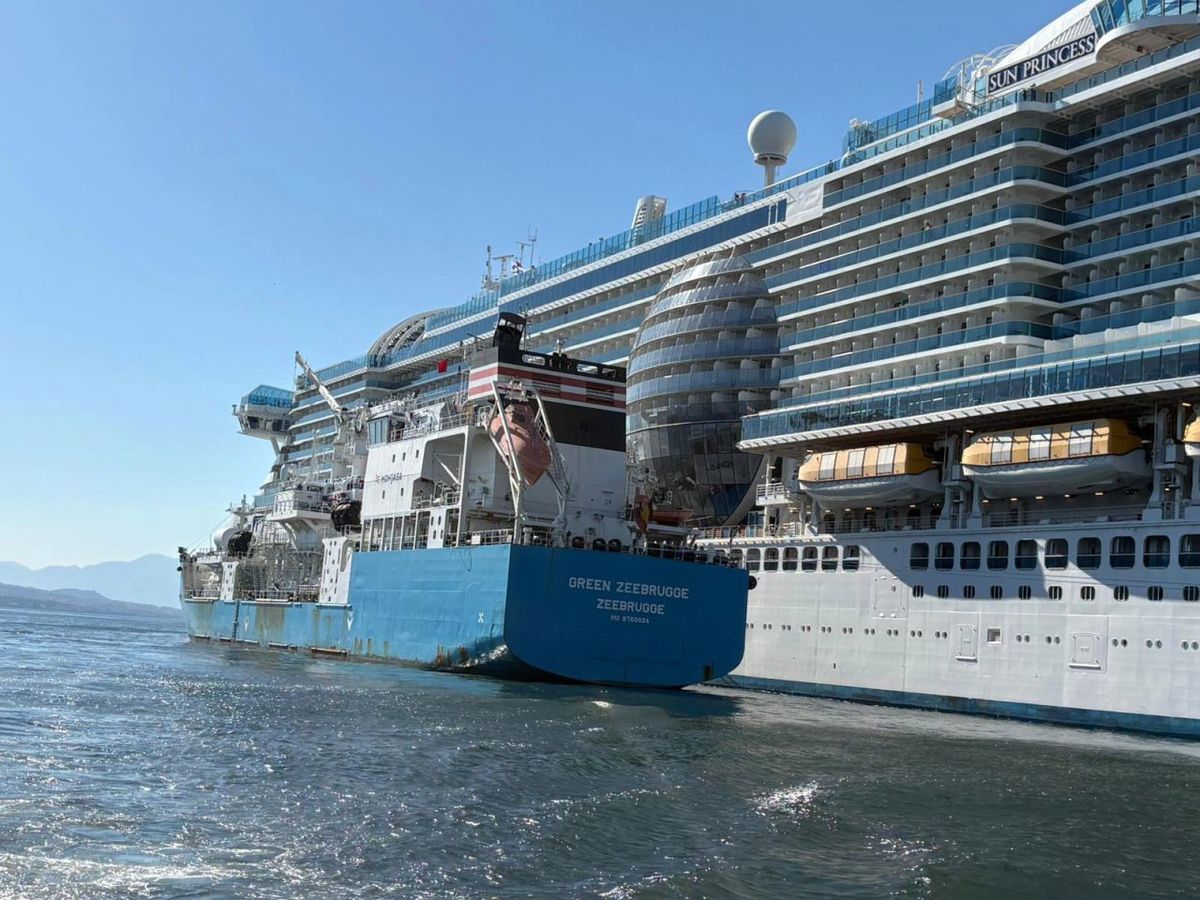 IMAGE: The bunker tanker Green Zeebrugge delivering LNG to the cruise ship Sun Princess. Linkedin of Daniele Corti
Uncertainty around shipping's future fuel regulations is strengthening the case for LNG dual-fuel vessels, as shipowners seek an immediately available fuel without closing off longer-term alternatives.
Carnival has picked LNG as its preferred alternative to conventional fuel in the absence of "market-ready" zero-emission options. LNG is currently the most viable and readily available option for reducing a vessel's GHG intensity compared with conventional fuels, the cruise operator said.
Hawaii-based Matson has doubled down on LNG, citing limited availability and higher cost of low- and zero-emission fuels, along with thin bunker infrastructure. Ammonia, methanol and nuclear propulsion remain too early-stage for commercial deployment on ocean-going containerships, Matson said.
Safe Bulkers chief executive Polys Hajioannou framed the challenge more broadly. The problem is not developing low- and zero-emission fuels, he said, but deploying them at scale. He pointed to "limited economic incentives, uneven regulatory developments, and a lack of clarity regarding future fuel pathways" as factors clouding investment decisions.
Global fleet data also shows a clear tilt towards LNG.
DNV's database shows 929 LNG-capable dual-fuel vessels in operation, about six times the size of the methanol- and ethanol-capable fleet and more than five times that of the LPG-capable fleet.
LNG-capable ships also lead the orderbook by a wide margin. Another 663 LNG-capable vessels are scheduled for delivery by 2030, more than twice the 294 methanol- and ethanol-capable vessels on order and around four times the 164 LPG-capable vessels.
The ammonia-capable fleet trails much further behind, with just four vessels in operation and 42 on order.
Bunker infrastructure is expanding alongside the fleet.
Major hubs including Rotterdam and Singapore have reported higher LNG bunker sales this year than last.
Cumulative LNG bunker deliveries in Shanghai surpassed 2 million cbm (around 894,000 mt) in August.
New supply points are emerging too.
Italy's Civitavecchia and Spain's Bilbao have hosted their first LNG bunker operations. Muar LNG is developing a bunker hub at Malaysia's Maharani Freeport. Stabilis Solutions and Power LNG are separately developing LNG bunker infrastructure in the Port of Galveston in the US.
But the expansion of the LNG fleet and bunker network does not necessarily mean shipowners see fossil LNG as shipping's ultimate fuel choice.
Carnival, for example, has identified bio- and e-methane among its potential future fuel pathways as fuel supply matures.
LBM bunkering is growing most visibly in the EU, where FuelEU Maritime's GHG-intensity targets are encouraging use of lower-emission fuels, and its pooling mechanism is strengthening the case for LBM specifically.
Rotterdam's LBM bunker sales rose by around 1,200 mt over the year to around 3,000 mt in the second quarter of 2026.
Several cruise operators have bunkered LBM. One of Royal Caribbean's new cruise ships has bunkered LBM with Peninsula in Spain's Port of Cadiz. MSC Cruises has bunkered around 7,000 mt of mass-balanced LBM on the LNG dual-fuel cruise ship MSC World Europa.
German cruise operator TUI Cruises said its dual-fuel cruise ship Mein Schiff Relax operates its Northern European itineraries entirely on LBM during the summer season. Another vessel, Mein Schiff Flow, has been “regularly bunkering” LBM in Barcelona since May 2026 and will continue using the fuel beyond the winter season.
Fossil LNG is not a zero-emission fuel and carries significantly higher well-to-wake GHG emissions than its greener counterparts.
But LNG dual-fuel vessels give owners access to an established fuel supply and bunker network today. If and when global or other regional regulations come into effect with stricter GHG-intensity targets and incentives, the same network can be used for lower-emission fuels such as LBM and e-methane.
In other alternative fuels news this week, FuelEU Maritime will not take effect in Norway before 1 January 2028, the country's Ministry of Climate and Environment said. Until it does, only half the energy used on voyages between Norwegian or Icelandic ports and EU ports counts towards FuelEU compliance.
Nuclear tech firm Core Power has set out a faster route to nuclear-powered US shipping, built on light-water reactors, early route selection and an initial contract carrying options for at least two follow-on ships rather than a single demonstration vessel.
South Korea's Polaris Shipping has ordered four ethanol- and methanol-capable bulk carriers from China's Qingdao Beihai Shipbuilding, fitted with WinGD engines that can also burn conventional fuel oil. Deliveries run sequentially from 2031.
By Konica Bhatt
Please get in touch with comments or additional info to news@engine.online